
Why People Still Buy Homes in Seoul Despite High Prices
Seoul homes are expensive, yet buyers still value stable tenure, access to jobs and schools, retirement security, and protection from future rent or price pressure. This guide weighs those motives against debt, concentration, transaction costs, and the freedom of renting.

Seoul home prices can look detached from ordinary incomes, so the obvious question is: why buy at all? The short answer is that a home in Seoul is not only an investment. It is also long-term control over where a household lives, access to a scarce location, a potential retirement asset, and protection against the risk that renting or buying later becomes harder. Those benefits are real. So are the costs: debt, lost flexibility, taxes and fees, maintenance, and putting a large share of wealth into one property.
This is not a case for buying or renting. It is a framework for understanding why reasonable households can look at the same market and make opposite decisions.
The contradiction is real
The Ministry of Land, Infrastructure and Transport's 2024 Korea Housing Survey found that 86.8% of households believed a home should be owned. The figure was 86.9% in the capital region and 79.3% among household heads under 40. But the same survey put the capital-region median price-to-income ratio for owner households at 8.7, meaning the price burden remained far above a single year's income.
That combination is the key to the puzzle. High prices do not erase the reasons people want to own. They make the trade-off harsher.


A Seoul purchase bundles two things that cannot be separated: a private home and a place in the city. The dense apartment cityscape represents the home; the downtown skyline represents access to work, transport, schools, hospitals, shops, and social networks. A buyer is paying for both.
1. Ownership buys stability, not just square meters
Renters can have secure and comfortable homes, but ownership gives a household more control over renewal, renovations, pets, and the timing of a move. That matters when children are settled in school, a commute works, or elderly family members live nearby.
The 2024 Housing Survey gives this motive a measurable shape. Owner households had lived in their current home for an average of 11.5 years, compared with 3.6 years for renter households. The figures do not prove that buying causes a better life, and some owners would prefer to move. They do show that ownership and long residential continuity often travel together.
This helps explain why a monthly comparison can miss the point. A mortgage payment and rent may look similar on a spreadsheet, but the owner is also buying control over the address. For a household expecting to remain for a decade, avoiding repeated searches, deposits, negotiations, and moves can carry substantial value. For someone whose job, visa, relationship, or preferred neighborhood may change, that same permanence can become a burden.
2. Location is part of the product
People do not buy an abstract average Seoul home. They buy a particular commute, school route, subway connection, care network, and set of daily services. Homes near established employment centers and transport links can therefore attract demand even when cheaper space exists elsewhere.
Education is one part of this, but it should not be reduced to a race for famous school districts. Families may value keeping a child in the same school, living near after-school care, or having grandparents close enough to help. Single buyers may place more value on a short commute or the ability to live without a car. Retirees may prioritize hospitals, markets, and familiar neighbors. The value is household-specific.
A cheaper home that adds two hours of travel every day is not automatically cheaper in lived terms. Conversely, paying a large premium for an address only makes sense if the household will actually use the access it is buying.
3. Housing is also the household balance sheet
In Korea, housing and household wealth are tightly connected. Statistics Korea's 2025 Survey of Household Finances and Living Conditions reported that real assets made up 75.8% of average household assets at the end of March 2025. That does not mean every household owns a home or that property is always the best investment. It means many families experience housing as their main store of wealth.
That role can serve several goals at once: living in the property now, reducing housing payments after a mortgage is repaid, holding an asset for retirement, or leaving something to children. A buyer may therefore accept a lower financial return than a pure investor would, because the home also provides years of housing service. A Bank of Korea issue note describes this dual character directly: housing is both a durable service and an asset.
The other side is concentration risk. If most of a household's net worth is one apartment, its finances depend heavily on one neighborhood, one building, Korean interest rates, and future policy. A home can feel safe because it is physical and familiar while still being a leveraged, illiquid asset.
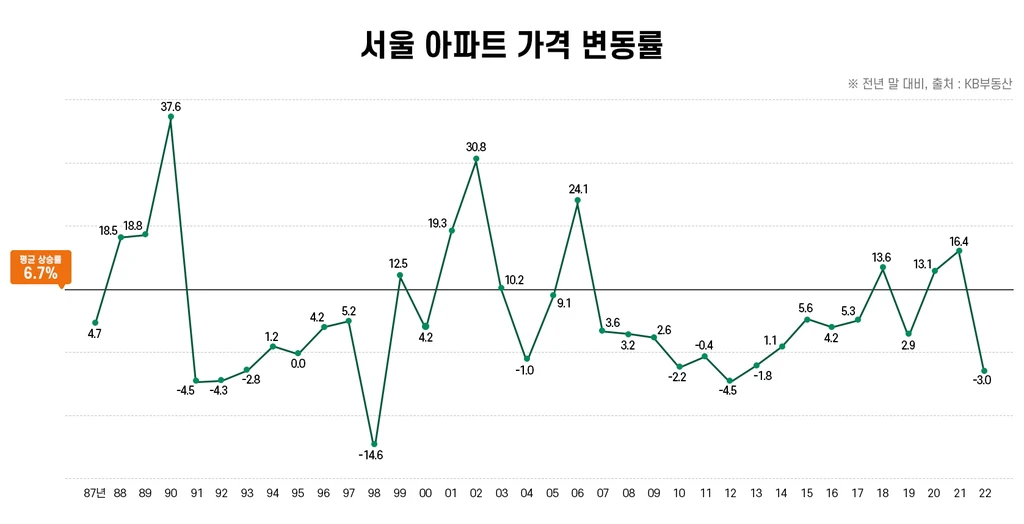
The historical chart above, published by Yonhap using KB Real Estate data, runs only through 2022. It is useful because it shows both gains and down years, not because it predicts what happens next. A long upward history can shape expectations, but no past average guarantees a future selling price, especially for one specific unit.
4. Waiting carries risks too
Buying has obvious downside risk, but remaining a renter is not risk-free. Rent can rise. A jeonse deposit can tie up substantial capital. A landlord may decide not to renew. A household that wants to buy later may face a higher price, a higher rate, or tighter borrowing rules.
The Bank of Korea's March 2026 monetary-policy assessment noted that rising jeonse prices can feed actual purchase demand when households also expect home prices to rise. It also noted that higher household lending rates constrain demand. These forces pull in opposite directions: fear of being priced out can push a renter toward buying, while financing costs can make the same purchase unsafe.
Online discussions make this emotional conflict easy to see. In threads about why anyone would buy in Korea and what buyers wished they had known, commenters repeatedly mention proximity to work, fear of missing future gains, debt stress, and regret about tying up too much money. These are anecdotes, not market evidence, but they show why the decision rarely feels purely mathematical.
5. The real cost is bigger than the mortgage
A fair buy-versus-rent comparison must include more than the monthly loan payment. For a purchase, estimate:
- the down payment and the return that capital could have earned elsewhere;
- mortgage interest under today's rate and a higher-rate stress case;
- acquisition tax, legal and registration work, brokerage, and moving costs;
- recurring property tax, apartment management fees, insurance, repairs, and renovation;
- the cost of selling later, including brokerage and any tax that applies at that time;
- the risk that the exact unit is harder to sell than the neighborhood average.
For renting, include the jeonse or monthly-rent deposit, rent, deposit financing cost, moving and brokerage costs, likely rent increases, and the chance of another move. Our guide to why Korean monthly rent needs a large deposit explains why a renter's upfront capital is not zero.
Do not count the whole mortgage payment as a cost. Principal repayment builds equity, while interest is a financing cost. But do not count projected appreciation as guaranteed income either. Model at least a flat-price case and a price-decline case before considering an optimistic scenario.
Also inspect the exact building. Brand recognition may affect marketability, but it does not replace checking the unit, land rights, maintenance history, redevelopment assumptions, and the building's finances. See our guide to what Korean apartment brands can and cannot signal and the separate explanation of Korean apartment management fees.
When buying can be reasonable
Buying may fit when most of these statements are true:
- You expect to stay in the same area for many years.
- Your income is stable enough to cover the loan after a meaningful rate increase.
- You will still have an emergency reserve after the down payment and transaction costs.
- The home works for your real daily life, not only for a resale story.
- You understand the exact unit's legal, physical, and financial condition.
- A flat or lower price would be disappointing but would not force a sale.
- You accept that a large share of your wealth may be concentrated in Korean property.
A long holding period does not make a bad purchase good. It does, however, spread one-time transaction costs over more years and gives the stability benefit time to matter.
When renting can be the stronger choice
Renting may fit better when one or more of these conditions apply:
- Your job, visa, household size, or preferred city may change soon.
- Buying would consume nearly all liquid savings.
- The mortgage only works if rates fall or prices rise.
- Comparable rent is low relative to the purchase price.
- You value mobility and diversification more than control over one address.
- You have not completed legal and physical due diligence on the unit.
Renting is not necessarily delaying adulthood or wasting money. It is paying for housing and flexibility. Buying is not automatically wealth creation. It is purchasing housing, control, and a concentrated asset with financing and transaction risk.
A practical way to decide
Run the comparison over the period you realistically expect to stay—often five and ten years—rather than over one month. Use three home-price paths: lower, flat, and higher. Use at least two mortgage-rate paths. Include every large cash flow and the opportunity cost of the deposit or down payment. Then ask four non-financial questions:
- How costly would an unexpected move be?
- How much do you value control over the address?
- Would a price decline damage your plans or only your feelings?
- Are you choosing this unit because it fits your life, or because you fear the market?
Foreign buyers should add another layer. Loan availability, reporting duties, acquisition rules, taxes, residency status, and document requirements can differ from those for Korean citizens and can change. Verify current rules with the relevant bank, local government office, and a qualified Korean real-estate or tax professional before committing. Do not assume that a mortgage example from a Korean household applies to you.
The bottom line
People still buy homes in Seoul because ownership packages stability, city access, housing service, and a long-term asset in one decision. The Ministry's survey shows that the preference for ownership remains widespread even among younger households, while the same data shows how heavy the capital-region price burden is. Both facts can be true.
Buying is most defensible when the household can carry the debt under stress, plans to stay, preserves cash reserves, and wants the specific home even without rapid appreciation. Renting is often stronger when flexibility, liquidity, or diversification matters more. The right answer is not the one with the boldest price forecast. It is the one that still works when the forecast is wrong.
Sources and image credits
- 2024 Korea Housing Survey — Checked for guide details or image attribution.
- 2025 Survey of Household Finances and Living Conditions — Checked for guide details or image attribution.
- Bank of Korea issue note — Checked for guide details or image attribution.
- March 2026 monetary-policy assessment — Checked for guide details or image attribution.
- why anyone would buy in Korea — Checked for guide details or image attribution.
- what buyers wished they had known — Checked for guide details or image attribution.
Last updated


