
Why a Korean Rooftop Room Turns Brutal in Summer
An oktapbang can offer a private roof, an open view, and lower rent. Before signing, inspect its insulation, air conditioner, waterproofing, drains, stairs, legal record, and repair terms in real summer conditions.

A Korean rooftop room can look like the perfect first home: open sky outside the door, no upstairs neighbor, a private-feeling terrace, and rent that may be lower than a conventional studio nearby. Then July arrives. The roof absorbs sun all day, the room stays hot after dark, monsoon rain tests every drain and seam, and every bag of groceries still has to climb the last flight of stairs.
That contrast is built into the structure. An oktapbang (옥탑방) is a room at roof level, often a small addition on top of a low-rise building. Some are carefully renovated and comfortable; others have thin walls, tired waterproofing, or an access route that was designed for maintenance rather than daily life. The label alone tells you almost nothing about quality.
Judge the exact room on one question: Can it control heat, keep out rain, and support your daily routine at the time of year when the roof is under the most stress?
Why the romance is real
The appeal is easy to understand. A rooftop can make a tiny interior feel larger. You may be able to dry laundry outside, keep plants, sit in the evening air, or see across a low-rise neighborhood. In a 2026 essay about Korean rooftop culture, architect Shinji describes the rooftop as outdoor living space that compensates for a small room. That is exactly why oktapbangs work so well in dramas: a modest home opens directly onto a wide sky.
But do not treat the roof as yours just because the door opens onto it. Ask who has the legal right to use it, whether other tenants or the owner need access, whether smoking or storage is allowed, and who must clear the drains. Put any exclusive-use promise in the contract. A shared roof presented as a private terrace is a very different bargain.
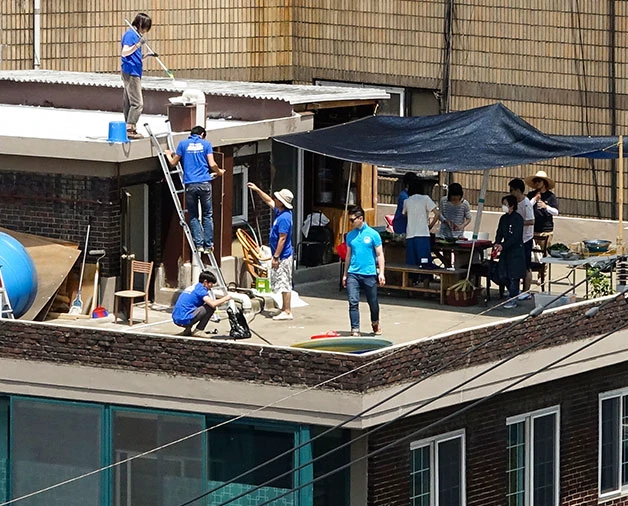
This Seoul cool-roof project shows the basic geometry: the room, walls, and surrounding roof are all exposed. Shade can improve the outdoor space, but it does not prove that the room itself is insulated or waterproof.
Why the room can stay hot after sunset
A conventional apartment usually shares walls, floors, or ceilings with conditioned homes. A rooftop room may have its roof and several walls facing sun and hot outdoor air. Solar energy heats those surfaces during the day; the materials then release stored heat toward the interior. Thin construction, weak insulation, dark roof finishes, west-facing windows, and poor air sealing can make the effect worse.
Seoul has addressed rooftop-room heat as a housing issue. The city-backed 2015 cool-roof campaign for rooftop homes applied white reflective coating because rooftop residents were especially exposed to summer heat. The article explains that a high-reflectance, high-emissivity surface absorbs less solar heat and releases heat more effectively. That can help, but a white roof is not a substitute for insulation, shading, ventilation, or a properly sized air conditioner.
The vulnerability remains current. In August 2026, Jongno-gu's emergency heat response explicitly included older residents living in rooftop rooms among people offered air-conditioned safe accommodation. That policy does not mean every oktapbang is dangerous. It does mean you should not dismiss heat exposure as an old stereotype.
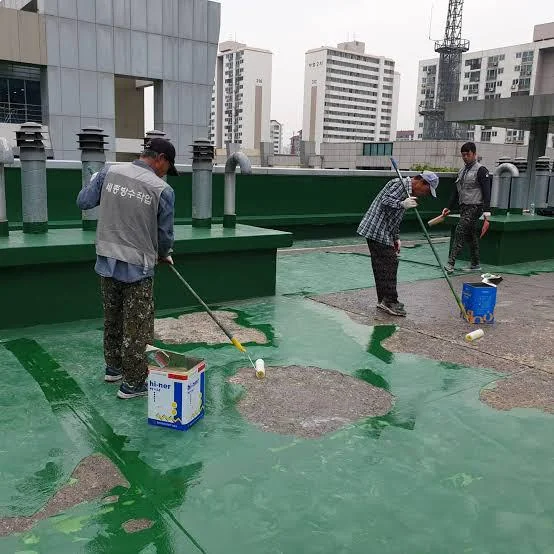
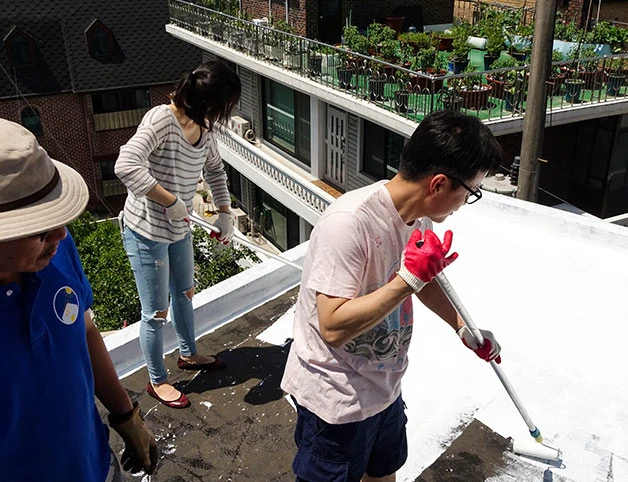
These surfaces solve different problems. The green coating in the first slide is being applied as part of a waterproofing system; the white coating in the second is intended to reflect solar heat. Color alone proves neither a complete waterproofing assembly nor good thermal performance. A detailed r/korea discussion about green roofs includes a commenter with Korean roof-work experience stressing the importance of preparation, drying, crack repair, multiple coats, and weather windows. Treat that as practical testimony, not a substitute for a contractor's records or an inspection.
Test the heat during a hot-afternoon viewing
Schedule a second viewing between roughly 2 p.m. and 5 p.m. on a hot, bright day. The exact hour matters less than seeing the room after several hours of sun. On arrival, pause before the agent turns on the air conditioner. Notice the air, ceiling, exterior-facing walls, floor near the roof door, and smell. Then run the installed air conditioner for at least 15 minutes with doors and windows closed.
Check five things:
- Does the room become comfortable, or does cool air disappear as soon as the compressor pauses?
- Is the air conditioner included in the lease, and who pays if it fails?
- Are the roof and west-facing windows shaded?
- Can you ventilate securely at night without leaving the entrance open?
- Can the owner show a recent summer electricity bill for the room, with personal details covered?
An agent saying “the air conditioner is strong” is not evidence. A running test on a hot day is better. If possible, revisit shortly after sunset. A room that cools quickly once the sun drops is a different risk from one whose ceiling still radiates heat late into the night.
Monsoon rain tests the weak points
Rooftop rooms sit beside drains, parapet walls, pipe penetrations, door thresholds, and waterproof membranes. Water can enter through failed seams or cracks, back up around a blocked drain, or reach the room when wind-driven rain crosses a low threshold. None of this is inevitable, but fresh paint and silicone can hide an old problem long enough for a quick viewing.
Inspect with a flashlight even during the day. Look for:
- Brown rings, bubbled wallpaper, peeling paint, swollen trim, or a musty smell
- New patches limited to one ceiling corner or the base of an exterior wall
- Cracks around pipes, vents, railing posts, and the joint where the room meets the roof
- Standing water, leaves, or debris around the nearest drain
- A roof-door threshold lower than nearby puddle marks
- A dehumidifier running in an otherwise empty room
Ask when the waterproofing system was last renewed, who did the work, what layers were applied, and whether there are dated photos or invoices. “The roof was painted recently” is too vague. Reflective paint can reduce heat while doing nothing to repair a failed waterproof membrane. Waterproof coating can stop water while doing little for insulation.
If heavy rain is forecast, ask for a viewing during or immediately after it. If that is impossible, request timestamped photos of the ceiling, wall bases, roof drain, and threshold after the next storm. Put responsibility for leak investigation, interior damage, and temporary accommodation in writing before paying a deposit.
The staircase becomes part of the rent
Many rooftop rooms are reached by an extra internal or exterior stair after the building's normal top floor. It may be steep, narrow, poorly lit, uncovered, or separated by a heavy roof door. That route affects every grocery run, suitcase, delivery, laundry basket, recycling trip, and move. Rain makes smooth stairs slippery; winter ice can make an uncovered final flight dangerous.
A June 2026 Naver Blog report from a Seoul small-move operator describes carrying a full one-room move to a fourth-floor rooftop room without an elevator and dividing the stairs among several helpers because the repeated climb was physically demanding. That is one job, not a universal cost estimate, but it illustrates the hidden labor. A low monthly rent can be less attractive if every move, appliance replacement, or bulky delivery needs extra people.
Walk the entire route twice during the viewing. On the second trip, carry your normal work bag or a full shopping bag. Check the handrail, lighting switches, head clearance, door locks, fire escape route, and whether a delivery person can identify the correct entrance. Ask how a refrigerator, washing machine, or mattress reached the room and whether the building permits a ladder truck.
Verify the room on paper
Not every rooftop structure was originally approved as a dwelling. Do not assume that all oktapbangs are illegal, and do not accept “everyone rents them this way” as verification. Ask the licensed agent to match the exact address, floor, room use, and area against the building register, or geonchukmul daejang (건축물대장). The official Government24 building-register service provides the document.
Have the agent explain any mismatch or violation notation in writing before you sign. Confirm that the person receiving the deposit is authorized to lease the room, and complete the same deposit-protection checks you would for any Korean rental. If you are new to the terminology, first read our guide to villas in Korean real estate and our guide to large Korean rental deposits.
Your contract should state:
- Whether rooftop use is private or shared
- Who maintains the air conditioner, roof coating, drains, windows, and exterior stairs
- How quickly the owner must respond to leaks or air-conditioner failure
- Which utilities and management charges are separate from rent
- Every repair promised before move-in, with a completion date
Do not rely on a messaging-app promise that never reaches the contract. Photograph the ceiling, walls, drain, roof surface, and stairs during the move-in inspection, then send the dated record to the owner or agent.
A simple decision rule
An oktapbang can be a good home when the discount is meaningful, the view and roof use genuinely improve your life, the room cools under real summer conditions, the waterproofing history is credible, and the stairs fit your body and routine. It is a poor gamble when the only evidence is a pretty evening viewing and fresh paint.
Before committing, require four kinds of proof:
- Heat proof: a hot-afternoon air-conditioner test and evidence of shading or insulation.
- Rain proof: clean drainage, no interior warning signs, and documented waterproofing work.
- Access proof: a stair route you can safely use every day and a realistic moving plan.
- Paper proof: a building record and contract that match the room, roof use, and repair responsibilities.
The view is a benefit you can see immediately. Heat, leaks, and stair fatigue are costs that reveal themselves later. A responsible viewing makes those delayed costs visible before they become your summer.
Sources and image credits
- Shinji on note — Architectural essay on the rooftop as outdoor living space; also the source of the featured illustration, used with written operator permission.
- Seoul Metropolitan Government cool-roof campaign — Reflective-roof purpose and source of the rooftop-room and white-coating images, used with written operator permission.
- Jongno-gu August 2026 emergency heat response — Current example of rooftop-room residents included in air-conditioned safe-accommodation support.
- r/korea discussion about green roof coatings — Practical roof-work testimony on surface preparation, drying, crack repair, coats, and weather windows; not a substitute for inspection records. Also the source of the green-waterproofing photo, used with written operator permission.
- Seoul small-move operator report — One June 2026 rooftop move illustrating the labor of repeated stair carrying; not a universal price estimate.
- Government24 building-register service — Official route to the 건축물대장 used to verify the approved address, floor, room use, and area.
- Delivery Spot featured image file — Illustration of a Korean rooftop room and terrace used as the cover.
Last updated


