
Acne-Prone Skin at Olive Young: Why Buying Less Works Better
Build a four-slot Olive Young basket for acne-prone skin, change one self-selected variable at a time, and know when clinical care is the better value.

For acne-prone skin, the best Olive Young haul is often the one you do not build. Start with a gentle cleanser, a moisturizer, broad-spectrum SPF 30+ sunscreen, and—only when self-care is appropriate—one carefully chosen acne product. If you already own a comfortable version of a step, keep it. A shelf full of “trouble,” “cica,” “AC,” and “blemish” labels is not a treatment plan.
Deep, painful, rapidly worsening, or scarring acne belongs with a dermatologist, not a bigger basket. So does acne that is taking a serious emotional toll or has not improved with consistent non-prescription care.
First decide whether this is a shopping problem
Do not start in the acne aisle if you have widespread hives, facial or eye swelling, difficulty breathing, a rapidly spreading painful rash, or signs of infection. Stop the suspected new product and seek urgent medical help appropriate to the symptoms. Do not call a severe reaction “purging.”
Book clinical care rather than experimenting at the shelf when you have:
- deep, tender nodules or cysts;
- new or increasing scars;
- rapid deterioration or extensive acne on the face, chest, or back;
- breakouts that may be another condition rather than acne;
- pregnancy, plans to conceive, or medicines and health conditions that change which actives are safe;
- distress that affects school, work, sleep, or social life;
- no useful improvement after a consistent, label-directed trial.
This is shopping and routine-planning guidance, not a diagnosis or individualized treatment plan.
Why Olive Young makes overbuying easy
Cleanser, pads, toner, essence, serum, spot gel, mask, cream, and sunscreen can all sit within one aisle. Several packages may promise similar-looking “trouble care,” yet front-label language does not tell you whether the products duplicate one another, contain an acne medicine, or will be comfortable together.
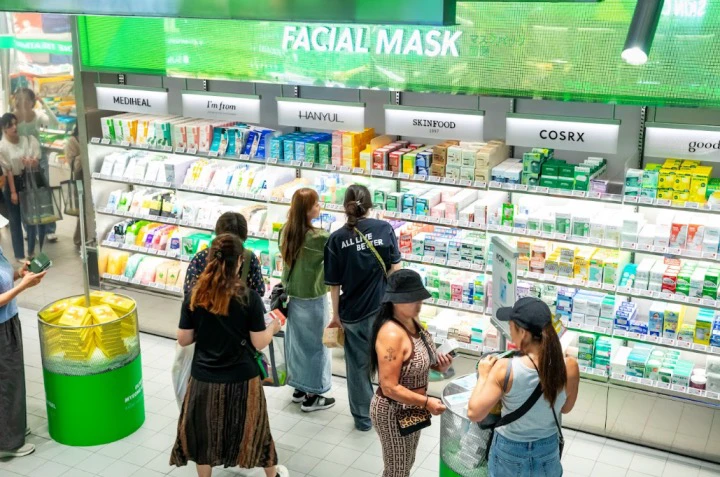

This is a decision problem, not proof that Korean skincare must be complicated. For a wider first visit, use the five-category Olive Young shopping list. For acne-prone skin, make the edit stricter: preserve the routine that already behaves well, fill only a real gap, and change one self-selected variable at a time.
The four-slot basket
- Gentle cleanser: Buy only when your current cleanser stings, scrubs, or is unavailable. Check for mild, non-abrasive wording and directions you can follow. Leave it when you already have a comfortable cleanser.
- Moisturizer: Buy only when your skin feels dry or treatment is irritating. Check for oil-free, non-comedogenic, or “won't clog pores” wording. Leave it when a current moisturizer works without discomfort.
- Sunscreen: Buy only when you lack a comfortable daily sunscreen. Check for broad-spectrum, water-resistant, SPF 30+, and a non-comedogenic claim. Leave it when you already use one reliably.
- Acne product: Buy only when self-care fits mild acne and you can identify the active and directions. Check the active ingredient, concentration, warnings, and frequency. Leave it when the active is unclear, duplicates your routine, or needs professional advice.
Those claims reduce uncertainty; none guarantees that a product will suit every person. A toner, ampoule, sheet mask, scrub, cleansing brush, and exfoliating pad are not missing foundations. Leave them out until the basic routine is stable. That is also why a 10-step Korean skincare routine is optional.
Build the base before choosing an active
1. Clean without scrubbing
The American Academy of Dermatology (AAD) advises a gentle, non-abrasive cleanser, applied with fingertips, up to twice daily and after sweating. More washing is not more treatment. Rough cloths, brushes, scrubs, and repeated cleansing can irritate acne-prone skin.
If your existing cleanser is comfortable, there is no acne-shopping prize for replacing it. A new cleanser should solve a defined problem, not merely carry a greener package or a more medical-sounding name.
2. Keep moisturizer in the routine
Acne treatments such as benzoyl peroxide, salicylic acid, and retinoids can dry or irritate skin. The AAD explains that moisturizer can help skin tolerate a treatment plan. Look for “oil-free,” “non-comedogenic,” or “won't clog pores.” These terms mean a product is less likely to cause breakouts for many users, not that irritation or acne is impossible.
3. Protect skin outdoors
The AAD recommends broad-spectrum, water-resistant SPF 30+ sunscreen on uncovered skin outdoors and suggests a non-comedogenic formula for acne-prone skin. Sun protection also matters when a treatment increases sensitivity, and picking inflamed spots can increase the chance of persistent dark marks and scars.

One self-selected change is not the same as one medical mechanism
The AAD's updated acne guideline supports several evidence-based therapies, including benzoyl peroxide, topical retinoids, and conditionally salicylic acid and azelaic acid. It also recommends combining different mechanisms in appropriate clinical treatment. That does not mean a traveler should buy several unfamiliar products and improvise a combination.
The shopping rule here is narrower: if you are choosing without an individualized plan, introduce only one new acne product while the rest of the routine stays steady. If a dermatologist deliberately prescribes or recommends a combination, follow that plan instead.
Read the active-ingredient list, concentration, directions, warnings, and product category. Do not choose from the front promise alone. Salicylic acid, benzoyl peroxide, azelaic acid, and retinoids do different jobs and have different precautions. Availability, strengths, and whether an item is a cosmetic or medicine vary by country; a U.S. non-prescription recommendation does not prove that the same product is sold on an Olive Young shelf in Korea.
If the Korean label is not clear enough to answer what the active is and how to use it, do not guess from a translation app or influencer shelf tag. Ask a pharmacist or dermatologist. If pregnant or trying to conceive, get professional advice before choosing acne or anti-aging actives; retinoids in particular require pregnancy caution.
What a Korean acne-related cosmetic claim does—and does not—mean
Korea's official functional-cosmetics scope includes products that help alleviate acne-prone skin within the human-cleansing product category. A cleanser carrying an eligible functional claim has followed the relevant review or reporting route; that still does not make every cleanser suitable for every person.
The reverse matters while shopping: a leave-on serum or cream labeled “trouble care,” “cica,” “AC,” or “blemish” is not automatically the same regulated acne-prone-skin functional claim, and it is not automatically an acne medicine. It may be a cosmetic positioned for soothing or general skin care. Check the formal Korean label, not just the shelf theme.
Use a five-question shelf test
Before putting any item in the basket, answer all five:
- Which exact slot does it fill? Cleanser, moisturizer, sunscreen, or one acne product.
- What is the active or function? If you cannot say, do not buy it as treatment.
- What will it replace? “Nothing; I will layer it too” is a warning sign.
- Can I follow the directions for six to eight weeks? A travel-size impulse is not useful if the routine cannot be continued.
- What would make me stop? Burning, marked swelling, hives, or a worsening reaction needs action, not another product.
Take a photo of the full label and ingredient list before discarding the box. Keep the receipt and check the specific store's return rules before opening anything; hygiene-product policies can vary. Do not apply communal testers directly to inflamed or broken skin.
Give one change enough time to answer
The AAD warns that switching acne treatments every week can irritate skin. It advises giving a treatment about six to eight weeks to show some improvement; complete clearing often takes three to four months. Follow the product directions rather than increasing frequency to hurry the result.
During that trial, keep cleanser, moisturizer, sunscreen, and the rest of the routine steady. Record the start date and take comparable photos in the same light. That creates a useful answer: better, unchanged, or worse. Five products started together create no useful answer at all.
Travel is usually a poor time to begin a strong unfamiliar active. Dry cabin air, different weather, sweat, masks, sunscreen changes, and disrupted sleep can all confuse the picture. Buying an item in Korea does not require opening it in Korea. If your current routine is stable, transport the sealed product and consider starting after the trip, subject to the label, expiry, storage needs, and your clinician's advice.
Do not turn irritation into a shopping loop
If a new product causes persistent burning, marked redness, swelling, hives, or a fast-spreading reaction, stop it. Seek urgent help for breathing trouble, facial or eye swelling, or other severe symptoms. For a non-urgent but continuing reaction, a pharmacist or clinician can help decide the next step.
Do not automatically interpret worsening as “purging,” and do not buy a calming serum, barrier ampoule, exfoliating pad, and new cleanser to repair a reaction you have not identified. Return to the last comfortable routine when appropriate and obtain medical advice rather than stacking more variables.
When a dermatologist is the better value
Deep nodules and cysts extend into the skin and are more likely to be painful and leave scars. Early, appropriate treatment can reduce lasting damage. A dermatologist can also distinguish acne from conditions that merely look similar and can select combinations that belong together.
Professional care is not a failure to understand K-beauty. It may prevent months of irritation and duplicate spending. Olive Young is useful for a gentle support routine; product variety cannot provide a diagnosis.
The checkout edit
Before paying, remove anything that fails one of these statements:
- I know which of the four slots this fills.
- I can read the active, directions, and main warnings.
- It does not duplicate a comfortable product I already own.
- I will not start it at the same time as another unfamiliar active.
- I am not using a cosmetic purchase to delay care for painful, scarring, worsening, or distressing acne.
Buying fewer products is not an anti-treatment rule. It is a way to keep self-directed shopping legible, while leaving evidence-based combinations to a plan that accounts for your skin, health, and medicines.
Medical and Korean regulatory references were rechecked on August 12, 2026. Stock, formulation, classification, price, promotions, and store return policies can change; use the current Korean package and professional advice where relevant.
Sources and image credits
- American Academy of Dermatology: 10 skin care habits that can worsen acne — patient guidance on gentle cleansing, avoiding frequent product changes, non-comedogenic labels, and a six-to-eight-week trial
- American Academy of Dermatology: Acne diagnosis and treatment — treatment overview and explanation of clinician-designed mechanisms; not a Korea shelf-stock list
- American Academy of Dermatology: Updated acne management guidelines — official January 31, 2024 summary of evidence-based therapies and appropriate combination treatment
- Korean Law Information Center: Cosmetics Act Enforcement Rule, functional-cosmetic scope — current statutory reference for the acne-prone-skin functional-cosmetics category
- CJ Newsroom: Olive Young Myeongdong Town store photos — official store-photo source and context
- Miriam Alonso on Pexels: woman cleansing her face — source page for the cleansing photograph
- Pexels license — license terms applying to the credited cleansing photograph
- Delivery Spot cover image — Olive Young Myeongdong Town exterior; editorial asset credited to CJ Corporation / CJ Newsroom
- Olive Young shelf image — shoppers comparing products; editorial asset credited to CJ Corporation / CJ Newsroom
- Olive Young checkout image — Myeongdong Town checkout area; editorial asset credited to CJ Corporation / CJ Newsroom
- Gentle-cleansing image — photograph by Miriam Alonso, used under the Pexels license
Last updated


