
Is Your Korea Itinerary Too Packed? The One-Minute Test
Use the 2–8–2 screen before locking a Korea travel day: two separated areas, about eight mapped walking kilometers, and two fixed-time commitments—then lower the limits for real conditions.

Use this one-minute screen before locking any Korea travel day: no more than two separated area clusters, about eight kilometers of mapped walking, and no more than two fixed-time commitments. Call it the 2–8–2 test.
This is a Delivery Spot planning heuristic, not an official standard or a fitness test. One number over the line means the day is demanding. Two or three mean you should remove a whole block before the trip. Lower every limit after a long flight, on steep routes, in heat or rain, with children, or whenever anyone needs more recovery time.
Run the 2–8–2 test in one minute
Open one day of your itinerary and count three things:
- Area clusters: two maximum. Count districts that require a meaningful subway, bus, or taxi transfer between them—not every attraction pin.
- Mapped walking: about eight kilometers maximum. Add the walking legs in a routing app. The number still excludes most movement inside palaces, museums, markets, malls, and stations.
- Fixed times: two maximum. Count reservations, timed tickets, tours, performances, and trains that would cause a real loss if you arrived late.
Read the result this way:
- Zero limits exceeded: the day has useful slack.
- One exceeded: it is a full day; protect meals and transfer buffers.
- Two exceeded: remove the least important area or fixed commitment.
- Three exceeded: rebuild the day around one anchor.
The numbers are warning lights, not targets. A day with two areas, 7.9 kilometers, and two reservations can still be too hard when it starts after an overnight flight.
1. Count area clusters, not saved pins
Gyeongbokgung, Bukchon, and Insadong can form one central historic cluster when placed in a sensible walking order. Hongdae, Seongsu, and Gangnam are three clusters even if a route app draws a clean line between them. The second plan is tiring because each district switch adds a station search, a wait, a ride, an exit, and a fresh round of orientation.
Official courses show why pin count is misleading. Visit Seoul allocates 2–3 hours to its Bukchon Hanok Village course, even though all listed stops remain in one compact area. Its Cheonggyecheon daytime course lists six stops from Cheonggye Plaza to Gwangjang Market and assigns two hours. The official pages also say separate experience programs are not included, so a workshop, museum detour, meal, or shopping stop needs its own time.
The next three images belong to that single Cheonggyecheon course: the official course map, Cheonggye Plaza, and the stream path below Supyogyo.
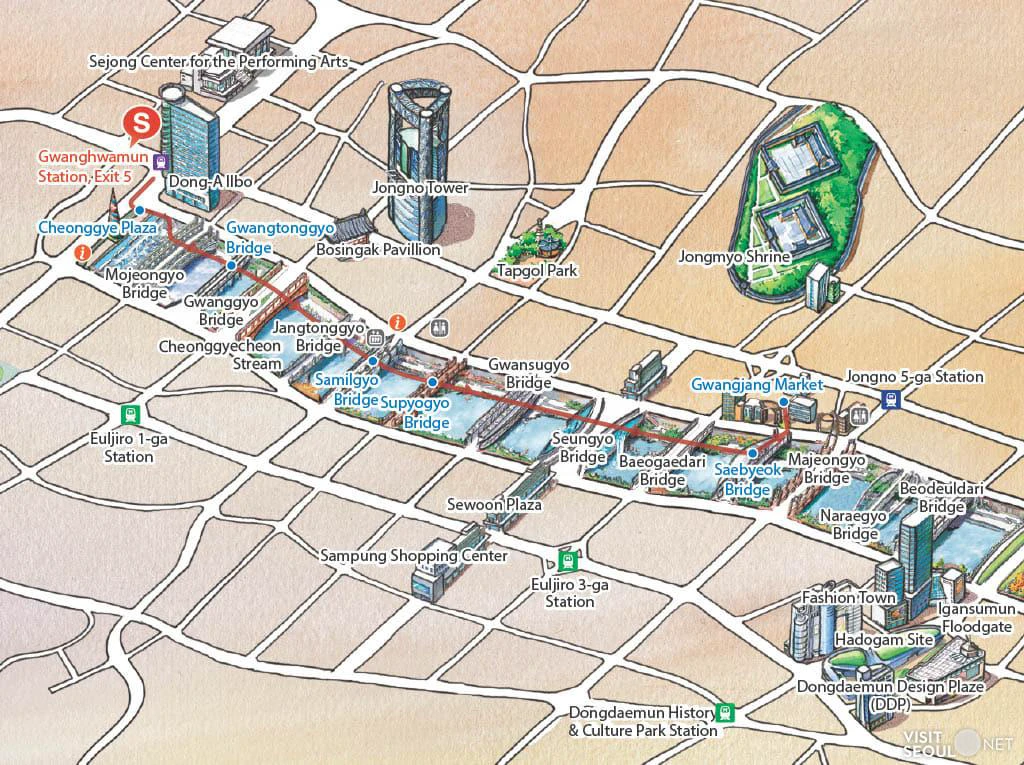
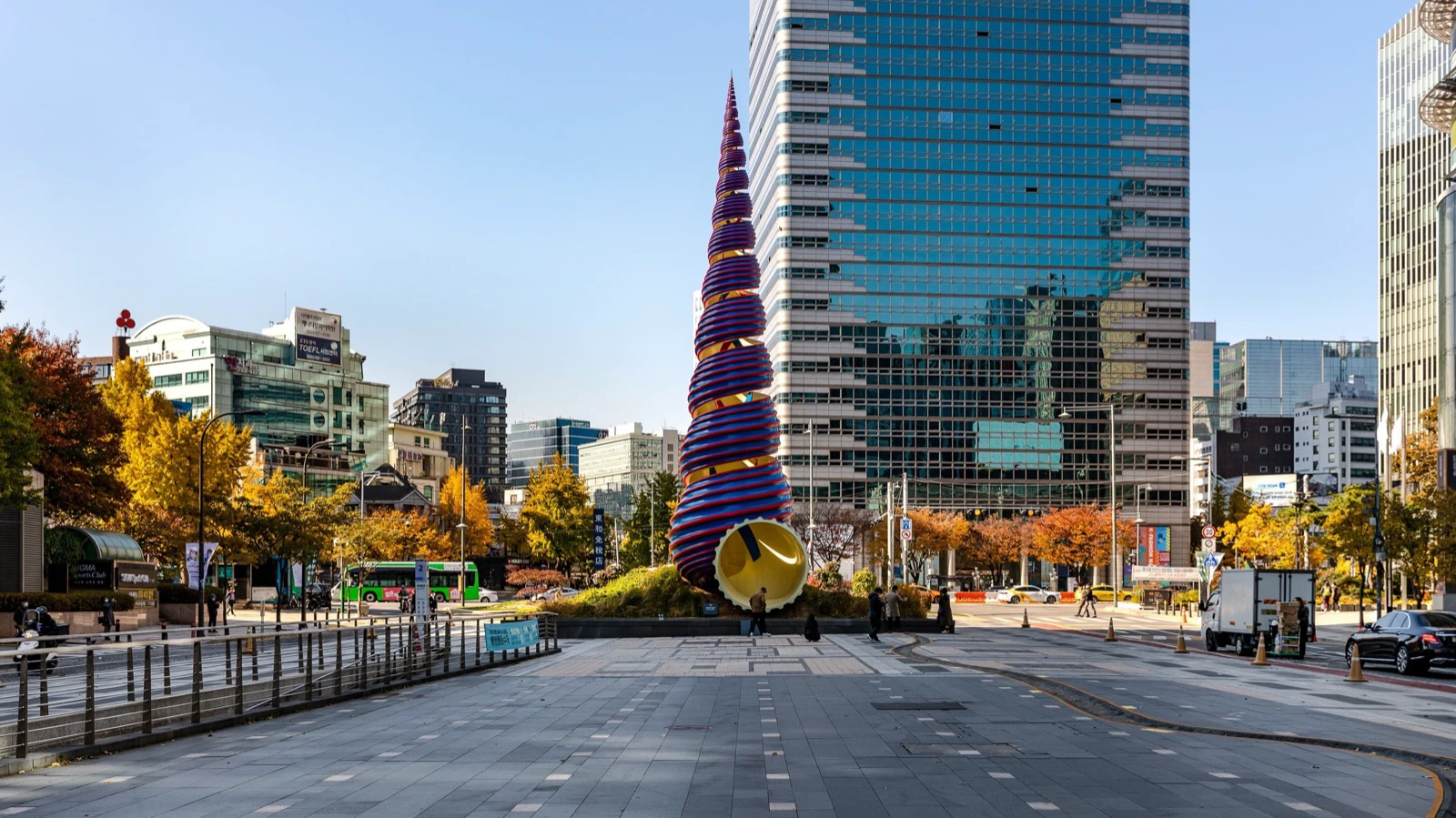
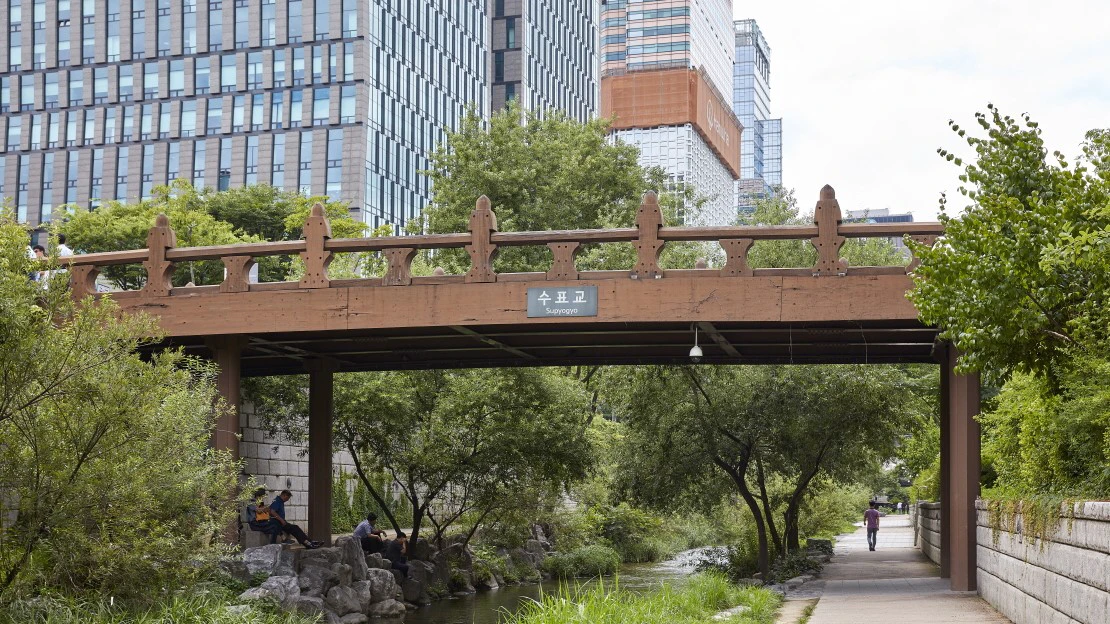
Treat adjacent places as one cluster only when you can walk naturally between them and would be content to drop a minor stop. If the next district requires transit, count a new cluster. As a rough planning placeholder, reserve about 45 minutes for the switch, then replace that estimate with a live route for the actual date and time. The buffer is not a claim that every ride takes 45 minutes; it covers the entire handoff, including finding the platform and getting oriented after the exit.
2. Use walking directions, not straight-line distance
Plot the full sequence in Naver Map or another routing app that works well in Korea. Add hotel-to-station walks, transfer corridors, the final walk after dinner, and any return to collect luggage. Do not measure only the first attraction to the last.
Use eight mapped kilometers as a conservative first-trip ceiling, not a goal and not a health recommendation. A route that already shows eight kilometers will normally grow once you enter a palace, browse a market, cross a large station, take a wrong exit, or walk inside a mall.
Lower the screen to roughly five or six mapped kilometers for Bukchon or another hilly area, humid summer weather, rain, snow, a stroller, mobility constraints, jet lag, or frequent photo and rest stops. A traveler accustomed to long walking days may raise the number, but walking fitness does not remove closing times, reservation clocks, or the mental cost of repeated navigation.
For an arrival day, start even lower. Our Korea arrival-day guide builds the first day around one easy area and a realistic recovery window.
3. Treat fixed times as rails around the day
One timed commitment gives the day an anchor. Two can work when they are widely separated, such as a morning palace program and an evening performance. Three often create a chain in which a slow meal or an unexpectedly good museum visit threatens everything that follows.
Count a fixed time whenever being 15–20 minutes late would forfeit money, admission, or the activity itself. A flexible café idea does not count. A reserved intercity train, guided tour, concert, popular restaurant, or timed attraction does.
Keep at least 60 minutes of unassigned time before the highest-stakes commitment. Use more when you must cross the city, return to the hotel, collect bags, or navigate an unfamiliar terminal. This is a planning buffer, not a prediction of travel time.
The official Seoul Guided Walking Tour information illustrates how even a free activity can put rails around the day. The current walking-tour FAQ says reservations should be made at least three days ahead, guided tours run at set times, and arriving more than 20 minutes late without notice can cancel a booking. Policies and available courses can change, so check the live reservation page rather than relying on a saved screenshot.
Add the invisible time before scoring the day
A route can pass 2–8–2 and still fail if ordinary travel blocks are missing. Put these into the timetable first:
- Morning launch: allow 60–90 minutes from waking to leaving on an unfamiliar morning.
- One real meal: protect an unhurried meal instead of treating every stop as a snack.
- Opening and last entry: check the official page for the exact date and weekly closing day.
- Shopping: browsing, fitting rooms, tax-refund steps, and carrying purchases all slow the second half.
- Weather: heat, humidity, rain, ice, or fine dust can turn a short walk into a rest period.
- Luggage: checkout, storage, and collection are schedule blocks, not footnotes.
VISITKOREA describes Korean summers as hot and humid and advises travelers to check real-time conditions for unexpected rain or extreme heat. Its official climate guide is a useful reason to lower the walking number rather than force the same itinerary through every season.
Repair an overloaded day in 60 seconds
First, choose the reservation or place you would be most disappointed to miss. That is the anchor. Then:
- Remove the farthest district, not automatically the least famous attraction.
- Keep nearby flexible stops around the anchor.
- Move shopping and optional cafés from the timetable to a short backup list.
- If three fixed times remain, move or release one.
- If mapped walking remains high, shorten the outdoor sequence rather than assuming taxis will erase every delay.
Taxis can reduce steps, but traffic makes them an unreliable rescue for an impossible schedule.
An overloaded plan might read: palace morning, Bukchon, Insadong, Seongsu cafés, a Gangnam dinner booking, and a concert. A sturdier version keeps the palace, Bukchon, and Insadong as one daytime cluster, uses the concert as the second anchor, and moves Seongsu and Gangnam to another day.
The final decision rule
A strong Korea itinerary is not the one with the most saved pins. It is the one that survives a slow breakfast, a crowded station, an unexpected shop, one wrong exit, and a weather change.
Check two clusters, eight mapped kilometers, and two fixed times. If two limits fail, remove one whole block. If the traveler or conditions demand more recovery, lower the limits before the day begins.
Travelling after checkout? Find a nearby Delivery Spot luggage location and include both drop-off and collection in the schedule rather than carrying the bag through every stop.
The official course durations, tour policies, and climate guidance were rechecked on August 12, 2026. The 2–8–2 thresholds and suggested buffers are explicitly planning heuristics; they are not official Seoul rules or universal physical limits.
Sources and image credits
- Visit Seoul — Bukchon Hanok Village walking course — Official route, listed stops, 2–3-hour duration, and experience-program qualifier; rechecked August 12, 2026.
- Visit Seoul — Cheonggyecheon daytime walking course — Official six-stop route, two-hour duration, course map, and location images; rechecked August 12, 2026.
- Naver Map — Korea routing tool linked for live point-to-point walking and transit checks.
- Visit Seoul — Guided Walking Tour information — Existing official program reference retained from the published guide.
- Visit Seoul — Walking-tour FAQ — Current reservation lead time, fixed-time, lateness, and weather-policy guidance; rechecked August 12, 2026.
- VISITKOREA — Climate — Official seasonal climate and real-time weather-planning advice; rechecked August 12, 2026.
- Delivery Spot cover illustration file — Original editorial illustration created for Delivery Spot.
- Delivery Spot body image 1 — Cheonggyecheon course map from Visit Seoul, used with permission.
- Delivery Spot body image 2 — Cheonggye Plaza image from Visit Seoul, used with permission.
- Delivery Spot body image 3 — Cheonggyecheon below Supyogyo image from Visit Seoul, used with permission.
Last updated


