
Does Jeonse Deposit Insurance Make Your Money 100% Safe?
Understand what HUG deposit-return guarantees cover, how foreign-tenant and property eligibility work, and why claims do not pay at lease-end automatically.

No. A jeonse deposit-return guarantee can be one of the strongest protections available, but it does not make every contract eligible, cover every won automatically, or pay on the lease-end date. It is conditional loss protection, not instant bridge financing for your next home.
This guide uses HUG's standard return guarantee because its published FAQ addresses foreign tenants. HF and SGI products have different applicant, loan, property and claim rules. The certificate and terms for the product actually issued to you control. Facts below were rechecked on 12 August 2026; get current written guidance for a live contract.
Know which guarantee you are buying
HUG describes its Jeonse Deposit Return Guarantee as protection when a landlord fails to return a covered deposit after the lease ends. It is not contents insurance and is not identical to a guarantee that supports a jeonse loan. Similar English names can conceal different products.
For HUG's current standard product, the deposit must generally be no more than KRW 700 million in Seoul, Gyeonggi and Incheon, or KRW 500 million elsewhere. A new application generally must arrive before half of the lease period has passed. Those headlines are only gates, not approval. HUG also assesses recognized home value, senior claims, ownership, registration records, illegal-building notations, lease form and other case-specific conditions.
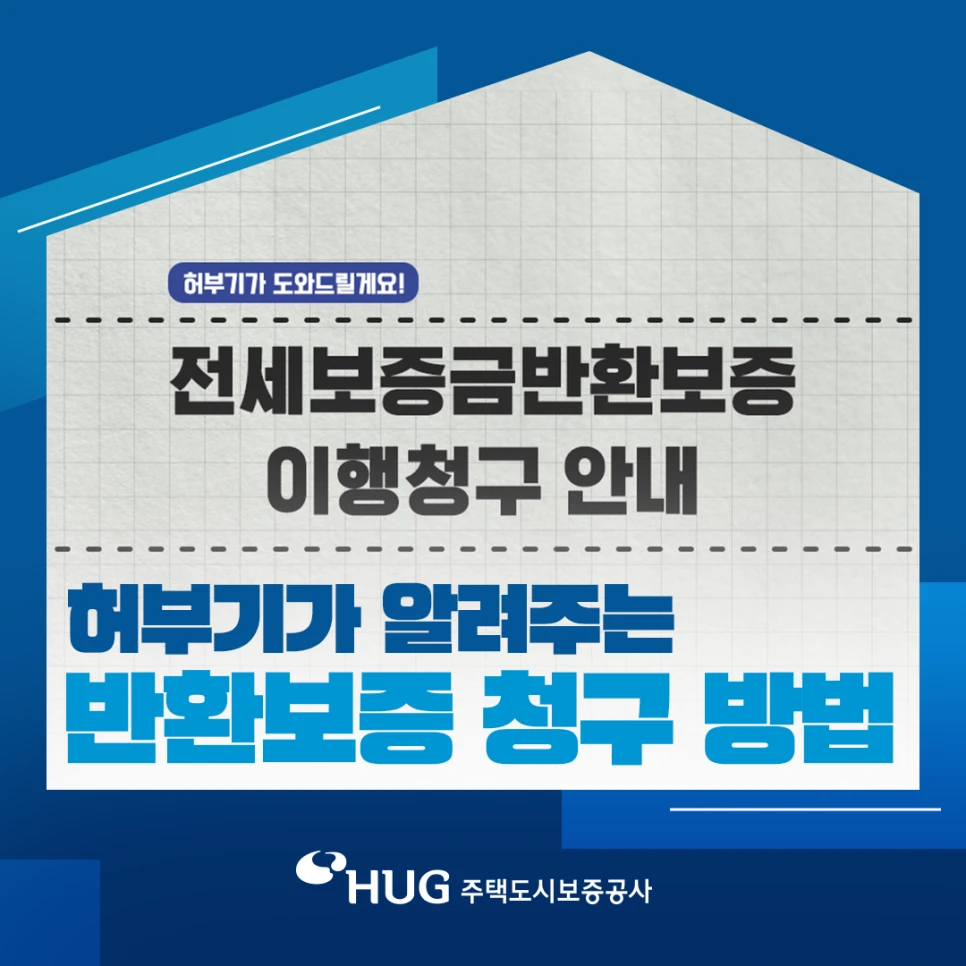
Investigate before signing or transferring the deposit. Ask the exact issuer or handling bank whether you, the contract, the home, the deposit, the recognized property value and senior debt appear eligible. Then read the issued certificate for covered amount, guarantee period, exclusions and fee. A broker's reassurance, calculator result or preliminary self-check is not approval.
Foreign tenants must compare the named provider
HUG's foreign-tenant FAQ says a foreign tenant may use the standard return guarantee when the conditions are met. It points to the legal protections built from possession, foreign registration, a report of change of residence and a fixed date on the lease.
Provider rules are not interchangeable. HF's Jeonse Jikim Guarantee self-check currently lists Korean citizenship for all tenants and connects the product to an HF-backed jeonse loan guarantee through a participating bank. HF also warns that passing the self-check does not guarantee approval. A foreign applicant who appears eligible for HUG should not assume the same result from HF or SGI.
Preserve legal priority from move-in to claim
Complete the address-related registration and fixed-date steps that apply to you, keep dated evidence, and do not casually surrender possession or change the protected address. HUG's claim self-check tells tenants to maintain possession, residence registration and priority rights until the deposit is fully returned or tenant-right registration is complete.
If you will not renew, send clear notice early and retain proof that every landlord received it. HUG's current claim guidance says termination or non-renewal notice should reach the landlord at least two months before the lease ends. The legal end date can still depend on contract wording and renewal history. A sent message is weaker than delivery evidence; obtain Korean legal advice when the end date is disputed.
Do not move out or transfer your registration merely because the calendar reaches the end date. HUG's June 2026 claim guide instructs tenants to confirm both the tenant-right registration decision and the completed registry entry before leaving or changing registration. Ask the named issuer for the sequence that applies to your case.
“Covered” still involves an accident and claim clock
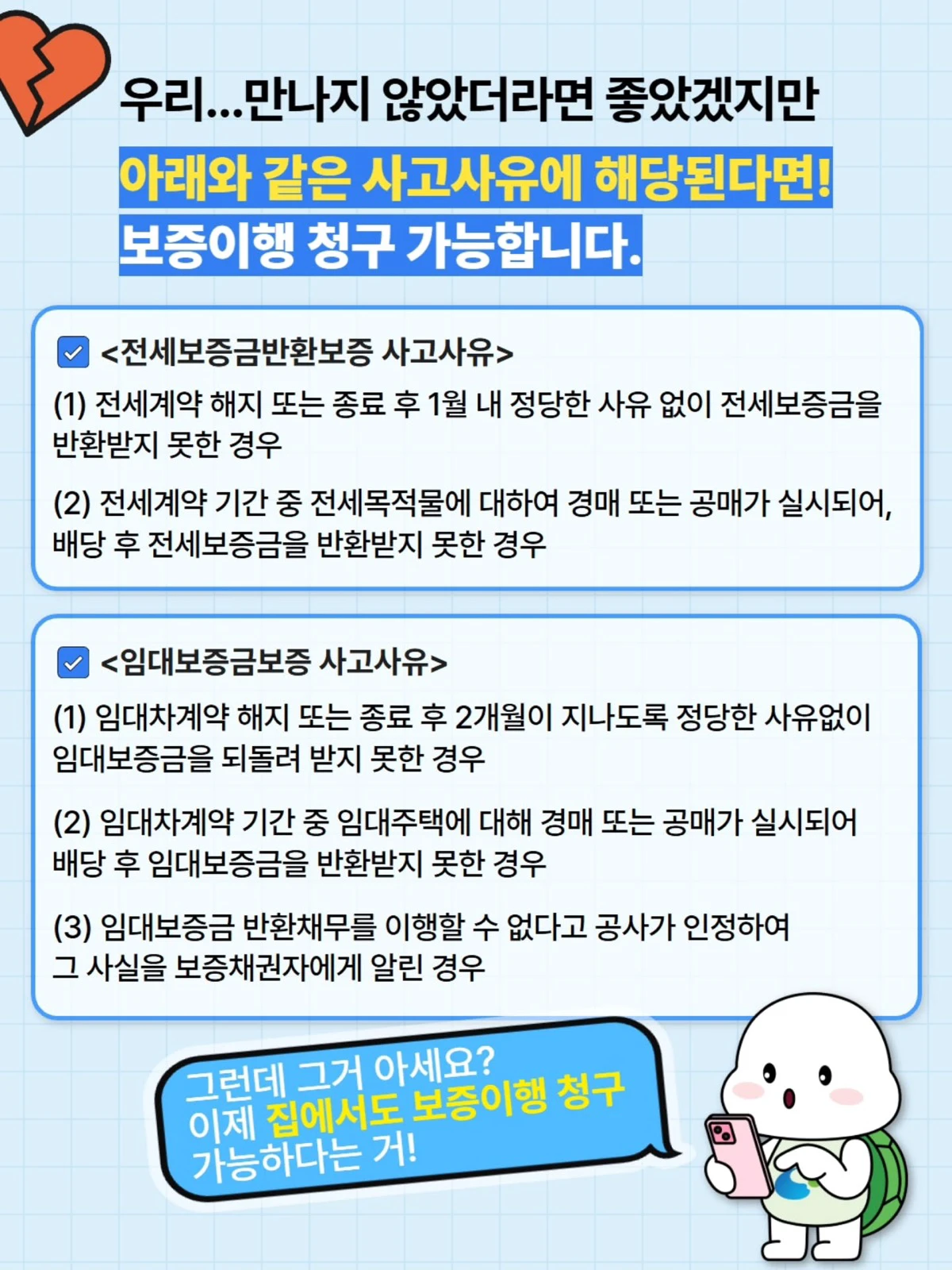
HUG accepts certain performance claims through mobile service, but an online form does not remove prerequisites. Current HUG materials describe one standard guarantee event as the deposit remaining unpaid for one month after the lease ends. The standard route also generally requires tenant-right registration before the performance claim.
HUG's standard terms and claim instructions say the creditor should report a guarantee accident within one month of learning of it and submit the performance claim within two months of the accident. They say HUG performs within one month after receiving a valid claim. That is not one month from lease-end: termination, the defined non-payment period, registration and a complete claim come first. Missing papers, ownership issues or disputes can add time.
A family in a March 2026 Reddit discussion said its insured case took nearly a year end to end and required remaining in the home before moving shortly after reimbursement. That is one anecdote, not an official average or forecast. It is useful only as a warning against promising your next landlord that guarantee money will arrive immediately.
Build the file before non-payment
Keep the original lease and renewals, guarantee certificate, deposit-transfer proof, property records, fixed-date evidence, residence or foreign-registration records, and proof of termination notice. If ownership changes, an auction begins or the landlord disappears, contact the issuer promptly. HUG tells tenants in auction or public sale to report it and request distribution.
Use the issuer's current checklist, not an old screenshot. Depending on the event, HUG may ask for proof that notice reached all landlords, the tenant-right registration decision and completed registry entry, identity and bank documents, and auction materials. Keep full originals for formal submission; use redacted copies for informal help.
Our step-by-step guide for an unpaid jeonse deposit explains how termination evidence, priority, tenant-right registration, court procedures and guarantee claims fit together. It remains general information; deadlines and ranking can change with your documents.
Payment and move-out are coordinated later
Even after approval, payment and handover follow a sequence. HUG's performance-payment guidance tells an approved claimant to provide the planned move date at least ten business days in advance. Under HUG's process, the home is checked as vacant, utilities are settled and payment is finalized with move-out. Follow the case officer; do not return keys early based on an informal promise.
A guarantee is therefore unreliable bridge financing. Keep a contingency for temporary lodging, storage, rearranged movers, loan interest or a delayed new contract. Before committing to another deposit, coordinate timing with the new landlord, lender and the actual guarantee issuer.
Five written confirmations before paying
- The named product accepts you, this contract and this property.
- The covered amount and period match the lease money and dates.
- The issuer has assessed value and senior claims, not only the regional deposit cap.
- You know the application, notice, possession, registration and claim deadlines.
- You have cash and housing contingency if the landlord does not pay at lease-end.
The practical answer is yes, an appropriate guarantee can materially reduce loss risk—but never to “100% safe” in every contract or on every timetable. Preserve eligibility and priority throughout the lease, follow the issuer's sequence, and seek individualized Korean housing-law advice when facts are disputed. This article is general legal and financial information, not professional advice.
Sources and image credits
- HUG — current standard return-guarantee product page — deposit caps, timing and property conditions checked 12 August 2026.
- Mobile HUG — current performance-claim process — tenant-right registration, review and payment sequence checked 12 August 2026.
- HUG — current manuals and FAQ index — June 2026 standard-product manual listing.
- HF — current General Jeonse Jikim Guarantee — provider-specific product context checked 12 August 2026.
- Atlantic Ambience via Pexels — featured lease-and-keys photograph, used under the Pexels license.
- HUG official Naver Blog — source credit for the HUG claim-guide body graphics; June 2026 guide.
- HUG official Instagram — source credit for HUG guarantee-performance graphics; used under the operator's written permission.
- Uploaded featured image — published copy of the credited lease-and-keys asset.
Last updated


