
How Much Cash to Carry in Korea When Cards Usually Work
Cards cover most everyday spending in South Korea, but ₩50,000 per adult is a practical arrival reserve for physical Tmoney, an occasional cash-only stall and a failed foreign-card payment.

Cards can cover most day-to-day spending in South Korea. A sensible starting reserve is ₩50,000 per adult: use part of it for a physical Tmoney card and its first top-up, then keep the rest for a market stall, a declined foreign card or the next transit reload.
This is arrival cash, not a budget for the whole trip. If it runs low, withdraw another modest amount rather than carrying several days of spending from the start.
A practical first withdrawal
For one traveler spending most of the trip in cities, begin with ₩50,000. Two adults can share ₩100,000, especially if both need their own transit card. A family or anyone planning several traditional-market meals may need more later, but there is little reason to take it all out on day one.
A useful split is:
- ₩3,000–5,000 for the physical Tmoney card
- ₩20,000–30,000 for its first transit balance
- the remainder in ₩10,000 notes for small cash-only payments or a card failure
Keep this reserve separate from normal food, attraction and shopping costs. Use the daily Korea budget guide to estimate those.
Physical Tmoney is the cash exception to remember
The regular prepaid Tmoney card is still the most predictable cash-only moment for an international visitor. The Korea Tourism Organization's 2026 transportation guide says foreign-issued cards are not accepted when buying or topping up a physical prepaid Tmoney card. Convenience stores and subway stations sell it, generally for ₩3,000–5,000, and both the card and stored value require cash unless you have a Korean-issued card.
Seoul now has a narrower cashless option. Since March 17, 2026, Seoul Metropolitan Government says 440 newer machines at 273 stations on Lines 1–8 accept overseas Visa and Mastercard cards, including supported mobile payments. They sell single-journey tickets and let visitors buy or recharge the 1-, 2-, 3-, 5- and 7-day Climate Card passes. The city lists an average service fee of about 3.7%.
That change does not turn an ordinary physical Tmoney top-up into a foreign-card transaction. Decide which product you want before standing at the machine: a regular Tmoney card works as stored-value transport money across a wider range of trips, while the cashless update is for Seoul's named short-term Climate Card passes and single journeys.
A November 2025 Naver account illustrates the distinction on arrival. The visitors used a Monzo card through Apple Pay at ordinary restaurants, but a CU clerk asked for cash to top up Tmoney. They found a nearby Woori machine marked Global, withdrew ₩30,000, bought a ₩4,000 card and loaded ₩20,000. Treat that as one traveler's experience, not a promise that every branch or ATM will work the same way.
At markets, ask before ordering
Korean markets are not uniformly cash-only. Payment can change from one stall to the next, even within the same building.
In an April 2025 Naver visit to Gwangjang Market, a doughnut seller accepted a card after foreign customers asked, while a hand-cut noodle stall took cash. Show the card and ask before food is prepared. A few ₩10,000 notes cover the stalls that cannot take it.
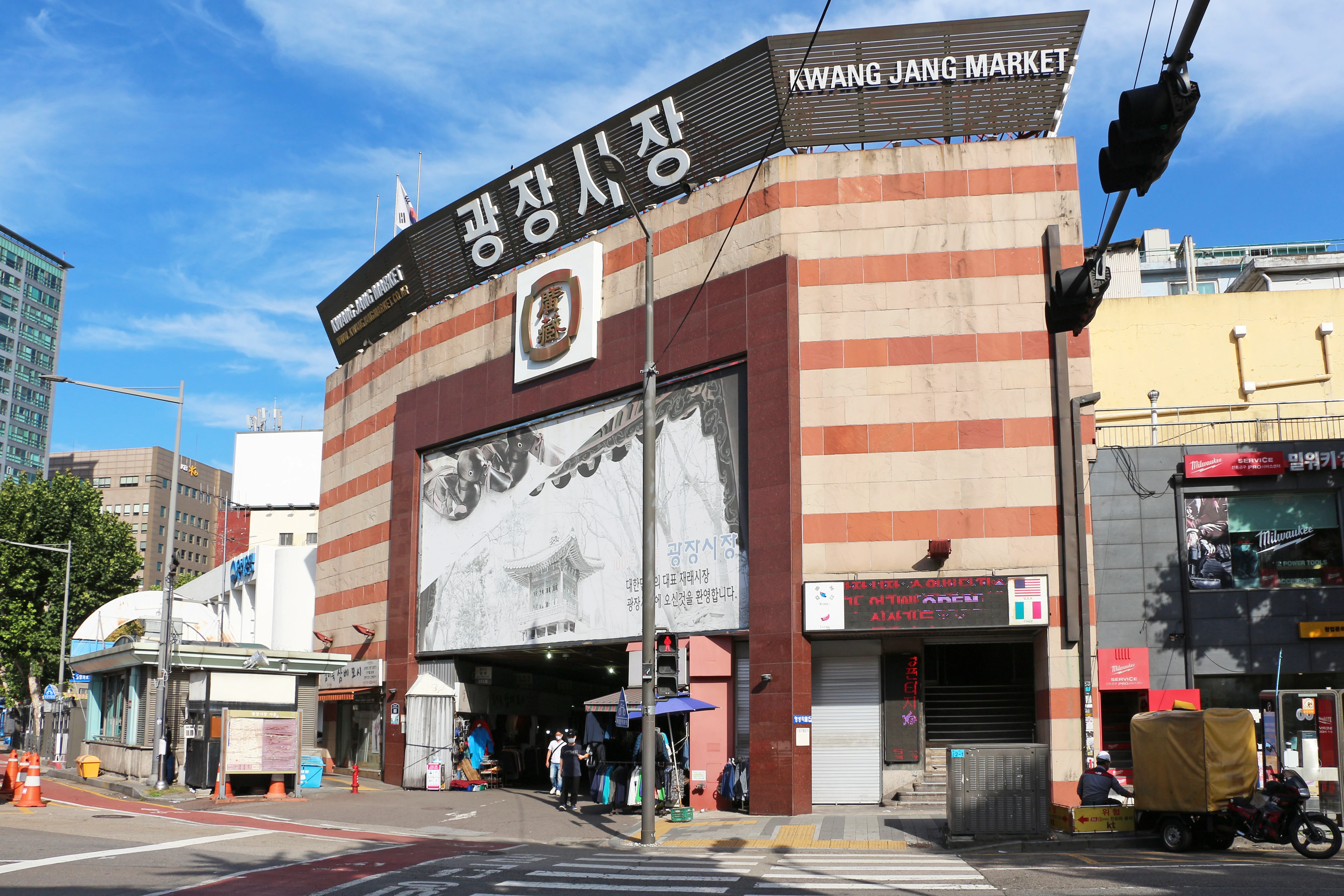
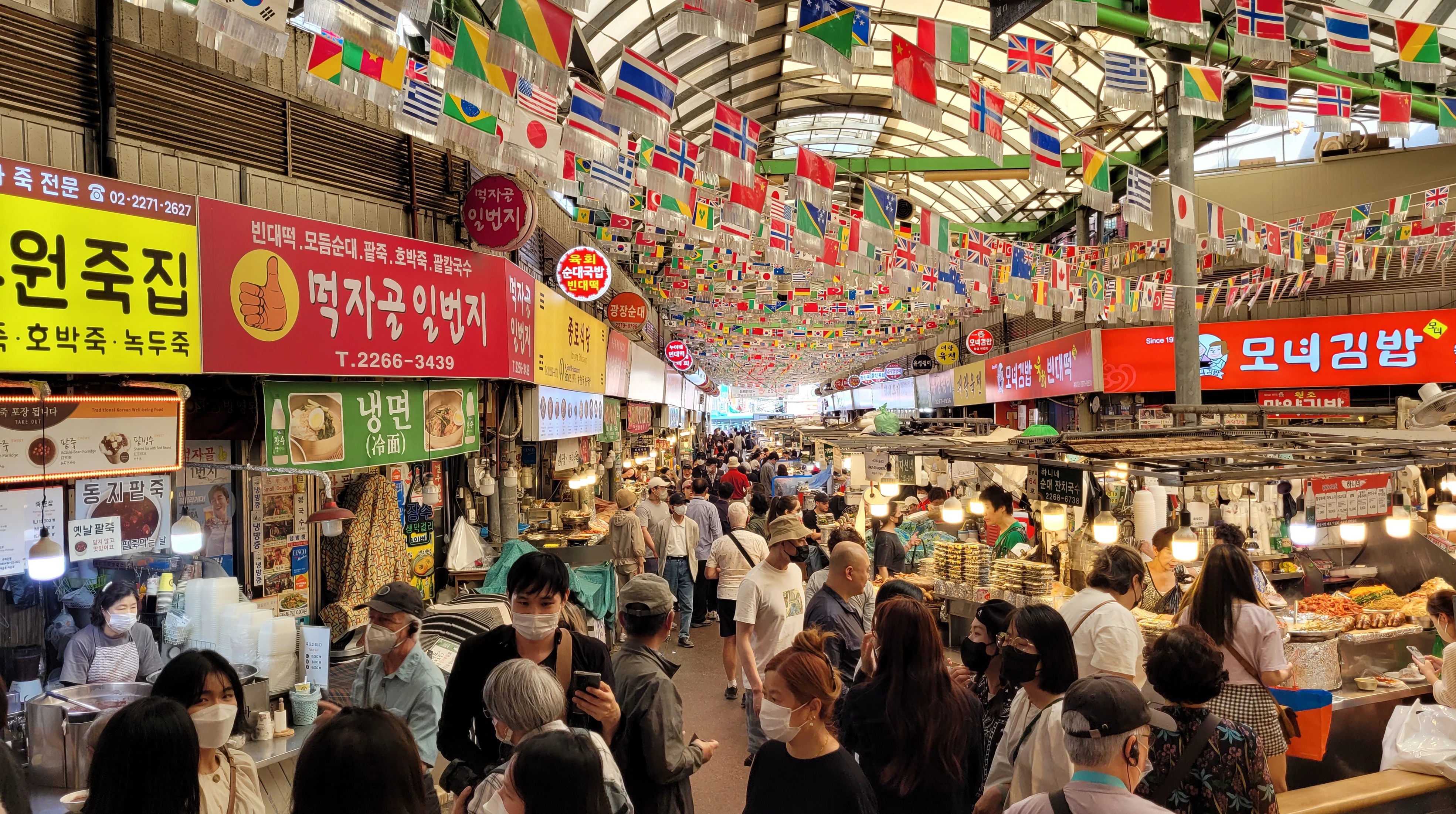
These photos show the exterior and food aisle of the same market. Each stall still handles its own payment.
A May 2026 Reddit thread about market payments describes a similar trip: its writer used a foreign card in Suncheon, Busan and Seoul and needed cash only once at a Gwangjang hotteok stall, apart from Tmoney top-ups. It is another individual report, so check the stall in front of you.
Find a compatible ATM and read every fee
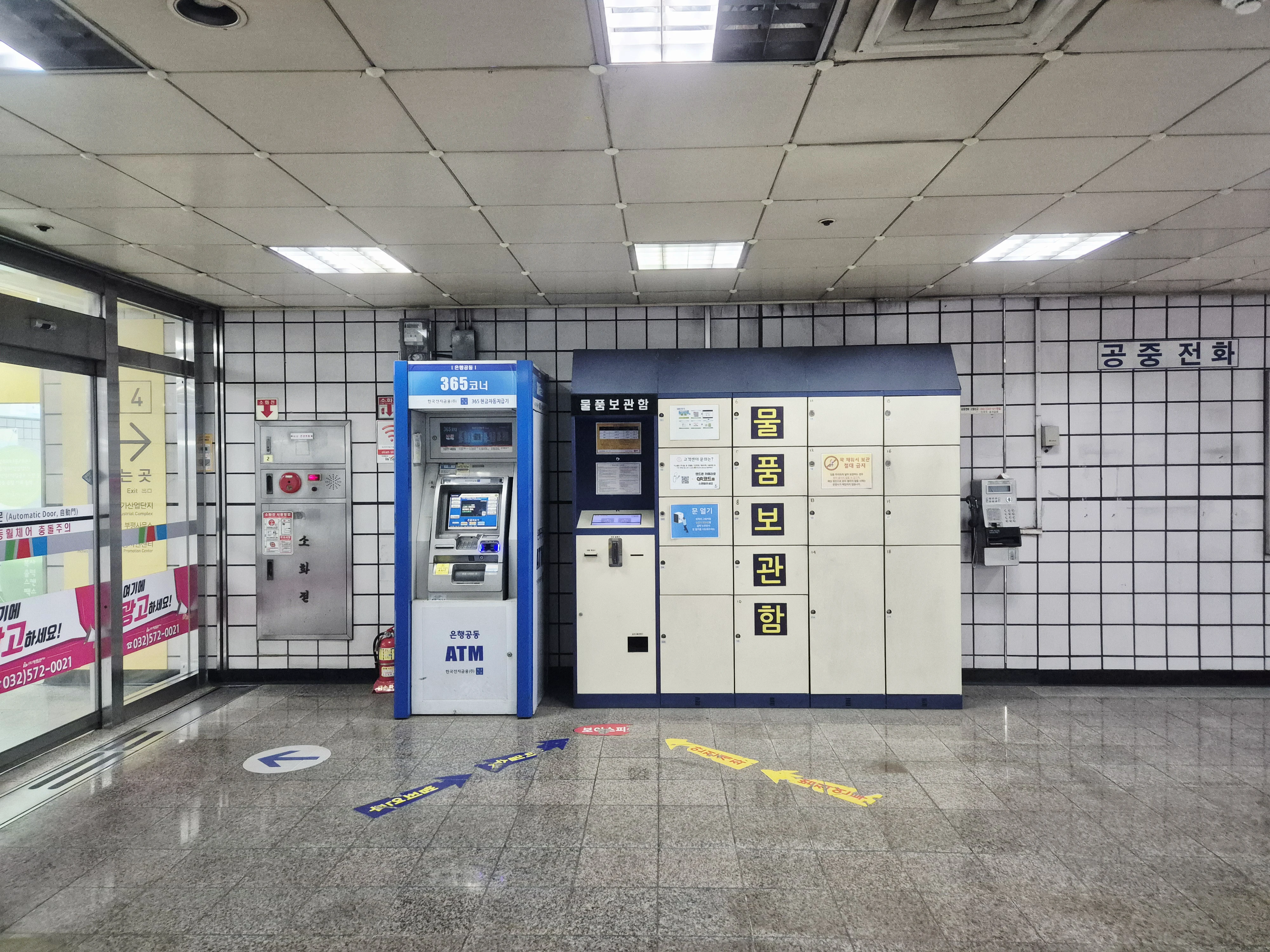
The Galsan Station machine pictured above is not being identified here as a Global ATM. A subway location alone does not establish foreign-card support. Look for Global ATM or Global Service wording and a network logo matching your card before inserting it. If one bank's machine rejects the card, move to a different bank rather than repeating the same transaction.
The ATM may disclose its own fee before approval, and your issuer can charge a separate cash-withdrawal or foreign-transaction fee. Check your card's terms before the trip. One moderately larger withdrawal can reduce repeated operator fees, but carrying more than you are comfortable losing brings no benefit.
If the screen offers to charge the withdrawal in your home currency, pause. Visa's dynamic currency conversion explanation says the screen should show the KRW amount, the home-currency amount, the exchange rate and added markup or fees, then let you accept or decline. Selecting KRW leaves the conversion to your card network and issuer; compare those terms instead of choosing the familiar currency automatically. Mastercard likewise advises using a machine that displays your card's network logo and protecting the PIN.
When a payment fails, change one variable
A declined tap does not always mean the merchant refuses foreign cards. Insert the chip card and enter the PIN. If that fails, try a backup card from a different issuer or network. At an ATM, switch to another bank's machine that is explicitly marked for overseas cards.
Keep the backup card separate from the first. Do not put your only physical card through several unfamiliar machines, and retain enough cash for the next ride and meal. Contact your issuer if both chip payments and compatible ATMs reject the card.
Use cards for routine purchases and reserve the banknotes for physical Tmoney and the occasional awkward counter. Start with ₩50,000 per adult; the way you actually spend will tell you when to withdraw more.
Information checked August 11, 2026.
Sources and image credits
- Korea Tourism Organization: 2026 transportation guide — foreign-card acceptance for transport purchases and the cash rule for physical prepaid Tmoney checked August 11, 2026
- Seoul Metropolitan Government — March 2026 international-card rollout, covered products, station and machine counts, and average service fee; also the featured illustration credit under KOGL Type 1
- Featured image file — published copy of the Seoul transport-payment illustration
- Naver arrival account — attributed example of a visitor buying and loading Tmoney after using a Global ATM
- Naver Gwangjang Market account — attributed example of card and cash acceptance varying by stall
- Reddit market-payment thread — attributed individual experience, not used as a universal payment rule
- Visa — dynamic currency conversion disclosure and choice
- Mastercard — ATM network-logo and PIN-safety guidance
- Bgag: Gwangjang Market exterior — exterior image, CC0 1.0
- Bgag: Gwangjang Market food aisle — food-aisle image, CC0 1.0
- Narubaru7: Galsan Station ATM — Galsan Station ATM and lockers image, CC BY 4.0
Last updated


