
Why Korean Thrillers Hit So Hard Worldwide
A critical guide to how selected Korean thrillers combine social conflict, genre shifts, intimate emotion, ambiguous repair, and precise craft—without turning film patterns into national stereotypes.

Why do Korean thrillers so often leave international viewers shaken long after the plot is clear? “More violent” is an easy answer, but a poor one. Violence can startle; it cannot explain why Memories of Murder, The Wailing, Burning, Train to Busan, and Parasite work through such different rhythms.
A more useful answer is craft and structure. In many acclaimed examples, suspense carries a conflict larger than one villain, genre changes keep the viewer emotionally off balance, and intimate obligations make institutional failure personal. This is a pattern in selected films and an evolving industry—not a claim that Korean people possess a shared taste for darkness.
The compact answer
Four techniques often overlap:
- A crime reveals a system. The investigation also exposes policing, work, housing, class, family authority, or local power.
- Genres remain permeable. Comedy, melodrama, horror, action, and satire can share one story.
- Emotion drives the suspense. Shame, grief, loyalty, parental duty, and rage determine what characters risk.
- A solved plot need not repair the world. A culprit may be found while the institution, family, or community remains damaged.
No single title represents an entire national cinema. These are recurring strategies, not rules.
Thriller as an engine, not a sealed category
Korean commercial cinema often uses the thriller less as a shelf label than as an engine able to pull several kinds of drama. KOFIC's 2025 overview of Korean genre innovation discusses the industry's long practice of reshaping familiar forms through family drama, social critique, horror, comedy, and local history.
That helps explain why Parasite can begin as a comic confidence game and tighten into domestic suspense and tragedy. The Host combines monster action, family melodrama, slapstick, and political satire. The Wailing shifts between rural police comedy, occult horror, family crisis, and doubt. Train to Busan uses disaster momentum while keeping a father-daughter relationship at its center.
These movements are not inherently superior, and they do not always succeed. At their best, however, comedy establishes ordinary behavior, melodrama creates attachment, and the thriller then threatens something emotionally specific. The tonal turn feels like pressure increasing, not like a random genre swap.
Social conflict gives danger a second meaning
Some prominent Korean thrillers ask two questions at once: who caused the immediate harm, and what conditions allowed it to continue? KOFIC's report on research into social criticism in Korean cinema describes a study of films from 1994–2017. Within that defined dataset, roughly 18 percent of commercially released features were classified as social-problem films, and such films appeared regularly among box-office leaders. That historical finding should not be projected automatically onto every newer film.
In Memories of Murder, the investigation is inseparable from poor methods, authoritarian habits, and an institution unprepared for the crime. The Chaser draws urgency from delay and indifference as well as pursuit. Parasite turns employment, debt, housing, and architecture into suspense. The antagonist still matters, but removing one person cannot repair the surrounding structure.
Compromised protagonists create moral pressure
The central figure is often neither a flawless expert nor a clean moral proxy. A protagonist may be indebted, disgraced, exhausted, implicated, or simply outmatched. When formal systems fail, improvisation begins—and its cost becomes part of the suspense.
The Chaser follows a former detective whose first motives are hardly heroic. Mother turns devotion into investigation and moral danger. A Hard Day makes a corrupt detective's attempted cover-up generate each new crisis. Park Chan-wook's revenge narratives repeatedly test whether privately administered punishment can remain morally contained.
This is different from the pleasure of pure competence. The viewer may want action while distrusting the available actor and the action itself.
Melodrama makes danger intimate
“Melodrama” need not mean careless excess. In Korean film history it can organize family separation, sacrifice, shame, betrayal, and duty—the very relationships that give a thriller something to lose.
The outbreak in Train to Busan matters because it tests a father and daughter. Mother pivots on a parent's absolute belief in her child. The Man from Nowhere attaches action to an isolated adult's bond with a child. The suspense persists after a chase ends because grief and obligation do not reset.
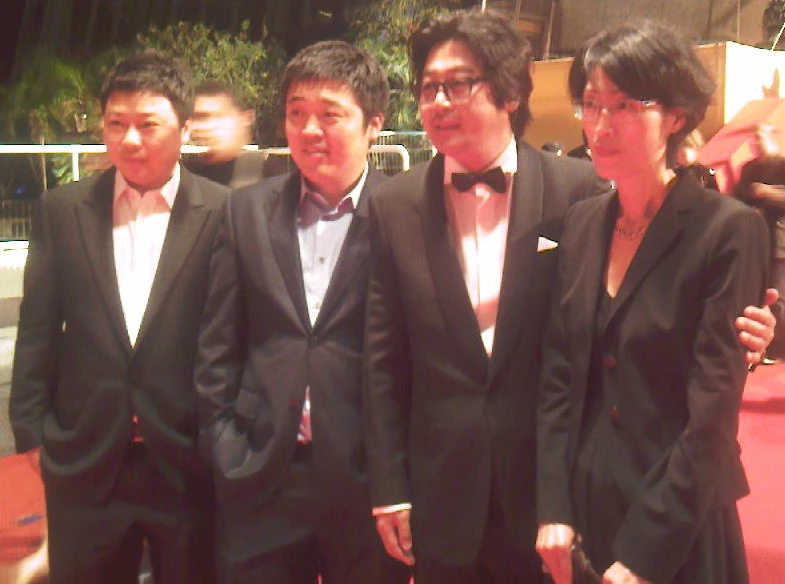


The three filmmakers pictured have worked across crime, horror, action, melodrama, and social observation. The images identify creators; they do not imply that one style defines Korean cinema.
Comedy is a tool, not a tonal mistake
A joke inside a grim film can establish recognizable vanity, give the viewer a false sense of safety, or expose incompetence before its consequences become serious. In Memories of Murder, clumsy police behavior can be funny until the same behavior destroys evidence or harms someone. In The Host, a family's awkward public grief sits beside its abandonment by institutions. Parasite makes the family's scheme pleasurable before changing the physical and moral geometry of the house.
The tonal shift asks viewers to keep recalibrating. A laugh may reveal character, conceal a threat, or make the next turn land harder. That is a deliberate option in these films, not a national temperament.
Why incomplete endings can feel honest
Many thrillers promise that knowledge restores order: identify the culprit, expose the conspiracy, rescue the victim. Several celebrated Korean films weaken that promise. The case may remain unresolved, survival may carry irreversible loss, or an institution may absorb the scandal.
Memories of Murder leaves uncertainty facing the viewer. Burning makes interpretation unstable. The Wailing supplies competing explanations without a safe position outside the characters' fear. Ambiguity is not automatically profound, and bleakness is not automatically truthful. But if the film has made the larger system part of the damage, a perfectly restorative ending may contradict its own diagnosis.
Industry and craft make hybridity readable
Genre mixing needs control. Expressive locations, exact sound cues, performance, blocking, and editing keep the emotional line legible while the tone changes. A semi-basement, fluorescent police room, rural road, or train carriage can convey social relations before dialogue explains them.
Industry development since the late 1990s also created technical capacity, distribution, festivals, and audiences accustomed to experimentation. KOFIC's earlier retrospective on the rise of Korean mystery thrillers recorded that the form had moved toward the commercial mainstream by 2010, while already provoking debate about violence, revenge, social pessimism, and genre mixing. This is historical industry commentary, not a timeless formula.
Why particular films travel
The films that circulate most widely are often locally specific: their housing, workplaces, family roles, institutions, and history are not interchangeable with those of another country. Genre gives an international viewer an immediate entry—a chase, mystery, outbreak, or monster—while the film introduces unfamiliar social detail through action rather than a lecture.
Festivals, theatrical distribution, and streaming expanded access. Yet access alone does not create attachment. The stronger works let momentum and social meaning arrive together. Viewers can recognize fear of falling, distrust of power, grief, parental anxiety, or anger at impunity without pretending every society is identical.
A six-film route through the range
- The Housemaid (1960): domestic space, class desire, and psychological threat in a classic form.
- Memories of Murder (2003): investigation shaped by institutional limits, violence, comedy, and unresolved history.
- The Chaser (2008): a pursuit intensified by failure, indifference, and a punishing clock.
- The Wailing (2016): rural procedure, family tragedy, humor, horror, and spiritual doubt in unstable balance.
- Train to Busan (2016): disaster propulsion powered by class behavior and parent-child emotion.
- Parasite (2019): social comedy and class architecture turning, step by step, into thriller and tragedy.
This is a viewing path, not a canon. Content intensity also differs: The Chaser and The Wailing contain especially disturbing material, while even The Housemaid deals with coercive relationships. Check detailed content notes if violence, abuse, child peril, or self-harm is a concern.
What the worldwide reputation leaves out
International distribution creates selection bias. Importers and platforms may favor titles that already fit a legible image—stylish, violent, twist-heavy, or socially sharp. That concentrated sample is not the whole Korean market, which also includes comedy, romance, documentary, animation, family film, independent work, and quiet drama.
Avoid converting film form into a claim about Korean people. The useful conclusion is narrower: parts of the Korean film industry developed durable room for commercial genre, social criticism, emotional directness, and formal ambition to coexist. Thrillers benefit because suspense can carry all four. Their impact comes not from an alleged national attraction to violence, but from how particular filmmakers make the next event feel like the consequence of an entire world.
Industry references checked on August 12, 2026. Film interpretations are critical readings, not claims that every viewer, filmmaker, or Korean production shares one meaning.
Image credits and licensing records
- Cover photograph: Bong Joon-ho and the Parasite cast at a 2019 film event, by Kinocine PARKJEAHWAN4wiki_director_and_cast_in_2019.jpg) — CC BY-SA 4.0 source and license record; accessed 2026-08-12.
- The Chaser team at Cannes in 2008, by Étienne ANDRÉ — CC BY 3.0 source and license record for slider image 1; accessed 2026-08-12.
- Yeon Sang-ho at TIFF 2025, by John Sears — CC BY-SA 4.0 source and license record for slider image 2; accessed 2026-08-12.
- Park Chan-wook at Cannes 2026, by YantsImages / Asatur Yesayants — CC BY-SA 4.0 source and license record for slider image 3; accessed 2026-08-12.
- Published cover derivative used by this guide — editorial asset derived from the credited Commons cover source; accessed 2026-08-12.
Last updated


