
Seochon vs Bukchon: Which Seoul Neighborhood Fits Your Day?
Choose Bukchon for concentrated hanok roof views and Seochon for food, small shops and a flexible half-day—then plan around Bukchon's enforced Red Zone hours.
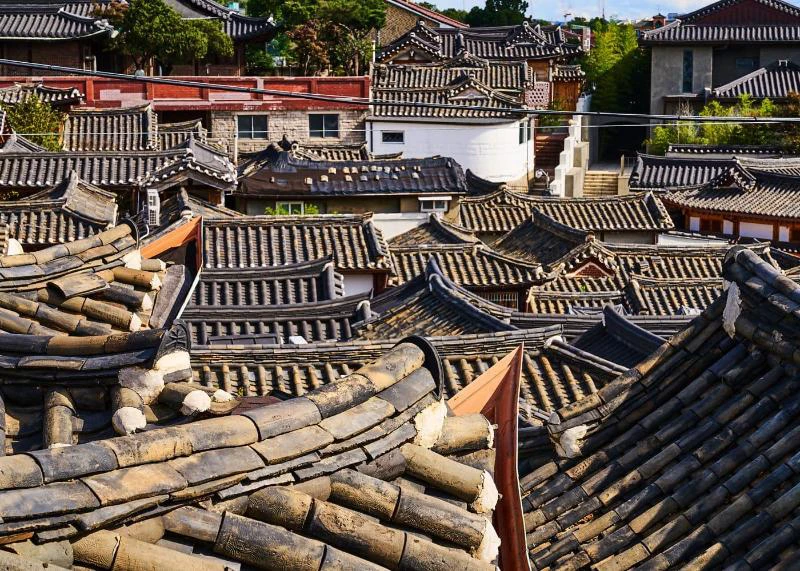
Choose Bukchon when the hanok view is the main event. Choose Seochon when you want a half-day built around food, small shops and a looser neighborhood walk. The two districts sit on opposite sides of Gyeongbokgung, but they do not deliver the same experience—and trying to squeeze both into one short block usually weakens both.
The 30-second decision
Pick Bukchon if:
- the classic uphill lane and layered hanok roofs are your first priority;
- you will continue to Changdeokgung, Samcheong-dong, Insadong or Ikseon-dong;
- slopes and a more concentrated visitor flow are acceptable;
- you can enter the protected residential Red Zone only between 10:00 and 17:00 and keep the visit quiet.
Pick Seochon if:
- cafés, a market, galleries and independent shops should shape the day;
- you prefer several small scenes to one signature viewpoint;
- your route already includes Gyeongbokgung's west side, Tongin Market or Suseongdong Valley;
- you want a plan that is easier to shorten when the weather or your energy changes.
Still tied? For a first Seoul trip with one hanok-photo priority, choose Bukchon. For a relaxed half-day that remains enjoyable after the photograph, choose Seochon.
The visual difference is real
Bukchon lies between Gyeongbokgung and Changdeokgung. Its best-known slopes compress tiled roofs, walls and long sight lines into a recognizably traditional cityscape. That concentration is the reason it wins the postcard test—and the reason visitors gather around the same lanes.
Seochon lies west of Gyeongbokgung, toward Inwangsan. Hanok sit beside brick homes, older storefronts, workshops, cafés and newer design spaces. The appeal arrives in fragments: a wood gate, plants against a wall, a mountain glimpse, then a busy food street. It rewards browsing rather than chasing one frame.
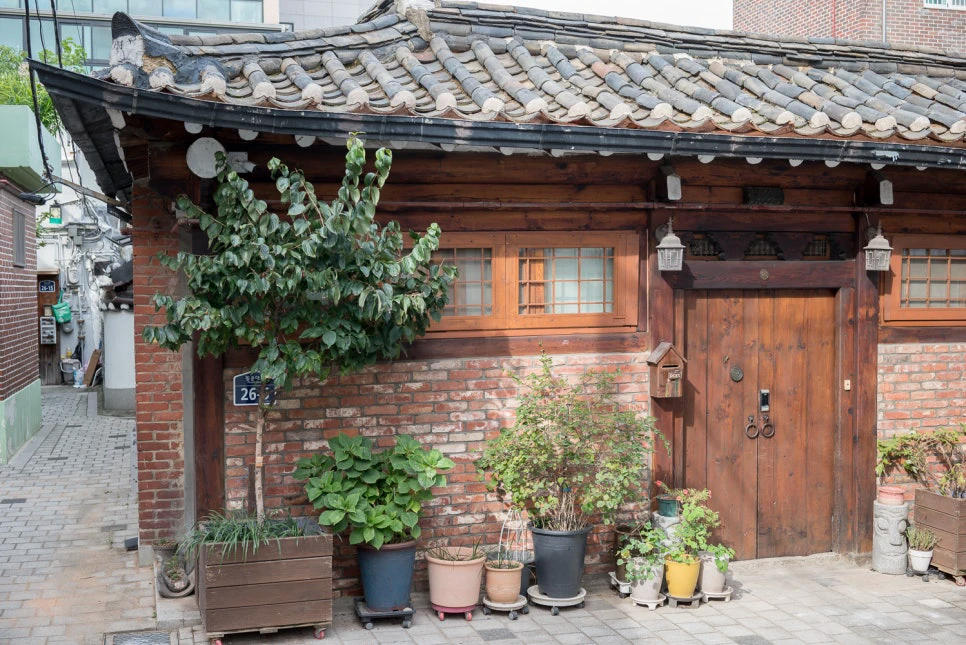
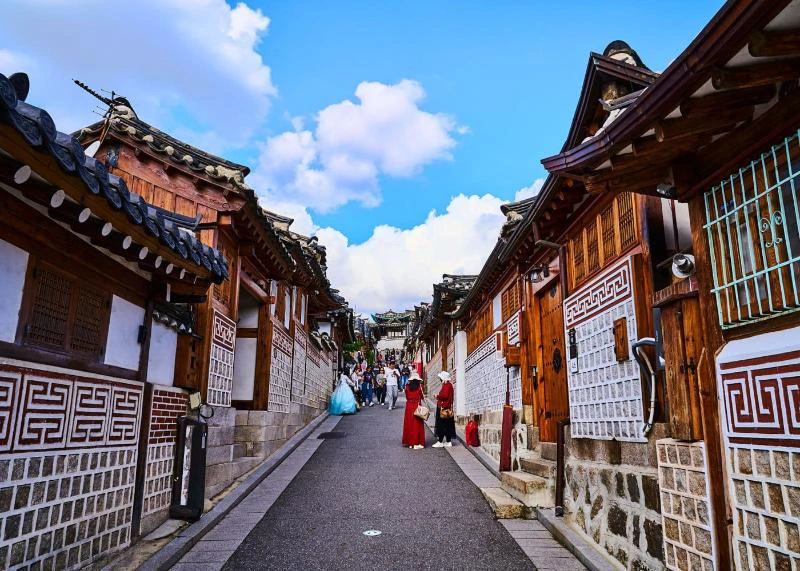
These images show the useful contrast, not every block. Seochon often places one traditional façade inside an everyday street. Bukchon more often creates an uninterrupted roof-and-wall composition. Both remain lived-in neighborhoods.
Bukchon gives the stronger hanok photograph
If the question is “Where can I see unmistakable hanok scenery in the least time?”, Bukchon is the safer answer. Elevation changes give the rooflines depth, and some lanes place modern Seoul behind the historic foreground.
The famous composition is not a set. Doors, windows and courtyards belong to residents. Photograph the public street, not the inside of an open doorway. Keep tripods, posed filming and group conversations out of narrow passages. If a sign asks visitors to move on, the photograph is finished.
Seochon suits photographers who prefer texture: old lettering, mixed materials, plants, workshop windows and changing architecture. It is less likely to produce one instantly identifiable “hanok village” image, but patient walkers get more varied details. The privacy rule is the same in both places.
Bukchon's Red Zone changes the plan
The most important difference is not subjective. Bukchon's designated Red Zone around Bukchon-ro 11-gil restricts tourist visits from 17:00 to 10:00 the following day. The area is about 34,000 m²; enforcement began on March 1, 2025, and the stated fine is KRW 100,000.
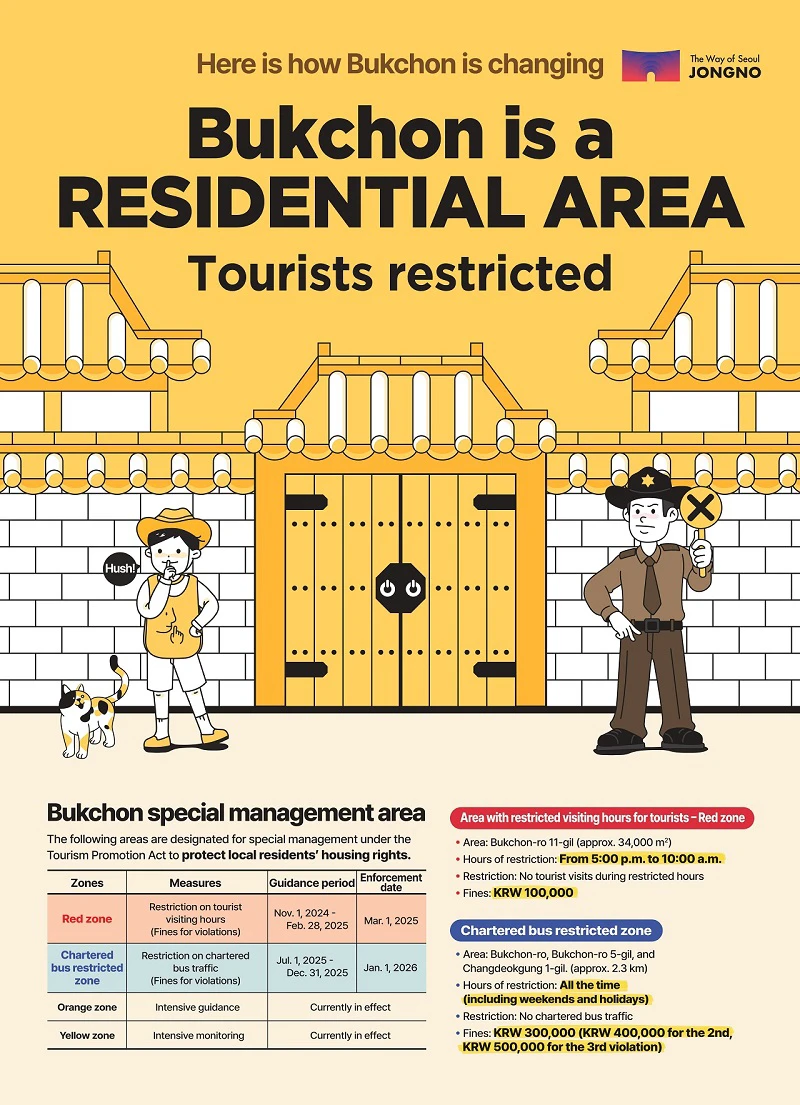
This is not a blanket curfew for every shop, museum or road in greater Bukchon. The official system also identifies Orange and Yellow zones with guidance or monitoring rather than the same visiting-hours ban. Follow the color and boundary signs on site instead of assuming the whole neighborhood has one rule.
The official material calls Sunday a “rest day” for the alleyways. Treat that as a clear request to give residents more space, not as wording that every wider-area business is legally closed. The same city notice now also lists a separate all-day chartered-bus restriction on designated roads, enforced from January 1, 2026, with its own fines. That measure affects chartered buses, not an individual traveler walking from Anguk Station.
Plan the residential lanes well inside 10:00–17:00, not at the final minute. Speak quietly, keep the group compact and avoid waiting outside a home. Seochon has no equivalent visitor-hours restriction in the official pages checked on August 12, 2026, but it also contains homes; courtesy is not optional there either.
Browsing and food favor Seochon
Bukchon has commerce, especially around Gye-dong and toward Samcheong-dong. It is simply a mistake to expect the quietest residential lane to function like a shopping street. A good Bukchon sequence separates the protected hanok walk from cafés, craft spaces and a meal on a busier road.
Seochon's shops and food feel more integrated with the walk. A lane can lead to a studio, then back to a café or older storefront without breaking the neighborhood experience. Tongin Market, Sejong Village Food Street, bakeries and small restaurants give the visit several possible anchors.
Choose Seochon when food is part of the reason for going. Choose Bukchon when the hanok walk comes first and the meal belongs afterward in Gye-dong, Samcheong-dong or Insadong. In either area, check the current hours of a specific venue; neighborhood character does not guarantee that one shop is open.
Build the rest of the day on the correct side
The palace is not a shortcut you can cross at any hour. The neighborhoods sit on opposite sides, and hills, photographs and stops make the connection slower than it looks on a map.
A practical Bukchon half-day:
- Begin near Anguk Station and enter through Gye-dong.
- Visit the designated residential lanes during permitted hours, following signs rather than a viral photo pin.
- Continue to Samcheong-dong, Changdeokgung, Insadong or Ikseon-dong for the next activity and meal.
A practical Seochon half-day:
- Begin at Gyeongbokgung Station or after visiting Gyeongbokgung's west side.
- Use Tongin Market or a chosen café as a time anchor.
- Browse the alleys at your own pace, then extend toward Suseongdong Valley only if time, daylight and walking energy allow.
Visit Seoul lists its Seochon alley walking tour at roughly three hours from Gyeongbokgung Station Exit 3. Use that as a scale, not a promise: a market meal, shopping or a valley extension makes the neighborhood a longer half-day.
If both areas matter, give each a separate half-day and use a palace visit or a proper meal as the bridge. Do not turn them into a two-hour checklist around the palace perimeter.
Slopes, heat and limited mobility
Bukchon's signature views require slopes and narrow residential lanes. A short distance can feel longer in summer heat, rain, ice or a crowd. Seochon is easier to adapt into a mostly level browse near main streets, but its inner alleys are also uneven and some venues have steps.
For limited mobility, choose exact venues first and verify their step-free entrances individually. A taxi drop near one point does not make the entire hanok area accessible, and chartered-bus restrictions do not imply a public accessibility shuttle. In poor weather, Seochon generally offers more ways to trade outdoor walking for cafés, shops and a meal without losing the purpose of the visit.
Final choice by traveler type
- One traditional-neighborhood slot on a first trip: Bukchon, unless crowds or slopes will dominate the experience.
- Slow traveler or repeat visitor: Seochon.
- Hanok roofline photography: Bukchon.
- Street detail and mixed architecture photography: Seochon.
- Food-led afternoon: Seochon.
- Changdeokgung–Insadong day: Bukchon.
- Gyeongbokgung–market–café day: Seochon.
- Need maximum flexibility for weather or energy: Seochon.
Bukchon is not a theme park, and Seochon is not a weaker hanok village. Bukchon offers a concentrated heritage landscape under real resident-protection pressure. Seochon offers a broader urban neighborhood where heritage, food and daily life overlap. Choose the day you actually want, then leave enough time—and enough space for residents—for that choice to work.
Sources and image credits
- Seochon hanok body image — Delivery Spot asset from the frozen English guide, illustrating a mixed residential lane.
- Bukchon lane body image — Delivery Spot asset from the frozen English guide, illustrating a concentrated hanok view.
- Bukchon management-area poster asset — official visitor-rule poster reproduced in the frozen guide.
- Seoul Metropolitan Government: Bukchon visitor restrictions — Red, Orange and Yellow zones; Red Zone hours, boundary, enforcement and fine; Sunday request; and the separate chartered-bus rule. Rechecked August 12, 2026.
- Visit Seoul: Bukchon Hanok Village — official residential character, etiquette, attractions and location; direct page was blocked by its web firewall during the August 12 recheck, so no unverified live venue detail was added.
- Visit Seoul: A Spring Day in Seochon — official description of Seochon's alleys, creative spaces and shops; URL preserved from the English master, with direct retrieval blocked during the August 12 recheck.
- Visit Seoul: Walk Along Seochon's Old Alleys — official route scale, start and cultural context; URL preserved from the English master, with direct retrieval blocked during the August 12 recheck.
- Visit Seoul: The Hidden Charm of Gye-dong — official examples of shops, food and craft spaces on the Bukchon side; frozen-source context retained.
- Reddit r/koreatravel: Seochon vs Bukchon discussion — traveler perspective on geography, crowds and preferences only; not used as an operating-rule source.
- Cover image asset — Delivery Spot cover showing layered Bukchon hanok roofs; attribution retained from the frozen English guide.
Last updated


