
How Many Parasite-Style Banjiha Homes Remain in Seoul?
The latest census counted 245,194 Seoul households living in basement or semi-basement spaces. See what that number means, why flood risk varies by address, and how the phase-out works.
They have not disappeared. The latest official count found 245,194 general households in Seoul living in basement or semi-basement spaces as of November 1, 2024. That was 5.9% of the city’s general households—roughly one in 17.
This is the newest full census snapshot, not a live August 2026 counter. It nevertheless answers the main question: despite the global image created by Parasite and Seoul’s phase-out policy, banjiha housing remains a large part of the city’s low-rise rental stock.
What the current number actually counts
Banjiha (반지하) is the everyday word for a semi-basement. Official statistics use the combined category basement or semi-basement—written (반)지하—so the figure is broader than rooms that look exactly like the film set. Under the current Building Act definition, a basement floor has its floor below ground and an average floor-to-ground depth of at least half the story height. A unit can therefore have a window at sidewalk level and still belong to the official basement category.
The 2024 register-based Population and Housing Census reports two different Seoul measures:
- 148,224 homes had a basement or semi-basement used for residence.
- 245,194 households were living in a basement or semi-basement space.
The two measures use different statistical units: “homes” and “households.” One low-rise property can contain more than one household. Use the household figure when asking how many households still live below street level; do not present it as 245,194 separate buildings.
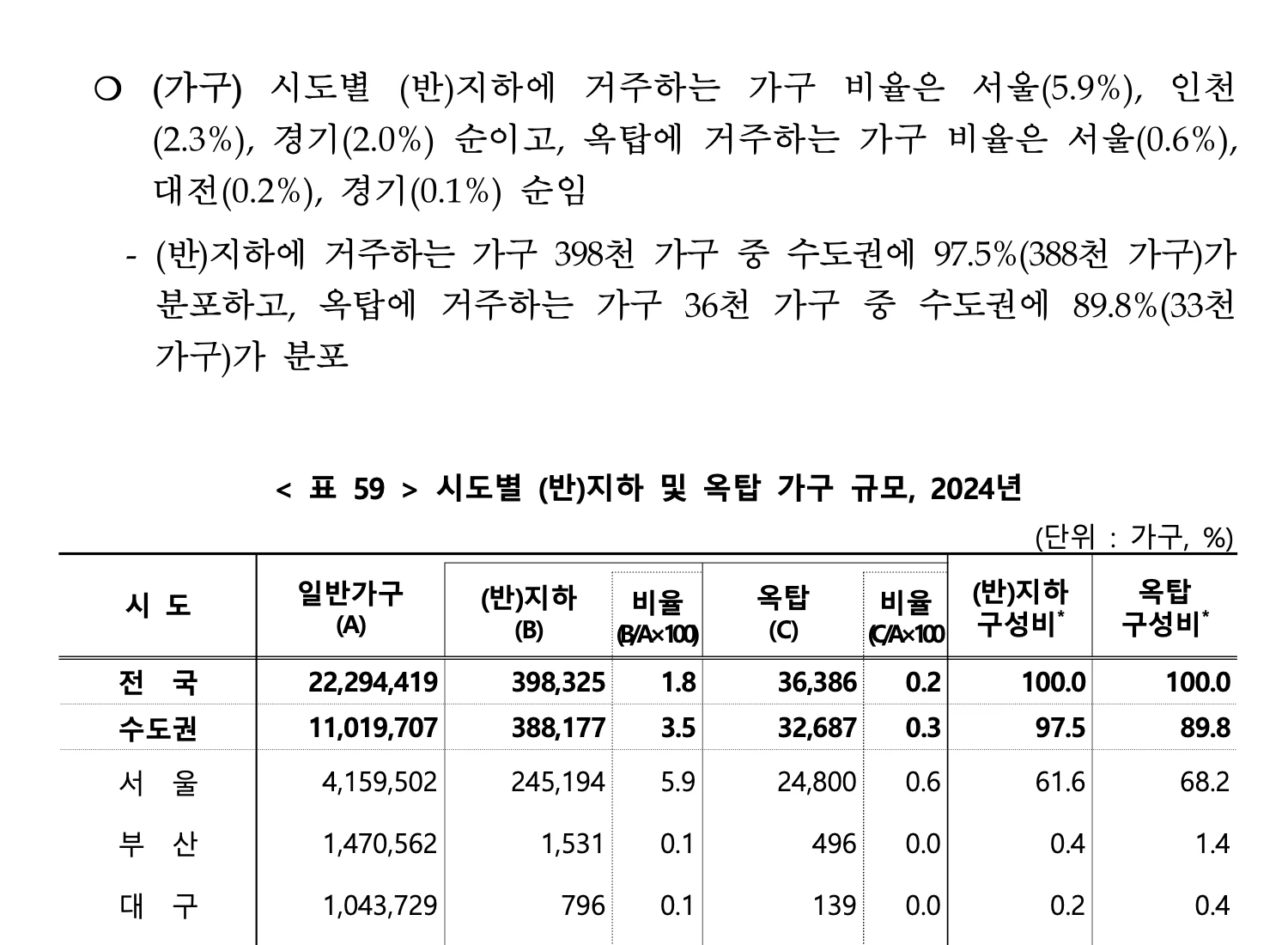
Seoul accounted for 61.6% of Korea’s basement and semi-basement households. The concentration is uneven: the same census counted 29,481 in Gwanak-gu, followed by 17,539 in Jungnang-gu and 17,353 in Gwangjin-gu. That does not mean every unit in those districts has equal risk. Street slope, drainage, building age, window position, flood history, and escape design matter at the exact address.
Parasite captured real problems, not one standard floor plan
The film made the low window, street view, dampness, and sudden flood legible to viewers around the world. Real banjiha units range from tiny dark rooms to renovated spaces with larger windows and a sloped site. The category alone cannot tell you the room size, rent, daylight, or whether water has entered before.
Resident accounts are similarly mixed. In a 2024 Living in Korea discussion, one former resident said three years passed without flooding or major humidity but described street-level privacy as a serious drawback. In a 2025 discussion, other commenters reported darkness, pests, sewer problems, or fear of summer flooding. These are anecdotes, not a citywide sample. Their disagreement is a reason to inspect the exact unit, not proof that the danger is either universal or imaginary.
Flood risk must be checked address by address
A semi-basement is structurally more exposed when runoff rises above the window or door, a drain backs up, or the only exit becomes blocked. A water barrier can delay inflow, and a backflow valve or openable security window can improve safety, but no device turns a low-lying unit into a guaranteed refuge during extreme rain.
In its July 2024 safety update, Seoul said it had surveyed about 230,000 semi-basement units and was closely managing about 28,000 that needed flood-prevention equipment. Among households that consented, it had completed 15,259 water-blocking installations and 5,108 escape installations. The city’s June 2026 field inspection shows that the risk is still actively managed: Seoul was checking barriers in low-lying Gwanak neighborhoods, expanding radar water-level sensors to 45 sites, and operating roughly 2,000 evacuation partners for vulnerable residents.
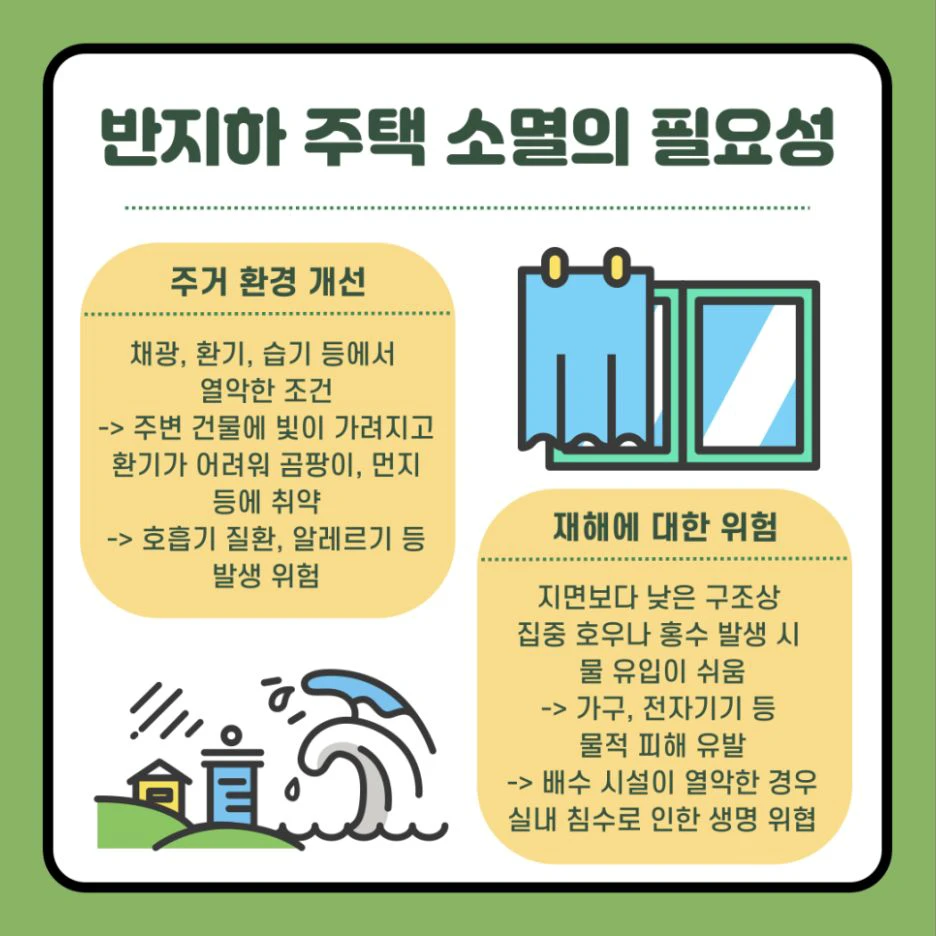
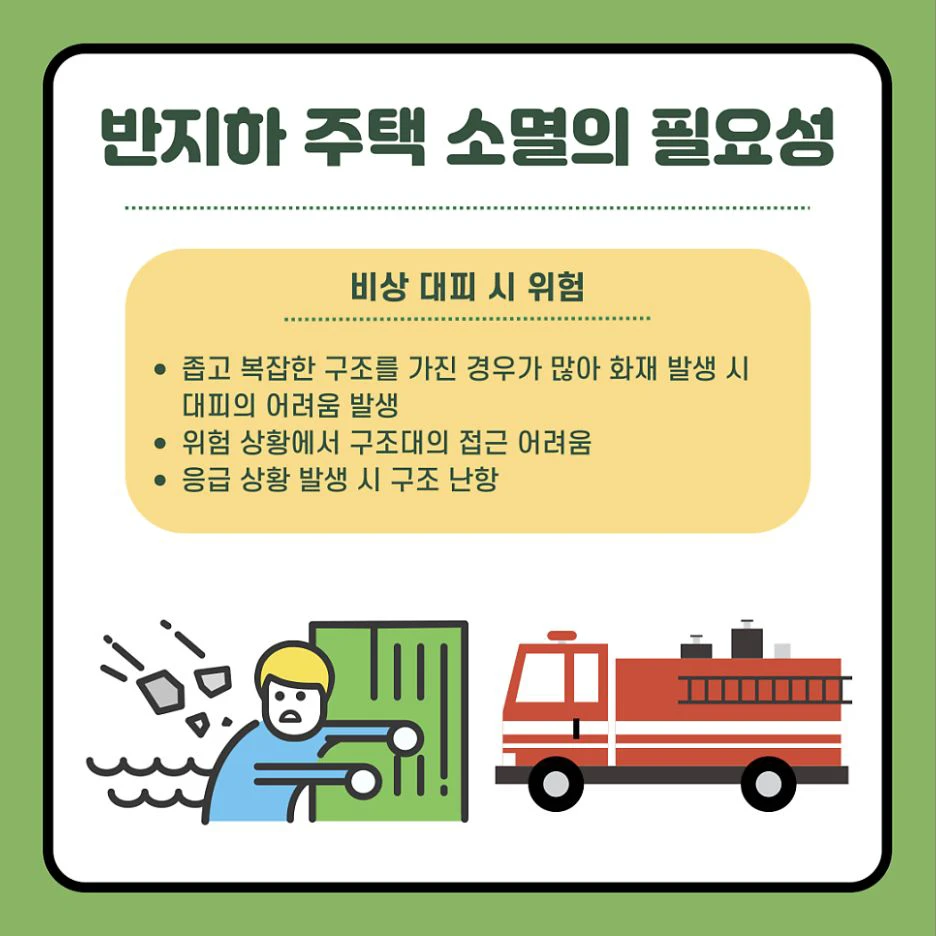
The two SH cards below summarize why policy focuses on both the room itself and escape: limited light and ventilation can worsen dampness, while flood or fire can make a complicated exit dangerous.
Before renting or renewing, check more than whether a barrier is visible:
- Ask the owner and broker in writing about past flooding, drain backflow, repairs, and insurance claims.
- Visit after rain. Look and smell for dampness, fresh paint over tide marks, swollen flooring, mold behind furniture, and a persistent sewer odor.
- Trace the fastest exit. Confirm that security bars open from inside and that furniture, parked vehicles, or storage cannot block the route.
- Identify the barrier, backflow valve, pump, alarm, or emergency bell and ask who tests each device.
- Plan where to go before a heavy-rain alert. Seoul’s current flood guidance says to evacuate immediately if water enters a basement space or sewage begins to flow backward; do not wait to protect belongings. Current alerts and safety information are available through Seoul Safety Nuri.
For a short stay, do the same checks rather than assuming a booking platform screened the flood history. If the host cannot explain the exit and rain plan, choose an above-ground room.
The phase-out is gradual, not an overnight ban
After the fatal 2022 floods, Seoul announced a long-term goal of ending residential use of semi-basements. The working policy is not to empty every unit on one date. It combines public purchase, conversion to non-residential community uses, redevelopment, public-rental moves, rent support, repairs, and flood or escape equipment for people who remain. The city’s 2024 update explicitly described reduction through purchases and neighborhood renewal as gradual.
The current Seoul semi-basement relocation voucher illustrates both the help and the limits. Eligible households that lived in a Seoul semi-basement on August 9, 2022 and moved above ground after August 10 can receive ₩200,000 per month for up to 72 months, subject to income and other exclusions. Someone who newly moved into a semi-basement after that date is excluded. Do not sign a new lease expecting this program to pay for a later move.
The scale also explains why removal takes time. A city cannot erase housing used by nearly a quarter-million households without enough affordable replacements, willing residents, owner cooperation, and viable purchase or redevelopment projects. Safety improvements support current residents while the gradual phase-out proceeds.
Should you rent a banjiha now?
Low rent or a useful location may make a well-maintained unit attractive, but the discount must be weighed against light, ventilation, privacy, mold, pests, sewer backflow, and evacuation risk. A dry unit high on a slope with large openable windows and no flood history can be more livable than a poorly maintained one in a street depression. It is still not equivalent to an above-ground room during extreme rain.
Walk away if there is a history of flooding, a fixed or blocked window, no credible alternate exit, persistent dampness, unexplained fresh repairs near floor level, or vague answers about drainage and barriers. The current census shows why Parasite still feels contemporary: banjiha is not a vanished cinematic relic. It is a large, varied housing category being reduced slowly while real households continue to make high-stakes trade-offs inside it.
Sources and image credits
- Korean Building Act basement-floor definition — Legal definition behind the combined basement or semi-basement category.
- 2024 Population and Housing Census — Seoul home and household counts, 5.9% share, national concentration, and district figures.
- Living in Korea 2024 discussion — One former resident’s privacy and flooding experience; anecdotal, not citywide evidence.
- Living in Korea 2025 discussion — Individual darkness, pest, sewer, and flood reports; not a representative sample.
- Seoul July 2024 safety update — Survey scale, equipment counts, installations, and the gradual phase-out.
- Seoul June 2026 field inspection — Barrier checks, water-level sensors, and evacuation partners.
- Seoul flood action guide — Official instruction to leave when water enters or sewage flows backward.
- Seoul Safety Nuri — Current Seoul alerts and safety information.
- Seoul semi-basement relocation voucher — Eligibility date, ₩200,000 monthly support, up-to-72-month duration, and exclusions.
- Seoul Housing & Communities Corporation Naver Blog — Phase-out and risk graphics, used with standing operator permission.
- Delivery Spot featured image file — Cropped SH phase-out graphic used as the cover.
- Delivery Spot census-table image file — Official 2024 table crop with data unchanged.
- Delivery Spot environmental-risk card file — SH card on light, ventilation, flood, and drainage.
- Delivery Spot evacuation-risk card file — SH card on fire and emergency-exit difficulty.
Last updated


