
Can You Really Live in a Goshiwon for One Month?
A goshiwon can work for one month, but verify the exact room, total fees, noise, shared systems, fire route, address documents and refund terms before paying.
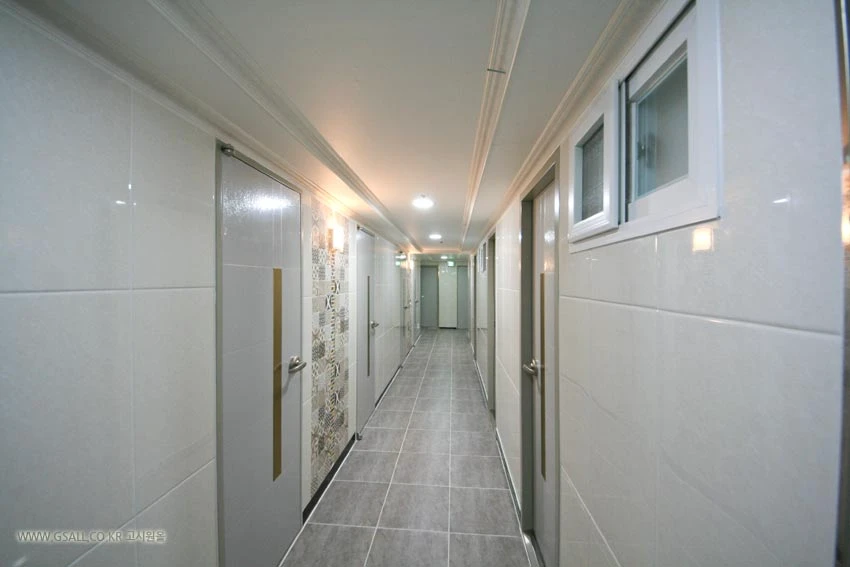
Yes. A one-month stay is one of the most realistic ways to use a goshiwon. Many operators rent by the month, rooms are furnished, and you can often move in without the large housing deposit expected for a Seoul studio. The catch is that you are buying flexibility and a low upfront cost by accepting very little private space, limited sound insulation, and building conditions that vary enormously.
A good goshiwon can be a practical landing pad while you study, start a job, or search for a longer lease. A bad one can turn thirty days into a test of sleep, hygiene, and patience. The name alone tells you almost nothing about which version you found.
What a goshiwon actually is
A goshiwon (고시원) is a building or floor divided into small single-occupancy rooms, usually with some shared facilities. The word comes from the rooms once used by people studying for difficult examinations. Seoul’s official 2019 goshiwon housing-standard announcement describes the old model bluntly: one-pyeong study rooms clustered along a narrow corridor, often with a shared kitchen and toilet. It also explains how the facilities became housing for a much wider group of people.
Today the label covers several levels of accommodation:
- an old room with little more than a bed and desk, with bathrooms shared by the floor;
- a goshi-tel or one-room-tel with a private shower or toilet, a refrigerator, and air conditioning;
- a women-only or men-only floor; and
- a renovated premium room that begins to resemble a tiny studio or co-living unit.
These are marketing descriptions, not reliable quality grades. One building may call a 6-square-meter room a premium one-room; another may provide a genuinely comfortable exterior window and private bathroom. Ask for the exact room number and inspect that room, not a model room or the best photographs in the gallery.
Why one month is possible when apartments want longer contracts
A conventional Korean studio normally involves a housing lease, a significant refundable deposit, brokerage, and a longer commitment. A goshiwon operator usually controls many furnished rooms and sells occupancy as a simpler monthly service. That makes quick move-in and short extensions easier.
When checked on August 12, 2026, the Modern House listing on Goshipages published daily and monthly options for individual rooms and distinguished a smaller inner-window room from a larger exterior-window room. It is one time-stamped commercial example, not a current-availability or market-wide price promise, but it shows the format clearly: choose a room type, pay for the period, and use furniture and shared systems already in place.
“No deposit” also needs translation. It often means no large jeonse- or wolse-style housing deposit. An operator may still ask for a reservation payment, key deposit, cleaning charge, or advance rent. Before transferring money, write down the total due, what is refundable, the cancellation deadline, the move-out notice period, and the amount returned if the actual room differs from the promised room.
The room can range from efficient to exhausting
The two photographs below show why reviews of goshiwons sound contradictory. The first is a compact, renovated private room with a bed, desk, refrigerator, air conditioner, and windows. The second is an older lived-in room photographed by Yonhap News when Seoul announced its housing standards. Both fit under the same broad label, but they offer very different amounts of usable floor, storage, daylight, and psychological breathing room.
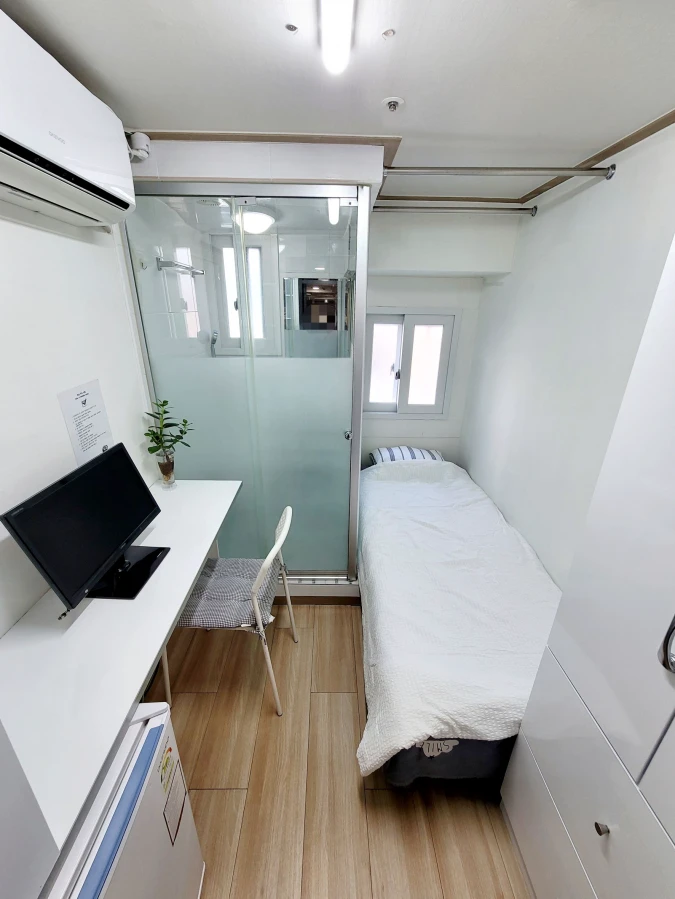
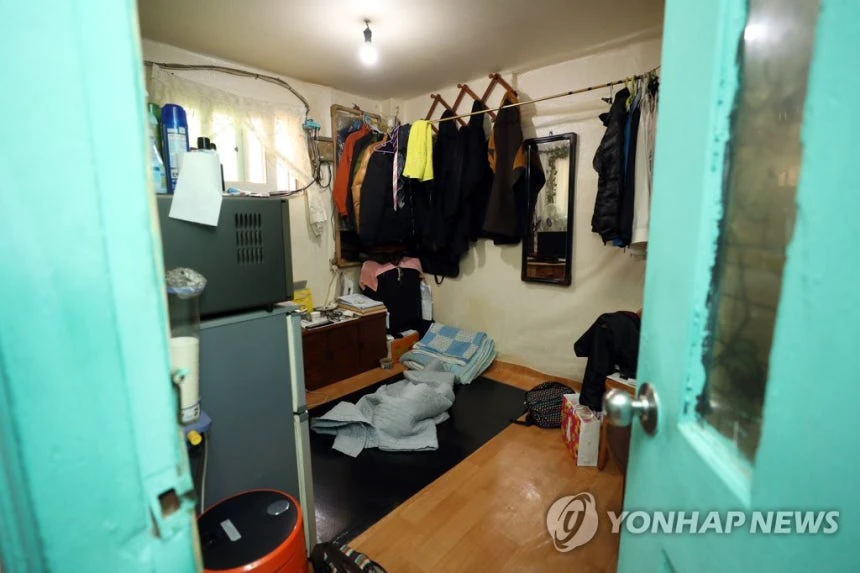
For a month, the measurements matter more than the adjective in the listing. Ask for the room’s exclusive-use area in square meters. Check whether the bathroom is inside the quoted area, whether the window faces outdoors or only an interior corridor, and whether you can open a suitcase without blocking the door. A wide-angle phone camera can make a room look almost twice as generous as it feels in person.
Do a simple movement test during a viewing: enter with a backpack, close the door, sit at the desk, open the refrigerator, reach the storage, and walk to the bathroom. If two of those actions cannot happen without moving a chair or luggage, that friction will repeat every day.
What the low monthly price usually buys
The appeal is real. The room is normally furnished, so you avoid buying a bed, desk, refrigerator, and basic storage for a temporary stay. Wi-Fi, water, heating, electricity, rice, kimchi, laundry machines, or detergent may be included. The location can also be excellent: university districts and employment centers have many facilities within walking distance of transit.
But none of those inclusions is universal. Ask which utilities have a cap, whether air conditioning is individual or centrally scheduled, whether food is replenished, whether laundry use is free, and whether there is a separate management fee. A room that looks cheapest can cost more after electricity, bedding, cleaning, and a nonrefundable reservation payment.
Shared facilities also create shared dependencies. One blocked shower drain, broken washer, crowded kitchen, or resident who ignores quiet hours affects everyone. Inspect the bathroom at the time you would normally use it. Look at ventilation, mold around silicone seals, hot-water pressure, trash storage, food labeling, refrigerator space, and the cleaning schedule.
Fire safety is part of the room decision
Do not evaluate safety from a listing checkbox. Stand inside the actual room, close the door, and trace the escape route to the outside. The narrow corridor below is from a Seoul goshiwon photographed by JoongAng. It shows why a clear path, working lights, and an exit you can reach in smoke matter as much as the room décor.
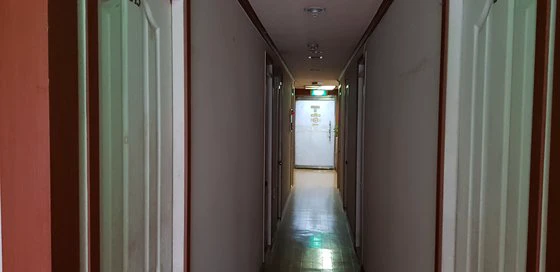
Seoul’s official fire-vulnerable building program specifically included goshiwons among multi-use facilities where a fire can cause many casualties. The city’s measures discussed sprinklers and replacing combustible exterior materials, while its earlier housing program also emphasized evacuation facilities.
Before paying, check for:
- a sprinkler head and smoke detector in the room;
- extinguishers, alarms, and illuminated exit signs in the corridor;
- doors and passages that are not blocked by shoes, boxes, or furniture;
- the actual evacuation route; an exterior window can help light and ventilation but is not, by itself, proof of a safe escape option;
- posted emergency instructions you can understand; and
- a manager who answers safety questions directly rather than saying “everything is fine.”
Seoul’s rules changed conditions for new construction and certain building work, but that does not mean every older room was rebuilt. A 2022 JoongAng report carried by Naver News explains that Seoul’s ordinance required at least 7 square meters and an exterior window for goshiwon rooms affected by new construction, extension, major repair, or change of use from that July, with more area when a toilet is inside. Treat those figures as a rule for the covered work—not proof that an existing room in an old building meets the same standard.
Noise is the everyday risk people underestimate
A room can be clean and still be impossible for you to sleep in. Thin partitions transmit door slams, phone calls, alarms, showers, and footsteps. An exterior window can improve light and ventilation while also bringing bar, traffic, delivery, or construction noise. An inner room may be quieter from the street but darker and harder to ventilate.
A detailed Living in Korea Reddit discussion about goshiwon noise shows the range of lived experience. Some commenters found a few months manageable or quiet; others said one month was depressing or that they could hear tiny sounds next door. These are anecdotes, not a scientific sample, but the disagreement proves that the specific building, room position, neighbors, and personal sensitivity matter.
Visit after work hours if possible. Pause in the room without talking or running the fan. Listen for the street, adjacent televisions, doors, water pipes, and the laundry area. Ask what sits above, below, and beside the room. Earplugs can help; they cannot fix a room beside a late-night restaurant or a corridor where doors slam every few minutes.
Can you register the address?
Sometimes, but never assume it from the word goshiwon. If you need the room as your official place of stay, ask the operator this exact question before paying: “Will you provide a written occupancy agreement, payment receipt, and the residence confirmation required for this exact room and period?”
A vague promise that “foreigners stay here” is not enough. The document needed can depend on whether you are registering for the first time, reporting a change of stay, handling a Korean resident-registration matter, or satisfying a school or employer. Confirm the current requirement with your university office, local authority, or the Immigration Contact Center at 1345 before you reserve. If the operator refuses to put the address and room in writing, choose a place that will.
How to reserve without creating a new problem
Direct payment to an operator is common, but speed should not replace basic verification. Use this sequence:
- Confirm the business and location. Match the name, phone number, street address, and map listing.
- Demand proof of the exact room. Ask for a live video call or a new video showing the room number, window view, bathroom, ceiling, and door.
- Get the terms in writing. Record dates, total price, included utilities, fees, refund rules, and move-out notice.
- Verify the recipient. Ask why the account holder’s name matches—or does not match—the operator or manager.
- Keep the payment trail. Save messages, the listing, receipt, bank record, and manager’s identity.
- Inspect before paying the full balance when possible. A small reservation payment limits exposure; an irreversible full transfer based only on old photos does not.
Do not send money merely because a place appears on Naver Map. A map entry confirms that a location is known, not that the person messaging you controls the room or will honor a refund.
A one-month viewing checklist
For a stay this short, prioritize problems that will affect every day:
- Sleep: wall noise, street noise, mattress, curtain, and quiet-hour enforcement.
- Air: exterior window, ventilation fan, odors, mold, and air-conditioning rules.
- Bathroom: private or shared, hot water, drainage, hooks, and cleaning.
- Storage: suitcase position, hanging space, shoe storage, and refrigerator capacity.
- Connectivity: test Wi-Fi in the exact room and mobile reception with the door closed.
- Safety: detector, sprinkler, corridor, exits, locks, CCTV coverage, and manager presence.
- Administration: written receipt, address documents, mail handling, and any visitor rule.
- Money: every fee, refund timing, extension price, and notice required to leave.
Photograph the room on move-in day, including stains, broken fixtures, mattress condition, and items supplied. Report problems in writing immediately. That protects you from disputes and creates a timestamp if the manager promises a repair.
Who can make it work
A goshiwon makes sense for a light packer who needs a central base, spends much of the day outside, can tolerate shared living, and values a low upfront cost more than private space. It is especially useful as temporary housing while you inspect longer-term homes in person.
It is a poor fit if you work from home, cook heavily, travel with large luggage, need reliable silence, feel distressed in windowless spaces, or require a partner or guests. Most rooms are designed for one person. Paying slightly more for an exterior window, private bathroom, wider floor, or professionally managed building can change the entire month.
The honest answer
You really can live in a goshiwon for a month, and many people do. The arrangement solves a specific Seoul housing problem: it replaces a large deposit, furniture purchase, and long lease with a furnished micro-room and simple monthly payment.
The bargain is only good if the room lets you sleep, breathe, wash, leave safely, and complete any address paperwork you need. Verify the exact room, visit at a noisy hour, trace the fire exit, read every refund term, and get documents before transferring money. For one month, a carefully chosen goshiwon can be an efficient bridge. An unseen bargain room can be thirty very long nights.
Photo credits
- Featured modern goshiwon corridor and compact private room: Modern House via Goshipages.
- Older lived-in goshiwon room: Park Dong-ju and Yonhap News via Naver News.
- Narrow Seoul goshiwon corridor: JoongAng Photo via Naver News.
Sources and image credits
- Seoul's 2019 goshiwon housing-standard announcement — Historical housing context and safety direction, not proof of a specific room
- Modern House listing — Commercial example of room and stay formats; not a market-wide price or availability promise
- Hosted renovated room image — Modern House via Goshipages
- Hosted older lived-in room image — Park Dong-ju/Yonhap News via Naver News
- Hosted older corridor image — JoongAng Photo via Naver News
- Seoul fire-vulnerable building program — Official fire-safety context
- 2022 JoongAng report on the Seoul ordinance — Historical covered-work standard; not proof that every old room meets it
- Living in Korea noise discussion — Individual experiences, not a representative sample
- Yonhap report carrying the older-room photograph — Original image context
- Hosted modern-corridor cover — Modern House via Goshipages
Last updated


