
How Many K-pop Trainees Actually Debut?
There is no honest single debut rate for K-pop trainees. KOCCA's 63.3% agency estimate, Boys Planet's 9 of 98, and a 120,000-entry global audition measure different groups.

There is no trustworthy single percentage for the chance a K-pop trainee debuts. The available numbers measure different stages: public submissions, signed trainees, television contestants, and actual debut releases.
The most useful current official figure is a 63.3% average reported by agencies with trainees, but it is not a person-by-person K-pop success rate. A survival show can produce a much smaller or larger number simply because it starts with a different group. Before trusting any percentage, ask: 63.3% of whom, over what period, and what counted as a debut?
Start with the denominator
The phrase "debut odds" can refer to at least four different gates:
- Public applicant to audition callback. This denominator can include anyone who submits a form or video. Companies rarely publish a complete, comparable count.
- Selected applicant to affiliated trainee. Some callbacks never become trainee contracts, and some candidates enter through scouting or private auditions rather than an open call.
- Affiliated trainee to debut release. This is the stage the Korean government survey comes closest to measuring.
- Debut release to a sustainable career. Chart performance, income, contract renewal, and long-term employment are separate outcomes.
A probability from one gate cannot be applied to another. Dividing a debut lineup by all public submissions answers a different question from asking what share of signed trainees eventually release music.
What Korea's official survey actually says
The 2025 Popular Culture and Arts Industry Survey from the Korea Creative Content Agency covers 2024 industry data. It estimated that 211 planning agencies had trainees, with 963 trainees in total. Of those, 613 were singer trainees; the rest were in acting, broadcasting, or other fields.
Those agencies estimated that an average 63.3% of their affiliated trainees debut. The response distribution also matters: 43.0% of agencies placed their share below 60%, 25.4% placed it from 60% to under 90%, and 31.6% placed it at 90% or above.
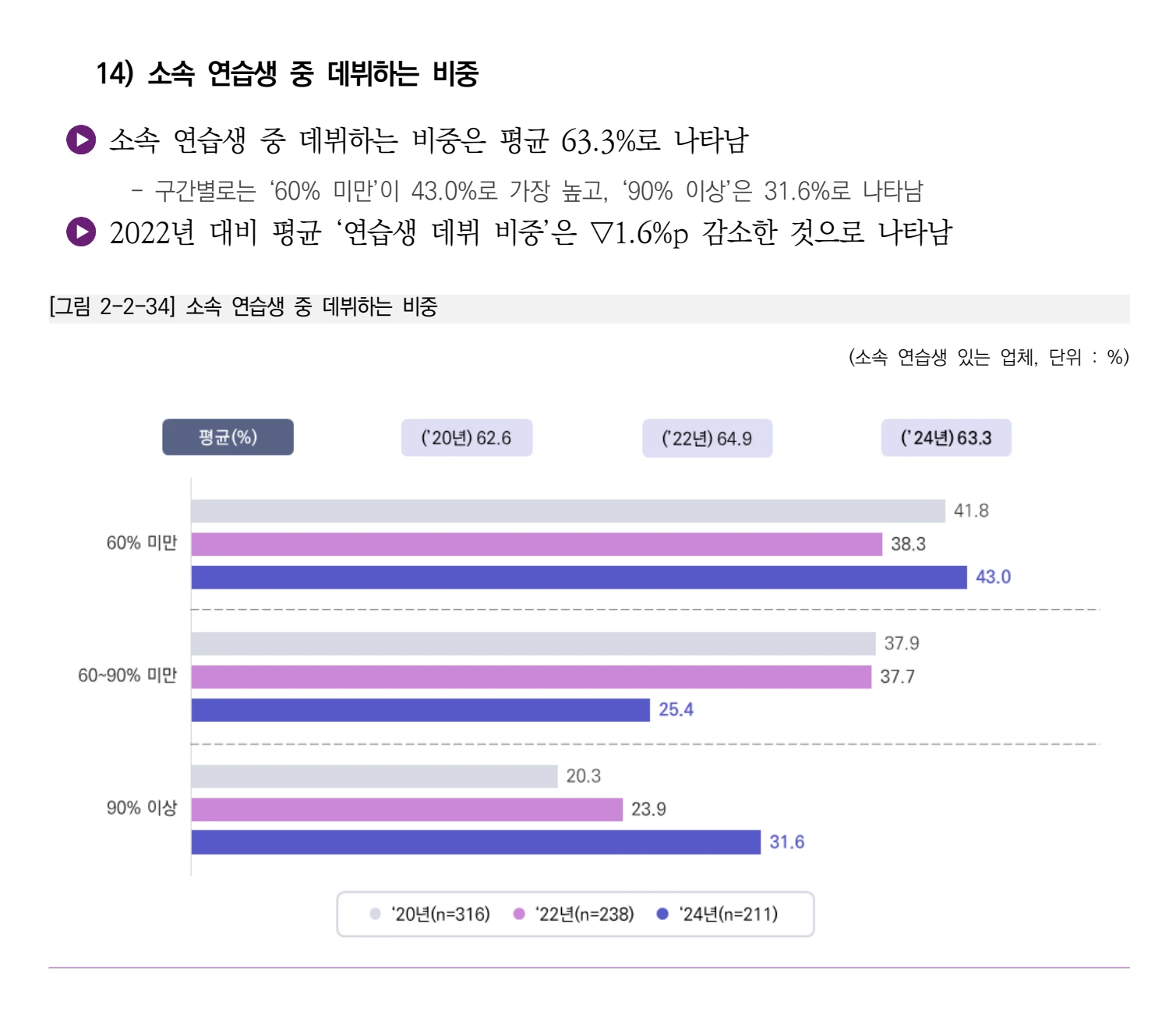
The figure is useful, but it needs four cautions. First, it is an approximate answer supplied by companies, not a longitudinal record following every person from entry to exit. Second, it averages agency responses; it does not mean each individual had a 63.3% chance. Third, the survey covers several popular-culture fields rather than K-pop singers alone. Fourth, its questionnaire defines a singer's debut as releasing a song or album. It does not require a hit, meaningful income, or a lasting career.
The same report says the trainee population fell by 207 from 2022 to 2024. That describes the estimated number affiliated at the survey point, not how many people entered and left during those two years. A stock count cannot substitute for a full cohort.
Why a survival show gives a different number
Mnet's Boys Planet started its broadcast with 98 contestants. CJ ENM's official finale release says the final debut group had nine members. That makes the televised contestant-to-lineup rate 9 out of 98, or about 9.2%.

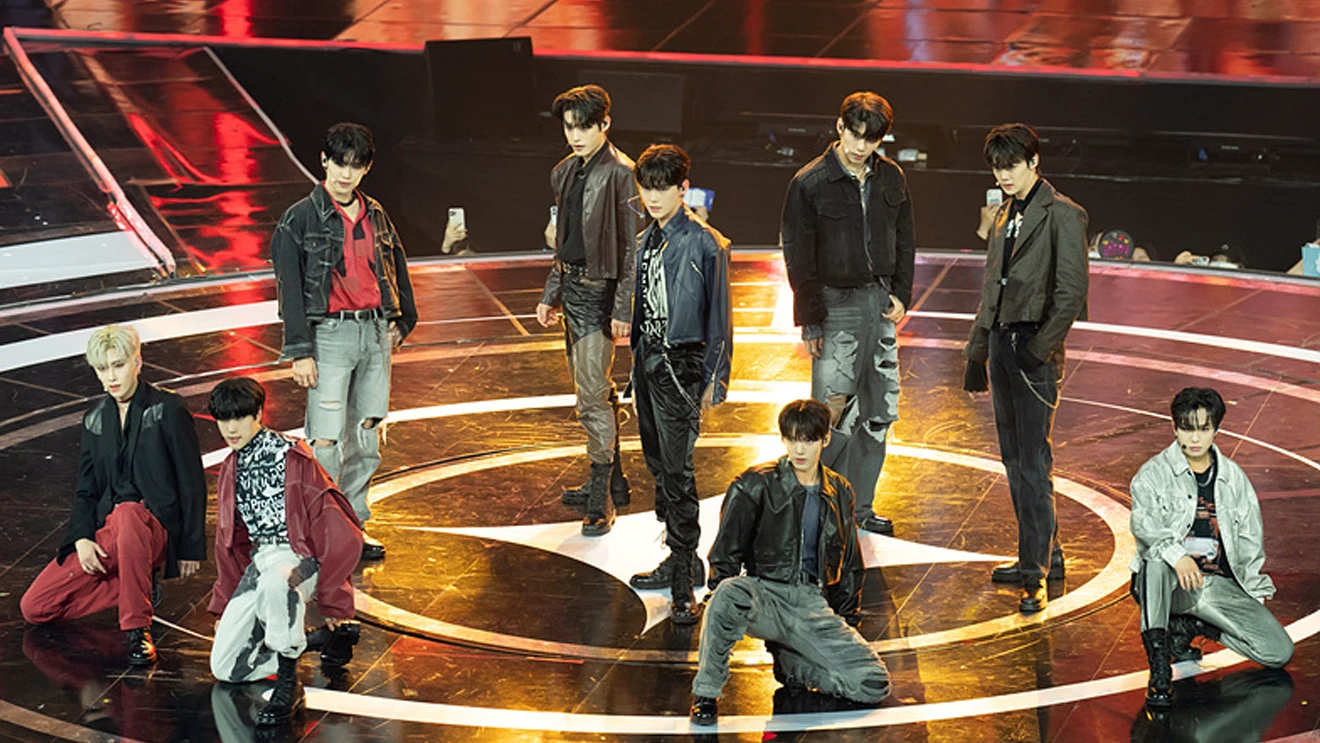
But the 98 contestants were already selected for a broadcast. The official open call allowed individual trainees, agency trainees, and previously debuted artists, so the group was not a random sample of beginners. Viewer voting, program rules, screen time, and a fixed nine-member lineup shaped the result. The 9.2% figure is accurate for that show's stated starting and ending groups; it is not an industry-wide trainee probability.
Survival programs also create a visibility illusion. Viewers see nearly every elimination inside a closed cast, while ordinary agency selection happens largely off-camera. A show makes the denominator look complete even though a much larger selection process occurred before episode one.
One project, two radically different percentages
A global HYBE x Geffen project gives the clearest denominator lesson. Netflix's official announcement says more than 120,000 submissions were narrowed to 20 contestants, from whom the six members of KATSEYE were chosen.
Using all submissions, six out of 120,000 is 0.005%. Using only the 20 selected contestants, six out of 20 is 30%. Both calculations describe the same final group, but they answer different questions. The project was a US-based global girl-group program modeled on K-pop training, so neither percentage should be presented as the Korean industry's trainee debut rate.
This is why an extremely small public-audition number and a much larger signed-trainee estimate can both be mathematically correct. They are not competing answers when their starting populations are different.
How to read any debut-odds claim
Use four checks before repeating a number:
- Who entered the denominator? Form submissions, callbacks, contracted trainees, or broadcast contestants?
- What is the time window? A single project, one year, or everyone currently affiliated?
- What counts as debut? Any released song, a named group launch, paid work, or commercial success?
- Who supplied the data? A tracked roster, an agency estimate, a media report, or an anonymous online claim?
If a post gives a precise probability without answering those questions, the precision is probably doing more work than the evidence. Company-specific odds are especially difficult to verify because public audition totals, scouting entries, repeat applications, and trainee exits are seldom published as one consistent cohort.
The honest conclusion is narrower than the headline many people want: Korea's latest official survey reports a 63.3% average agency estimate for affiliated trainees across several entertainment fields, while individual projects produce very different rates. There is no defensible universal percentage for a person who starts with a public K-pop audition, and debut itself is not the same as fame or a sustainable career.
Photo credits
- Rehearsal photo by Kazuo ota on Unsplash, used under the Unsplash License.
- KOCCA 2025 Popular Culture and Arts Industry Survey, Figure 2-2-34; used with written operator permission.
- Boys Planet full-episode listing on Mnet Plus; image courtesy of CJ ENM/Mnet and used with written operator permission.
- Boys Planet finale image from CJ ENM; used with written operator permission.
Sources and image credits
- 2025 Popular Culture and Arts Industry Survey from the Korea Creative Content Agency — Checked for guide details or image attribution.
- Boys Planet — Checked for guide details or image attribution.
- official finale release — Checked for guide details or image attribution.
- official open call — Checked for guide details or image attribution.
- Netflix's official announcement — Checked for guide details or image attribution.
- Rehearsal photo by Kazuo ota on Unsplash — Checked for guide details or image attribution.
- Boys Planet full-episode listing on Mnet Plus — Checked for guide details or image attribution.
Last updated


