
Korean Foods That Look Vegetarian but Often Aren’t
Korean dishes can hide anchovy stock, fish sauce, salted shrimp, meat broth, fish cake or egg. Use these exact questions to check the current batch.
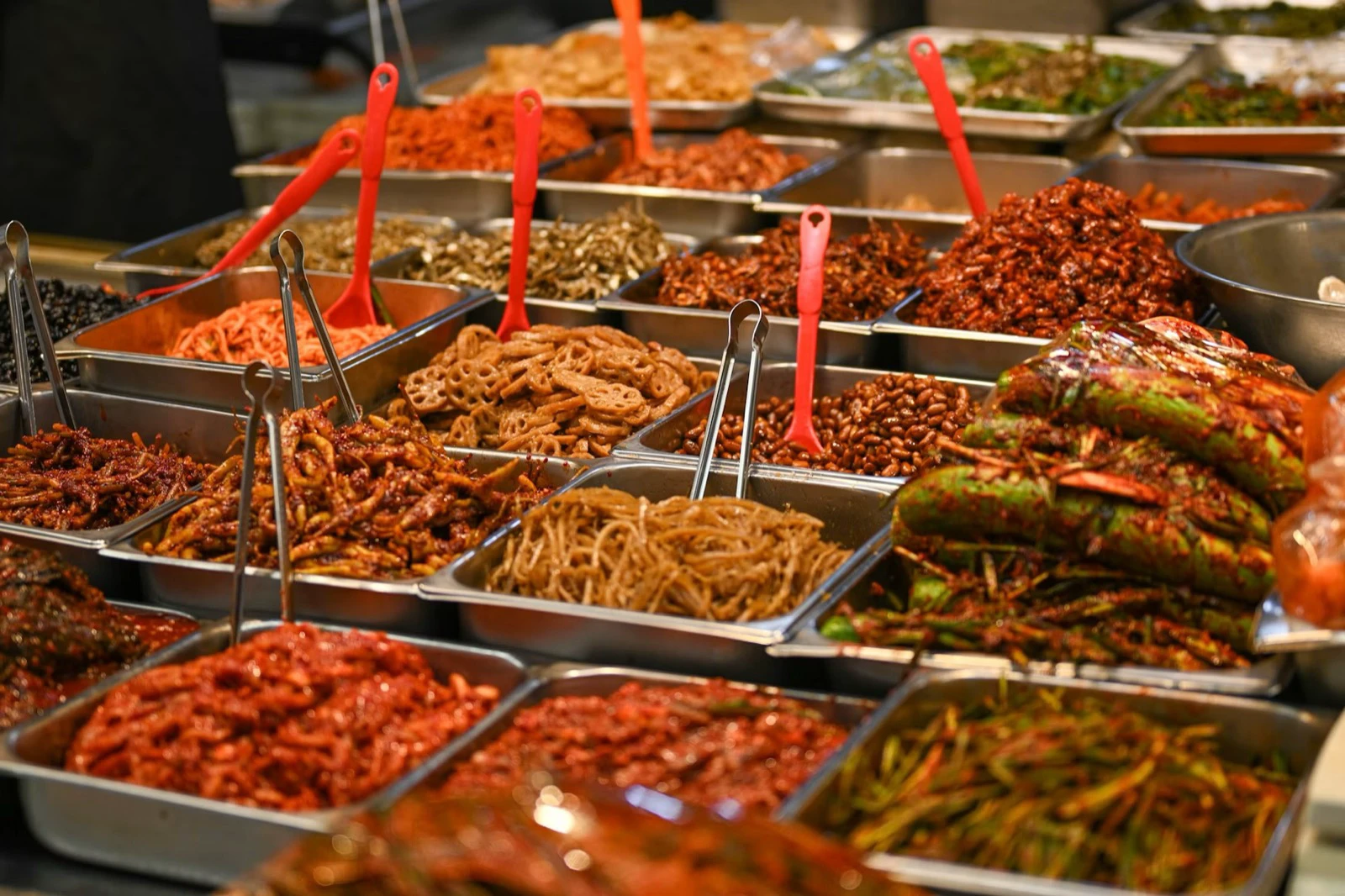
A Korean dish can look completely meat-free and still be made with anchovy stock, fish sauce, salted shrimp, meat broth, or fish cake. The useful question is not “Can I see meat?” but “What went into the stock, seasoning, and shared batch?”
In this guide, vegetarian means no meat, poultry, fish, or shellfish. Egg and dairy are separate choices, so name them too if you avoid them. A food allergy is different again: state that it is an allergy, name the allergen, and ask about shared utensils, fryers, and preparation surfaces. A restaurant that can remove a topping may still be unable to change a broth or prevent cross-contact.
The six Korean words that change the answer
- 멸치육수 (myeolchi-yuksu): stock made with dried anchovies
- 고기육수 (gogi-yuksu): meat stock; 사골육수 (sagol-yuksu) is bone broth
- 액젓 (aekjeot): fish sauce used in some kimchi and seasoned dishes
- 새우젓 (saeujeot): salted fermented shrimp used in some kimchi, stews, and seasoning
- 어묵 (eomuk): fish cake, common in tteokbokki, gimbap, and soup
- 계란 (gyeran): egg, sometimes mixed into batter or added as a topping
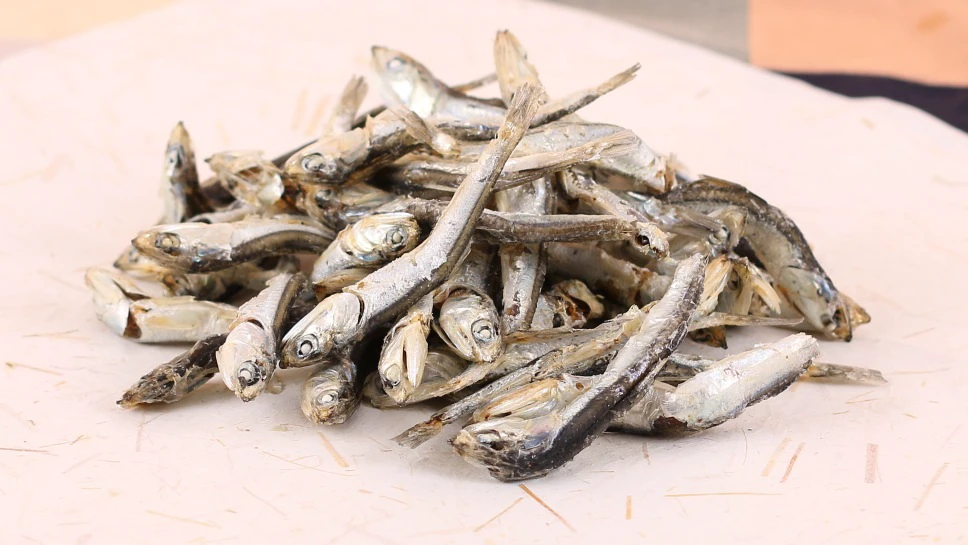
Large dried anchovies are commonly used for broth, then strained out. The finished soup may show no fish even though the base is not vegetarian. A step-by-step anchovy-and-kelp stock recipe makes the hidden step easy to see.
Foods that need one more question
Kimchi and vegetable banchan
Kimchi is not automatically vegetarian. Some batches use fish sauce, salted shrimp, seafood, or broth; others do not. The Korean Food Promotion Institute’s regional recipe collection includes anchovy fish sauce in vegetable-led burdock and chive kimchi. The main ingredient tells you very little about the seasoning.
Prepared banchan varies just as much. Namul and seasoned vegetables can be plant-based, but a server needs to check the specific tray or kitchen recipe. Do not assume every vegetable side contains fish sauce—and do not assume none does.
Tteokbokki
Rice cakes and red sauce look meat-free, but many versions begin with anchovy-kelp stock and include fish cake. A widely used classic tteokbokki recipe uses dried anchovies and kelp in the stock, with fish cake and egg among the additions. Individual shops use different recipes, so ask about this sauce batch, not tteokbokki in general.
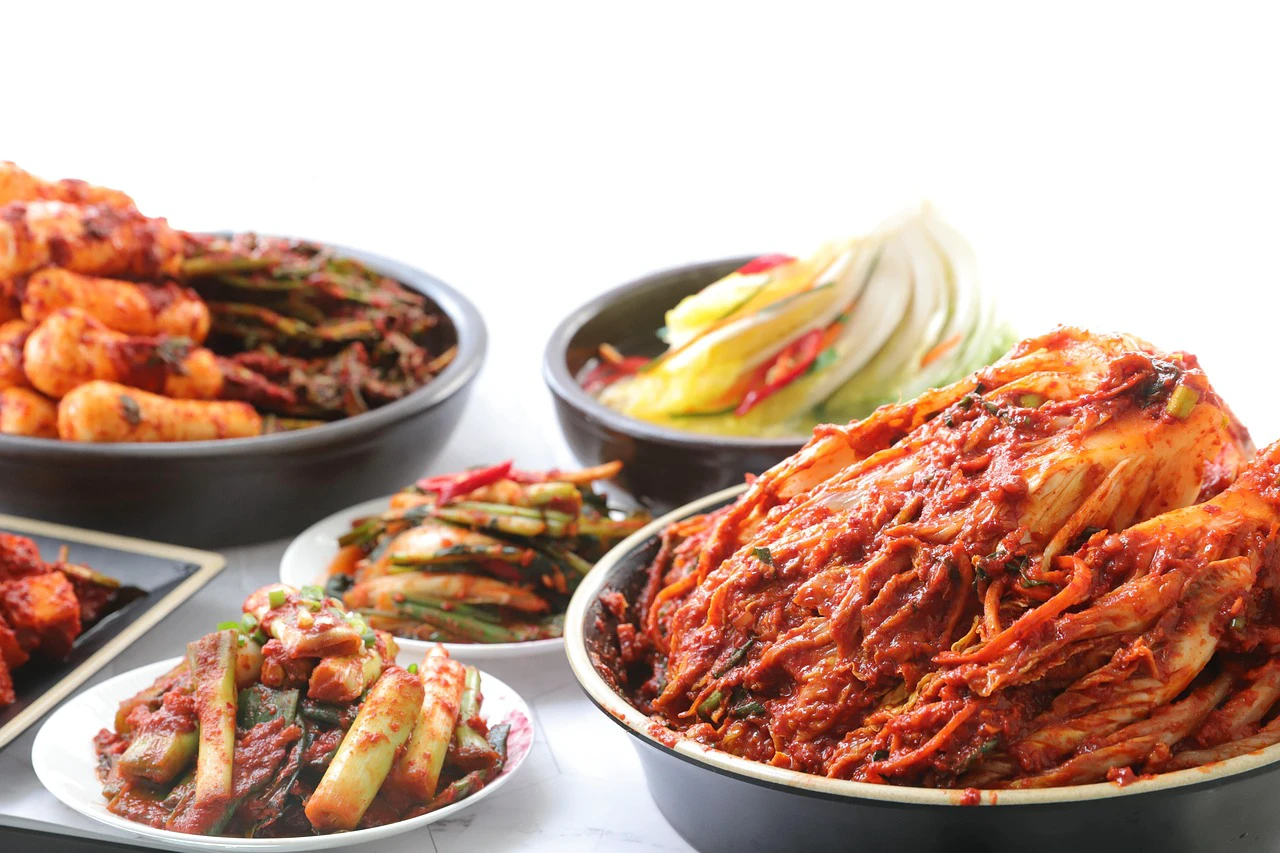
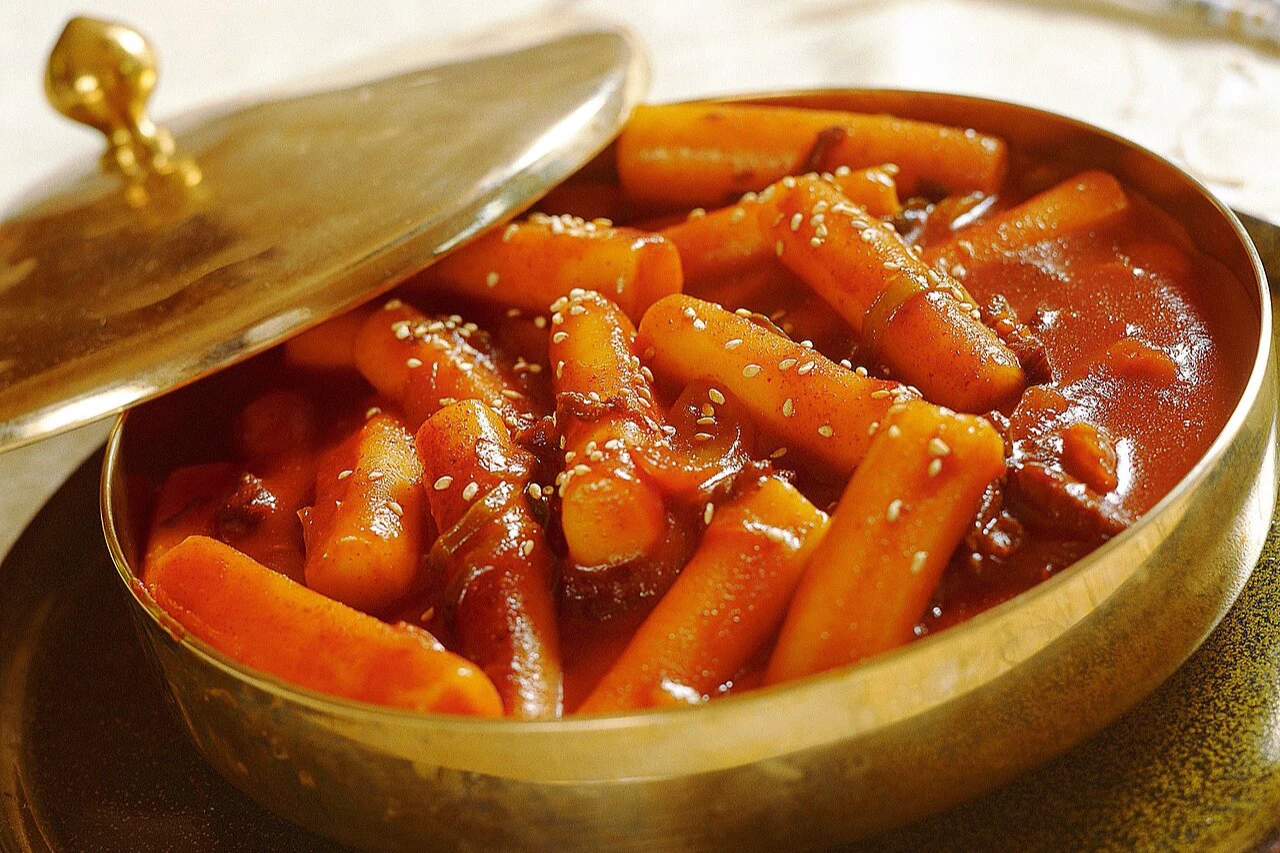
Kimchi hides animal ingredients in seasoning; tteokbokki often hides them in stock and a premade sauce. Removing visible fish cake does not undo either one.
Stews, soups, and noodles
Doenjang-jjigae, sundubu-jjigae, janchi-guksu, kalguksu, and naengmyeon can use anchovy, seafood, beef, chicken, mushroom, or kelp stock. The dish name does not settle the recipe. Ask 육수도 채식인가요?—“Is the stock vegetarian too?”
“No meat pieces” is not a complete answer. A garnish may be removable while a shared broth was prepared hours earlier. If staff cannot identify the base, choose a dish whose ingredients they can verify.
Gimbap, bibimbap, and japchae
Vegetable-looking mixed dishes often contain visible egg, ham, imitation crab, fish cake, or beef. A made-to-order gimbap counter may be able to leave out selected fillings; bibimbap toppings may also be adjustable. Japchae, sauces, and seasoned vegetables are often batch-prepared, so ask whether the ingredient can be excluded before cooking.
VISITKOREA’s vegetarian guidance makes the same caution about vegetable gimbap: the name can still conceal ham, egg, or crab-flavored meat. “Vegetable” describes the emphasis, not necessarily a vegetarian recipe.
Jeon and vegetable pancakes
A vegetable or kimchi pancake may contain egg in the batter. Seafood can be chopped into the mixture rather than placed visibly on top, and the kimchi itself may contain fish sauce or salted shrimp. Removing a few visible pieces does not answer what is in the batter.
Sauces, dumplings, and “plain” rice dishes
Mandu filling can combine tofu and vegetables with pork or glass noodles; a dark dipping sauce may be plant-based, but the filling decides the dish. Fried rice and rice bowls can contain egg, oyster sauce, meat seasoning, or a premixed sauce even when the menu photo looks vegetable-heavy. Ask about the prepared sauce as well as the toppings.
Show these Korean sentences in order
Begin with your overall limit, then name the ingredients most likely to be hidden. Showing the text on your phone is normal and often clearer than relying on one word such as “vegetarian.”
- 고기, 생선, 해산물을 먹지 않아요.
I do not eat meat, fish, or seafood.
- 이 음식에 멸치육수나 고기육수가 들어가나요?
Does this dish contain anchovy stock or meat stock?
- 액젓, 새우젓, 어묵도 들어가나요?
Does it also contain fish sauce, salted shrimp, or fish cake?
- 미리 만든 양념이나 육수에도 들어가나요?
Is any of it already in a premade seasoning or stock?
- 빼고 따로 조리할 수 있나요? 이미 들어가 있으면 먹을 수 없어요.
Can it be cooked separately without those ingredients? If they are already mixed in, I cannot eat it.
If you also avoid egg and dairy, add: 계란과 유제품도 먹지 않아요.—“I also do not eat egg or dairy.”
For a vegan diet, you can say 비건이에요. 동물성 재료를 전부 먹지 않아요.—“I am vegan. I do not eat any animal-derived ingredients.” Still name egg, dairy, broth, fish sauce, and salted shrimp; not every kitchen uses the label in exactly the same way.
The recurring issue in Korean-food community discussions is not a shortage of vegetables. It is that a question about “meat” alone may not cover seafood seasoning or stock. Ingredient-specific questions give the kitchen something concrete to check. Community comments are anecdotal, so use them for communication context rather than recipe proof.
What can usually be changed—and what usually cannot
The decisive difference is whether the animal ingredient is added to order or already in a shared batch.
Usually impossible to remove after preparation:
- Anchovy, beef, chicken, bone, or seafood stock
- Fish sauce or salted shrimp mixed into kimchi
- Batch-made tteokbokki sauce, japchae, or seasoned banchan
- Egg or seafood already mixed into pancake batter
- Dumpling filling or premade sauce containing animal ingredients
Sometimes adjustable before cooking:
- Egg, beef, ham, imitation crab, or fish cake used as a topping or filling
- A garnish added at the end
- A dish cooked individually when the kitchen has water or vegetable stock available
“Sometimes” matters. A restaurant may have no separate stock, pan, fryer, or made-to-order version, and a busy kitchen may be unable to make the change accurately. Accept a clear “not possible” rather than asking staff to promise something the kitchen cannot control.
Vegetarian preference and food allergy are not the same request
For an allergy, say 알레르기가 있어요—“I have an allergy”—and name the ingredient. Then ask 같은 조리도구나 기름을 사용하나요?—“Do you use the same utensils or oil?” Shared pans, cutting boards, fryers, and serving tools can matter even when the recipe itself is changed.
Official restaurant-allergy guidance emphasizes ingredient records, trained staff, and separate equipment or thoroughly cleaned preparation areas. A short conversation cannot guarantee those controls. If staff cannot verify the ingredients or cross-contact risk, do not treat a modified dish as safe; choose another restaurant or a sealed product with a label you can check.
The quickest reliable decision
Start with a restaurant or dish explicitly marked 비건 (vegan) or 채식 (vegetarian), but confirm what the label includes for egg and dairy. Dedicated vegan restaurants and temple-food restaurants can reduce the number of hidden-stock questions, yet individual menus and kitchen practices still deserve a check when your restriction is strict.
Use this three-part rule at an ordinary restaurant:
- Ask about the base: stock or broth.
- Ask about the seasoning: fish sauce, salted shrimp, oyster sauce, or premade sauce.
- Ask about timing: can it be omitted before cooking, or is it already in the batch?
If staff cannot answer, choose something with a short, verifiable ingredient list rather than inferring from color, vegetables, or the absence of visible meat. You can also save this guide offline and find a nearby Delivery Spot before your meal so luggage does not complicate the conversation. For more dining context, continue with our Korean dining etiquette guide.
Ingredients and official guidance were rechecked on August 12, 2026. Recipes vary by restaurant and batch; this guide helps you ask better questions but cannot certify a dish or kitchen as vegetarian, vegan, or allergen-free.
Sources and image credits
- Delivery Spot — dried broth anchovies — Web-ready body asset retained from the original guide; original photograph and license credited below.
- Maangchi — anchovy-kelp stock — Recipe example showing dried anchovies used and strained from a stock; checked August 12, 2026.
- Korean Food Promotion Institute — regional kimchi recipes — Official examples of vegetable-led kimchi recipes that use anchovy fish sauce; checked August 12, 2026.
- Maangchi — classic tteokbokki — Recipe example using anchovy-kelp stock with fish cake and egg among additions; venue recipes can differ.
- Delivery Spot — red and white kimchi — Web-ready slider asset retained from the original guide; Pixabay original and license credited below.
- Delivery Spot — tteokbokki in a brass bowl — Web-ready slider asset retained from the original guide; Wikimedia Commons original and license credited below.
- r/KoreanFood — vegetarian food culture discussion — Community experiences used only to illustrate communication gaps, not as recipe evidence.
- Ivan Wong on Unsplash — banchan market photograph — Original cover photograph; used under the Unsplash License.
- lpegasu on Pixabay — kimchi photograph — Original kimchi photograph; used under the Pixabay Content License.
- freddy an / Azeite on Wikimedia Commons — dried anchovies — Original dried-anchovy photograph, cropped for this guide; CC0 1.0.
- wizdata on Wikimedia Commons — tteokbokki — Original tteokbokki photograph, cropped for the slider; CC0 1.0.
- Delivery Spot cover image file — Published web-ready cover derived from the Ivan Wong photograph credited above.
- VISITKOREA — Tips for Vegetarians — Official guidance on meat/fish stock, detailed ordering, vegetable gimbap, salted shrimp in tofu dishes, and non-vegetarian kimchi; rechecked August 12, 2026.
- CDC — Food Allergy Reactions in Restaurants — Official guidance on ingredient records, staff training, separate equipment, and cleaned preparation areas; used only for allergy risk, not vegetarian definitions.
- Unsplash License — License for the credited cover photograph.
- Pixabay Content License — License summary for the credited kimchi photograph.
- Creative Commons — CC0 1.0 — License for the credited Wikimedia Commons anchovy and tteokbokki photographs.
Last updated


