
How Much of Korea’s Online Gender Conflict Reaches Daily Life?
Korea’s online gender conflict is not invented, but it is louder and more universal-looking on a feed than in most everyday interactions. Current surveys show serious concern, real discrimination, broad fatigue with hostile discourse, and more ordinary cross-gender communication than the internet suggests.
Korea’s gender conflict is real, but online feeds make it look more universal and more openly hostile than day-to-day life usually is. In a 2026 Korea Research survey, 61% called gender conflict a serious social problem, while 69% also said the media and some online communities exaggerate it beyond reality.
Those answers are not contradictory. People can see a genuine social problem, experience unequal treatment, and still believe that the most combative posts are a distorted sample of how most Koreans speak to one another at work, school, home, or over dinner.
The survey result that best explains the gap
Korea Research surveyed 1,000 adults nationwide in early 2026 using a web questionnaire weighted by region, gender, and age. It is a self-reported opinion poll, not a camera pointed at every Korean interaction, but it lets us compare several questions asked of the same public.
The headline number is high: 61% said gender conflict in Korean society was serious, up from 57% in 2025. Concern was strongest among younger adults. Among 18- to 29-year-olds, 79% described the conflict as serious; the figure reached 89% for women and 69% for men in that age group.
Now look at a different question from the same survey. A majority of men, 58%, said communication with women their own age went well, and 56% of women said the same about men their own age. The ratings were lower among the youngest adults—53% for men aged 18–29 communicating with women their age and 46% for women communicating with men their age—but this is still a much less dramatic picture than a permanent offline “gender war.”
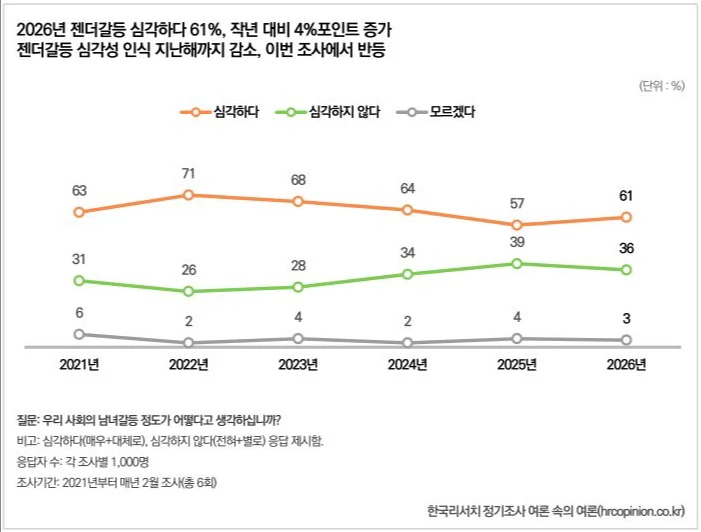
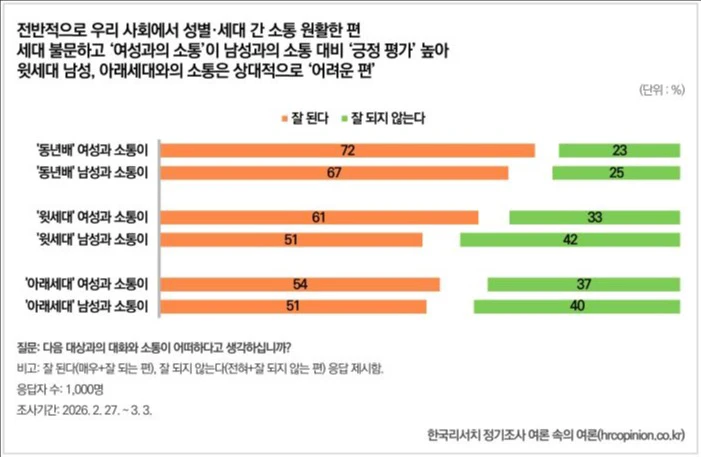
The first chart tracks the share who see social conflict as serious. The second asks about actual communication across gender and generation. Putting them side by side shows why a single percentage or viral clip cannot describe the whole country.
Online exposure, direct experience, and participation are three different things
The same 2026 survey separates them. Over the previous year:
- 37% said they had encountered gender-discriminatory content online;
- 27% said they had personally experienced gender discrimination in relationships with other people;
- 44% said they read gender-conflict posts in detail;
- only 20% said they directly expressed their own views in articles or posts.
That last pair matters. The people posting are a minority even among those paying attention. A quiet reader, a person exhausted by the topic, and someone who never clicks the thread all disappear from the visible argument, while prolific accounts can seem like a much larger public than they are.
The 27% who reported personal discrimination should not be waved away. Women reported it more often than men overall, 31% to 24%, and more than half of women in their 20s and 30s said they had experienced it. Among respondents who reported discrimination, 59% identified relationships with workplace colleagues or supervisors. Daily life is therefore not free of gendered friction; it is simply more specific than the internet’s all-purpose battle between “Korean men” and “Korean women.”
Reactions to hostile content were also mixed. Thirty percent said such material made anger toward the other gender rise, while 63% said it did not. Forty-eight percent reported helplessness or fatigue, and 48% did not. The dominant response was not mass participation: it was watching, distancing, disagreeing, or getting tired.
What the offline version usually looks like
It rarely resembles strangers announcing a full online ideology when they meet. The visible tension is more likely to appear through a concrete subject: military service, hiring, promotion, parental leave, dating expectations, childcare, sexual violence, or who is expected to provide and care for a family.
Those subjects do not affect everyone in the same way. Age, class, region, workplace hierarchy, marital status, and personal history change what a person means when they say “gender conflict.” Treating every disagreement as a single male-versus-female attitude erases most of the context.
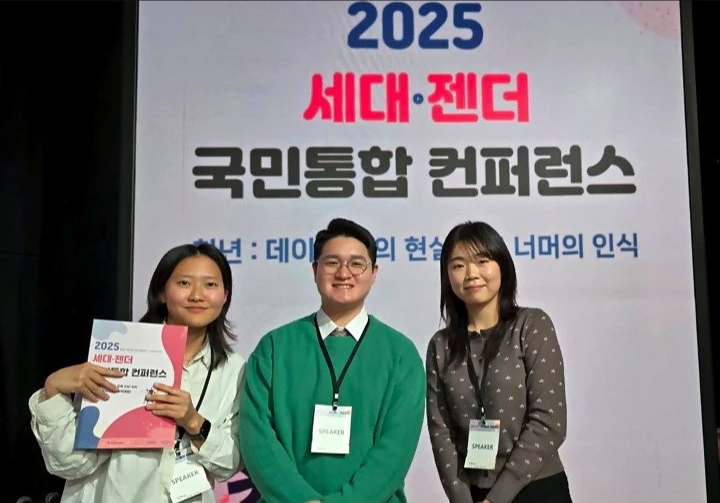
A December 2025 National Integration Commission conference was built around this exact problem. Researchers and young panelists discussed evidence that sharper, either-or questions make men and women look irreconcilable, while separately framed questions reveal substantial agreement. One example presented at the conference found support above 70% for both stronger punishment of sexual crimes and stronger punishment of false accusations when the questions were asked separately. The conflict looked most extreme when the two aims were forced into a zero-sum choice.
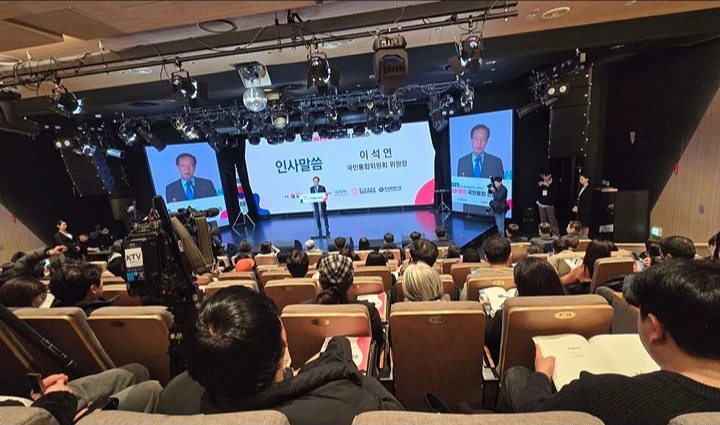
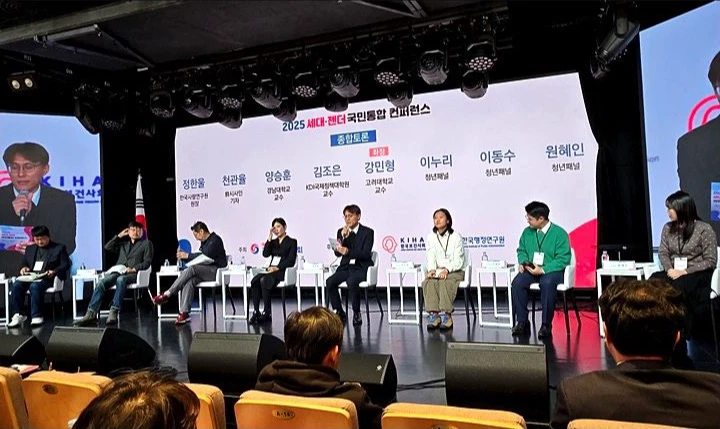
The conference did not prove that a friendly room represents every young Korean. It did show something a comment thread cannot: people who disagree can sit through evidence, ask questions, and speak without adopting the harshest language attached to their demographic online.
Reddit discussions repeat the same split in less scientific form. Some residents say gender-war vocabulary is treated as abrasive in ordinary social settings and that coworkers and friends generally get on with life. Others warn that normal-looking relationships do not erase discrimination, political division, or opinions people avoid saying aloud. These comments are useful for identifying the question; they are not a substitute for representative data.
“Amplified online” does not mean “imaginary offline”
The easiest mistake is to swing from sensationalism to denial. Korea has measurable structural gender gaps. The OECD’s 2026 well-being review reports that in 2023 the median wage for Korean men was 29% higher than for women, the largest gender wage gap in the OECD. It also notes the steep employment drop for women in their 30s and the heavy effect of childbirth and care responsibilities on women’s long-term income.
Men face different pressures that enter the same argument, including compulsory military service and strong expectations around paid work and financial provision. The Korea Research survey found that both younger men and younger women were especially likely to believe their own gender received excessive criticism. These are not mirror-image disadvantages, and counting them as if one cancels out the other produces the zero-sum frame that drives the loudest posts.
The useful distinction is between underlying conditions and the performance of conflict. Pay, care, safety, conscription, career breaks, and social expectations are underlying conditions. Slurs, clipped anecdotes, forced either-or polls, and accounts built around outrage are performances that package those conditions for attention. The second layer can be exaggerated even when the first is serious.
How to read the next viral claim about Korea
Before treating a post as a national portrait, ask what was actually measured. “People think conflict is serious,” “people experienced discrimination,” “men and women voted differently,” and “people use hostile language in person” are four separate claims. Evidence for one does not automatically prove the others.
Check the group behind the number. An average can conceal a 20-point gap between young women and young men, while a youth-only sample says nothing about people in their 50s or 70s. Seoul, a regional workplace, a university community, and an anonymous forum are not interchangeable settings.
Then check how the question was framed. If respondents must choose which gender is the victim or which of two protections matters more, the survey may be measuring a forced contest. If each concern is asked separately, shared priorities often become easier to see.
The honest answer is less cinematic than “Korean men and women hate each other.” Online conflict affects politics, language, and how younger adults interpret unfairness, but most daily interaction still runs through ordinary cooperation, selective silence, friendship, work, dating, and family. Korea has a real gender problem and an online amplification problem at the same time.
Sources and image credits
- Korea Research: 2026 Gender Awareness Survey — severity, online discourse, participation, communication, discrimination experience, survey method, and official charts.
- Korea Research: 2026 Gender Role and Communication Survey — daily exposure to gender-role language and generational differences.
- OECD: Inclusive and Sustainable Well-being in Korea — wage, employment, care, safety, health, and well-being gaps.
- Korea Policy Briefing: 2025 Generational and Gender National Integration Conference — conference findings and photographs; photo credit: Korea Policy Briefing, reporter Kim Yoon-kyung.
- Reddit: How actually bad is the gender war in Korea? — used to identify recurring questions and conflicting personal impressions, not as factual authority.
- Reddit: One interesting thing about Korea’s gender conflict discourse — used as community context only.
- Cover delivery asset — Delivery Spot publication image derived from the credited Korea Policy Briefing conference photograph.
Last updated


