
Buying Glasses in Korea? Choose Lens Options in This Order
Choose Korean eyeglass lenses by frame fit, measurements and daily use—not the highest index or longest coating list.

Choose the frame and measurements first, then the lowest refractive index that keeps the finished lens practical, then a durable anti-reflective and hard-coat package. Add photochromic treatment only if it matches how you move between indoors and outdoors, and treat blue-light filtering as optional—not as the default upgrade.
That order turns a crowded Korean optical-shop menu into a useful decision. It also gives you a calm answer when the quote suddenly branches into domestic and imported brands, 1.60 versus 1.67, several coating tiers and a blue-light add-on.
The 30-second answer at the counter
Ask the optician to build the quote in this order:
- Fit the frame and confirm the prescription, pupillary distance and fitting height.
- Compare a practical base index with the next thinner index in that exact frame.
- Add a hard coat and anti-reflective coating suitable for daily wear.
- Price photochromic treatment separately if you genuinely want one pair for indoors and outdoors.
- Leave blue-light filtering off unless you prefer its tint or have another specific reason to choose it.
Then ask for the product name and each option in writing. A recent r/koreatravel post about a Myeongdong purchase captured the problem neatly: the buyer remembered the premium brand and total price but left without clear lens specifications. One experience does not describe every Korean shop, but it is a good reason to slow the quote down.
Start with the frame, not the lens menu
A lens can be perfectly made and still feel wrong if its optical centre does not line up with the wearer’s pupils. A 2024 Community Eye Health article notes that pupillary distance guides where the laboratory positions that centre, and that a frame that is too large, too small or poorly adjusted can undo an otherwise correct measurement.
For a strong minus prescription, a smaller, well-centred frame can also reduce edge thickness and weight before you pay for a higher index. That is why the useful question is not “What is your thinnest lens?” It is “What will the finished edge thickness be in this frame at the two sensible index options?”
If the glasses are progressive, high-powered or your face is noticeably asymmetric, ask whether the shop recorded monocular PD—one measurement for each eye—and the vertical fitting marks with the chosen frame on your face. If impact resistance matters for sport, work or a child, say that separately; refractive index is not a safety rating.
Refractive index: stop at the number that solves the thickness problem
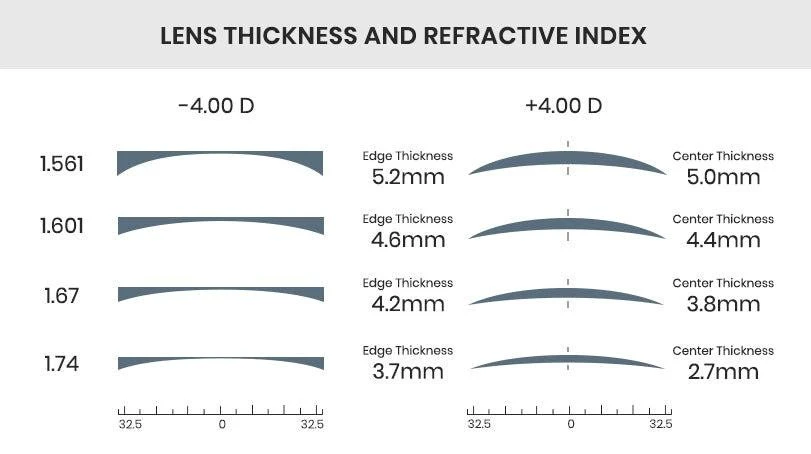
Korean shops often call a higher-index lens “one compression” or “two compressions” (압축). The lens is not pressed thinner after it is made; the useful specification is its numeric refractive index, or 굴절률. Common menu steps include 1.56, 1.60, 1.67 and 1.74.
For the same prescription and design, a higher index bends light with less material, so the lens can be thinner. But “higher” is not a universal quality score. Material, Abbe value, design, reflections, frame size, decentration and price all move with the choice. Some wearers are more sensitive than others to peripheral colour fringing from lower-Abbe materials.
Do not use a rigid prescription chart from the internet as a buying rule. Cylinder power, lens shape and the position of your pupils in the frame can change the result. Ask to compare the finished thickness at your actual prescription, not a sample lens held in the air.
A useful line is: “Please show me the difference between the practical base index and one step thinner in this frame.” If the visible and weight difference is small, keep the money for fit and coating. If the difference is meaningful—especially with a strong prescription or a larger frame—the higher index has a job to do.
Coatings: durability and reflections come before marketing names
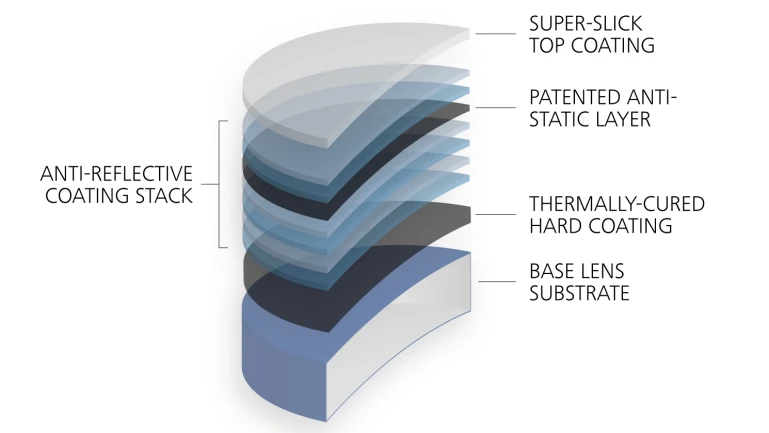
Plastic lens materials need a hard surface treatment for everyday scratch resistance. Anti-reflective coating reduces distracting reflections and is particularly useful on high-index material, which naturally reflects more light. A water- and oil-repellent top layer can make fingerprints easier to clean, but no coating makes a lens scratch-proof or maintenance-free.


Package names such as “multi-coating,” “premium coating” and “ultra water-repellent” are not enough on their own. Ask what the package actually includes: hard coat, anti-reflective layers, antistatic treatment, water/oil repellence, UV performance and a coating warranty.
For most all-day glasses, a dependable hard coat plus good anti-reflective performance deserves priority over a fashionable filter. If night driving is part of your routine, tell the optician directly; reducing reflections is a clearer target than buying every option in the catalogue.
Photochromic: useful for outdoor transitions, imperfect in a car

Photochromic lenses are worth pricing when you repeatedly move between street and indoor spaces and do not want to carry prescription sunglasses. They react to light—primarily UV—and the exact darkening and fade-back depend on the product, temperature, UV exposure and lens material.
A standard photochromic lens may stay much lighter behind a car windshield because the glass blocks most UV. Some specialist products also respond to visible light and can darken in a car, but that is a product-specific feature, not something to assume from the word “photochromic.” Polarised prescription sunglasses remain the clearer solution when road glare is the main problem.
Ask for the exact generation, colour, indoor residual tint, expected windshield behaviour and whether photochromic treatment changes the delivery time. Looking at the shop’s demonstration lens in daylight is more useful than choosing from a tiny colour swatch.
Blue-light filtering: an optional preference, not the foundation

Blue-light filtering is often presented alongside anti-reflective coating, but they answer different questions. The 2023 Cochrane review of 17 randomised controlled trials found that blue-light filtering spectacles probably make no difference to short-term computer-related eye strain or sleep quality compared with non-filtering lenses; it also found no evidence of retinal protection, while noting that the available studies were short and limited.
That does not make the option forbidden. Some buyers like a particular residual reflection or tint. But it is reasonable to skip the add-on, especially if you do colour-sensitive design, photo or video work. Ask to look at a white screen and a white sheet of paper through the demonstration lens before deciding.
If screens leave you uncomfortable, first make sure the prescription and fit are correct and look at working distance, breaks, blinking and room lighting. Persistent pain, sudden visual change or continuing symptoms belong with an eye-care professional rather than a coating upgrade.
The quote to request before you pay
You do not need to memorise optical terminology. Ask for three prices on the same frame and prescription:
- A: the practical base index with hard and anti-reflective coating
- B: one index thinner with the same coating level
- C: your preferred index with photochromic treatment added
Keep blue-light filtering as a separate yes/no line. For each quote, record the brand and product line, refractive index, spherical or aspheric design, coating package, photochromic variant, lens-only price, expected completion time and remake or coating-warranty terms.
These Korean terms make the conversation easier:
- 굴절률 (guljeollyul): refractive index
- 비구면 (bigumyeon): aspheric design
- 반사방지 코팅: anti-reflective coating
- 하드코팅: hard or scratch-resistant coating
- 발수코팅: water-repellent coating
- 변색렌즈: photochromic lens
- 블루라이트 차단: blue-light filtering
- 단안 PD: monocular pupillary distance
The best lens is not the most expensive line on the menu. It is the least complicated combination that fits your frame, prescription and actual day.
Sources and image credits
- Prescribing and fitting spectacles: the role of pupillary distance and the optical centre — 2024 Community Eye Health guidance on PD, frame fit and optical-centre alignment
- Choosing the right lenses for your glasses — refractive index, Abbe value, frame size and lens-treatment reference; also used as a high-traffic structural style reference
- Lens coatings: anti-reflective, hard layer and CleanCoat — professional explanation of hard, anti-reflective and easy-clean layers
- How photochromic lenses work — official explanation of UV response, temperature and windshield limitations
- Blue-light filtering spectacles review — summary of 17 randomised controlled trials
- Naver Blog: refractive index, not “compression” — Korean shop vocabulary and common index menu context
- Naver Blog: what opticians check before price — current Korean optician perspective on prescription, frame, lifestyle and unnecessary upgrades
- r/koreatravel: prescription glasses options in Korea — recurring buyer questions about 1.74, aspheric design and multiple coatings
- r/koreatravel: Myeongdong glasses purchase — community concern about itemised specifications and premium upgrades
- Refractive-index comparison image — image by 푸른아이웨어; discovered through Naver Image Search; reused under Delivery Spot operator permission confirmed 9 Aug 2026
- ZEISS coating-stack and anti-reflective comparison images — images courtesy of Carl Zeiss Vision; discovered through Google Images; reused under Delivery Spot operator permission confirmed 9 Aug 2026
- Photochromic lens image — image courtesy of Transitions Optical; discovered through Google Images; reused under Delivery Spot operator permission confirmed 9 Aug 2026
- Blue-light screen-use image — image courtesy of Cochrane; discovered through Google Images; reused under Delivery Spot operator permission confirmed 9 Aug 2026
- Cover image: photochromic lens close-up — Delivery Spot cover asset; usage permission recorded by the operator on 9 Aug 2026
Last updated


