
Apartment Footstep Noise in Korea: What to Do About Cheunggan Soeum
Upstairs footsteps can become a serious quality-of-life problem in a Korean apartment, but the useful response is documentation, neutral mediation, and the official Neighbor Center—not retaliation or a heated doorstep confrontation.

Korean news reports sometimes frame cheunggan soeum (층간소음), or noise between floors, as a war between neighbors. The everyday problem is less cinematic and more exhausting: repeated heel strikes, children running, furniture scraping, music, or a television that intrudes into someone else's home. The distress can be real even when nobody intends harm.
The practical answer is to separate three things that headlines often mix together: how sound moves through the building, whether the noise meets Korea's formal thresholds, and how neighbors can resolve the conflict without escalating it. If you are losing sleep, document the pattern, use your apartment management office, and move through the official mediation process. Do not retaliate with a ceiling speaker, pounding, threats, or an angry late-night visit.
What counts as inter-floor noise?
The Korea Environment Corporation's Inter-floor Noise Neighbor Center handles two main categories in apartment housing. Direct impact noise includes running and walking. Airborne noise includes sound from a television or audio equipment. These behave differently: a voice or television travels partly through the air, while a hard footfall sends impact energy into the floor and connected structure.
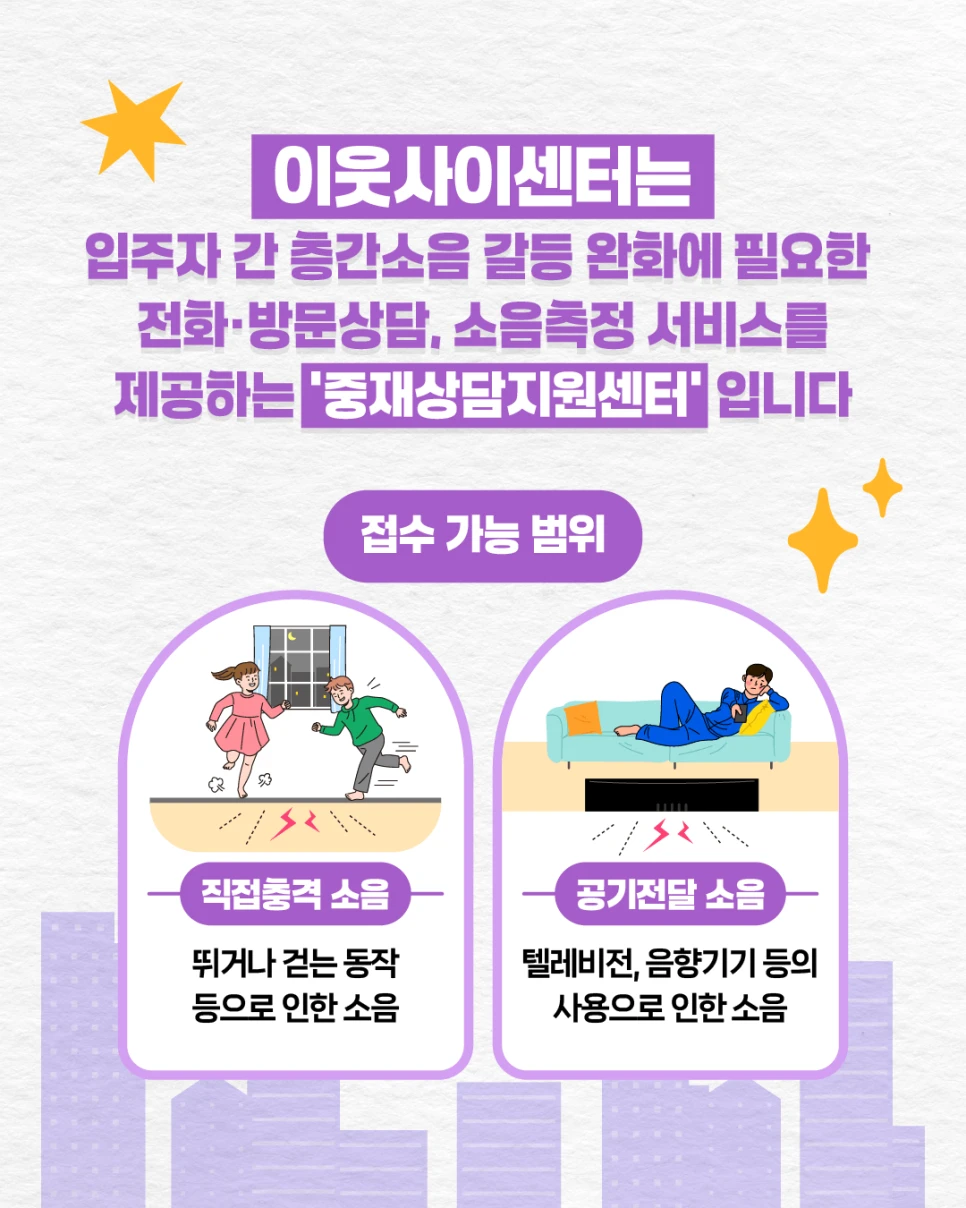
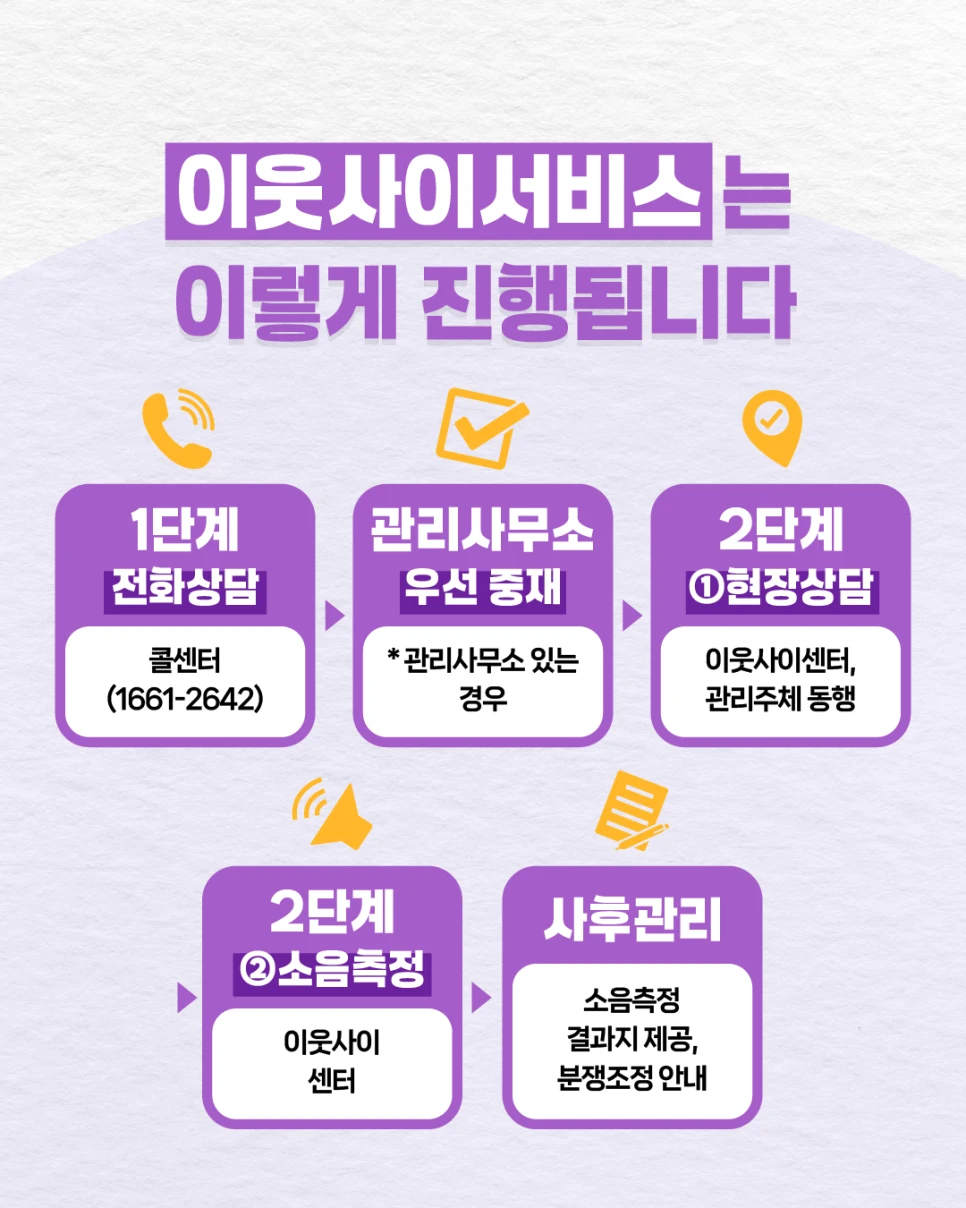
The first official card distinguishes impact noise from airborne noise. The second summarizes the help route: telephone counseling, initial mediation by the management office in a managed complex, a field visit, measurement when appropriate, and follow-up guidance. The graphics are in Korean, but the sequence is useful even if you do not read Korean fluently.
Why footsteps can feel much worse downstairs
A footstep reaches the room below through more than the visible ceiling. A heel strike or running child excites the floor slab, finish, resilient layer, ceiling, and adjoining structure. The receiving household may hear a low thud without hearing the lighter sounds that identified what caused it. Repetition and unpredictability make the problem especially stressful: you cannot relax when the next impact might arrive in two seconds or twenty minutes.
A brand name or construction year cannot predict acoustic performance by itself. Slab and floor assemblies, workmanship, later renovations, room layout, and the force of the activity all affect what a neighbor hears. Korea introduced a post-construction floor-impact performance confirmation system in August 2022 because performance in the completed home matters, not only the design on paper, according to the Ministry of Land, Infrastructure and Transport. A newer or more expensive apartment can still have complaints, while an older one may be tolerable with considerate habits.
Sound can also travel diagonally or through shared structure, which means the apartment directly above may not be the source. That is one reason neutral management is safer than confronting a household with an accusation. English-language residents describe the uncertainty vividly in Reddit discussions about late-night upstairs noise, but an anecdote is not proof about your building or the right enforcement route.
Korea's official noise thresholds
The Neighbor Center publishes the following current standards. Daytime is 6:00 a.m. to 10:00 p.m.; nighttime is 10:00 p.m. to 6:00 a.m.
- Direct impact, 1-minute equivalent level: 39 dB(A) by day; 34 dB(A) at night.
- Direct impact, maximum level: 57 dB(A) by day; 52 dB(A) at night.
- Airborne noise, 5-minute equivalent level: 45 dB(A) by day; 40 dB(A) at night.
For the maximum direct-impact standard, the published rule requires at least three exceedances during one hour. For apartments whose building permit or project approval predates June 30, 2005, 2 dB(A) is added to the direct-impact limits from January 1, 2025. The official scope, standards, and process page is the source to check because rules and methods can change.
These numbers are formal criteria for the defined procedure, not a promise that every disturbing sound below the line is harmless. A phone app can help you note timing and compare patterns, but it is not an official test: different phones, rooms, microphone settings, and measurement positions produce different readings.
What to do first
Start with a calm record for several days. Note the date, start and end time, whether the sound was footsteps, running, dragging, music, or something else, and where it seemed strongest. A simple log is more useful to a manager than “it happens constantly.” Record only what enters your home; do not invade a neighbor's privacy or publicly identify them.
Then contact the management office or security desk. Ask for a neutral notice and help identifying the likely source. In a managed complex, the Neighbor Center requires management to try mediation first before a field application proceeds. If Korean is difficult, prepare a short message such as: “Heavy impact noise is recurring between 11 p.m. and 1 a.m. Could management please confirm the likely source and send a neutral quiet-hours notice?”
Avoid direct contact while angry, especially late at night. A courteous daytime conversation can sometimes work when both households are comfortable with it, but there is no benefit in turning uncertainty into a doorstep confrontation. Counter-noise devices, ceiling pounding, and threats create a second complaint and make mediation harder. If you hear screaming, violence, or an immediate danger rather than ordinary household noise, treat that as a safety emergency and contact police; it is a different issue from the normal noise-dispute route.
How the official Neighbor Center process works
Call 1661-2642 on weekdays from 9:00 a.m. to 6:00 p.m.; the center lists a lunch break from noon to 1:00 p.m. Its normal sequence is telephone counseling, visit counseling, and then noise measurement when the earlier steps do not resolve the case. The service is intended to help communication as well as assess sound.
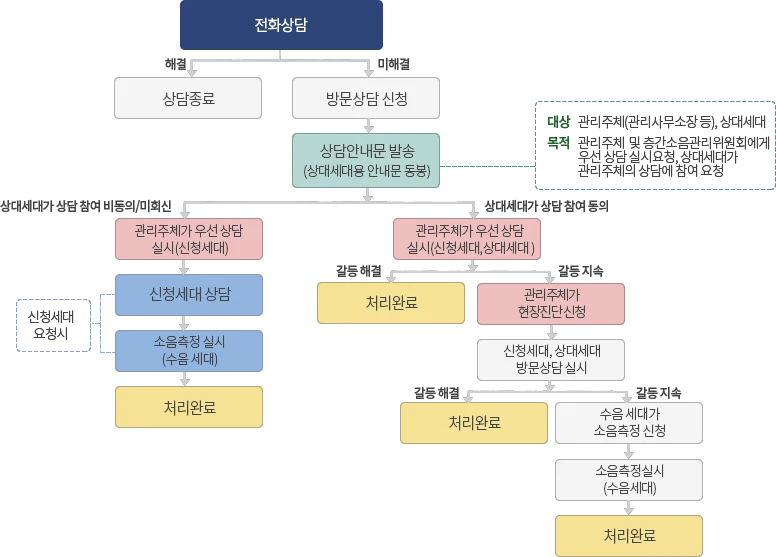
This official flowchart shows why management comes first in a managed apartment complex. If the accused household agrees to participate, mediation may resolve the case. If it does not, the receiving household can request measurement after visit counseling; the center says that request should be made within 30 days. The measurement can run from one hour to 24 hours. During it, the receiving home must exclude its own noise—typically by having no occupants or internal sound sources—so the result reflects the incoming disturbance.
A measurement result creates evidence for the dispute process; by itself it does not produce an instant eviction or police penalty. The center can explain results and provide further dispute guidance. The process may feel slow when you are sleep-deprived, but it creates a record and gives both households a neutral intermediary.
Changes that actually help inside the apartment
If your household may be creating impact noise, focus on force and timing. Soft indoor slippers, rugs or tested floor mats in play and circulation areas, felt pads under chairs, and lifting furniture instead of dragging it can reduce impacts. Keep running games, jumping, vacuuming, washing, and furniture rearrangement away from late-night hours. Move speakers and exercise equipment away from shared walls or floors where practical.
These measures are worthwhile, but a mat cannot correct every weak floor assembly. The fairest approach combines household changes with management-level investigation. The household hearing the noise should also avoid assuming that every creak or thud is intentional; the household creating it should not dismiss the complaint merely because the same sound seems quiet upstairs.
Check noise risk before you rent or buy
If impact noise would seriously affect your health or work, test the living conditions before signing. Visit in the evening when families are home. Ask the agent or owner whether the management office has issued recurring noise notices and whether the unit above has hard flooring or active renovation. Listen in the bedroom and main living area, not only near the entrance. A top-floor unit removes upstairs footsteps but may bring different trade-offs such as heat exposure, roof equipment, or a higher price.
Do not infer quiet from the apartment brand, a luxury lobby, or a recent completion date. Ask about the actual unit and building. If a seller or landlord promises exceptional acoustic performance, request the relevant test or construction documentation rather than relying on a slogan.
Inter-floor noise can be severe without becoming a “war.” Treat it as a building-and-behavior problem first: keep a usable record, ask management to mediate, and use the Neighbor Center when the problem persists. That route is slower than retaliation, but it is far more likely to preserve safety, evidence, and a livable relationship with the people around you.
Image credits
- Feature and slider infographics: Republic of Korea Ministry of Environment official Naver Blog, now the Ministry of Climate, Energy and Environment; used with written permission.
- Managed-complex resolution flowchart: Korea Environment Corporation Inter-floor Noise Neighbor Center; used with written permission.
Sources and image credits
- Inter-floor Noise Neighbor Center — Checked for guide details or image attribution.
- Ministry of Land, Infrastructure and Transport — Checked for guide details or image attribution.
- Reddit discussions about late-night upstairs noise — Checked for guide details or image attribution.
- scope, standards, and process page — Checked for guide details or image attribution.
- Republic of Korea Ministry of Environment official Naver Blog — Checked for guide details or image attribution.
Last updated


