
Is Jinhae Gunhangje Worth the Trip from Seoul?
Stay in Seoul if you only want a good blossom walk; choose Jinhae when the city-scale festival, Yeojwacheon, Gyeonghwa Station, and naval context are major goals and you can give the trip a full day or overnight.
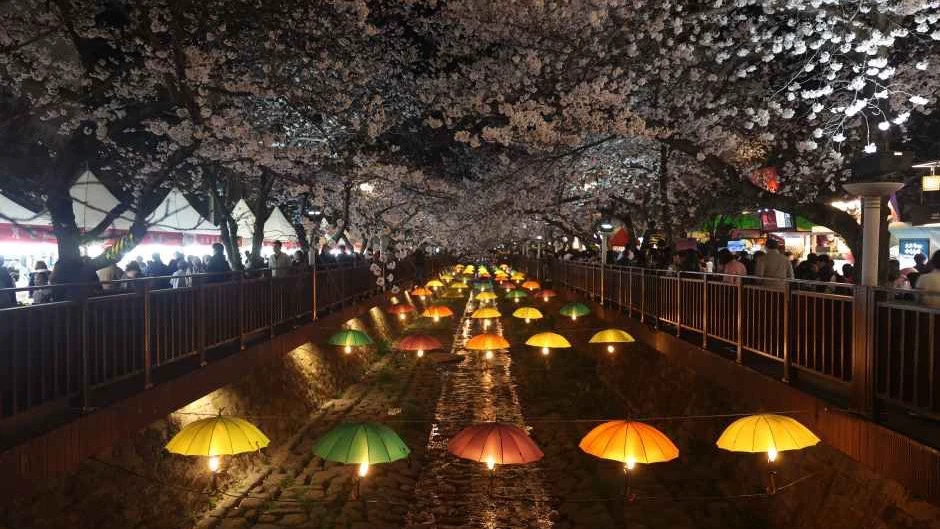
If Seoul is your only base and you simply want a beautiful cherry-blossom walk, Jinhae Gunhangje is usually not worth a rushed same-day detour. It becomes worth the trip when the naval-port festival itself—the lit stream, old railway, military traditions, and a city visibly organized around spring—is one of your main reasons for visiting Korea, and you can give it a full day or an overnight.
The base matters as much as the flowers. Jinhae is a strong choice from Busan or Changwon; from Seoul, the intercity journey and the final local transfer consume enough time that “better blossoms” is the wrong test.
The short decision
- Choose Seoul if you have three to five days in the capital, want flexibility around changing bloom dates, are traveling with someone who tires easily, or mainly want one good walk and photographs.
- Choose Jinhae if you are already in Busan or Changwon, can stay overnight, or specifically want Yeojwacheon, Gyeonghwa Station, night lighting, and the naval-city festival atmosphere.
- Do not commit to either city by an old average bloom date. Check the live bloom report and the current event notice close to travel.
- Avoid a Seoul–Jinhae day trip on a peak weekend unless you are comfortable spending much of the day in transit and moving through dense crowds.
See the scale before deciding
- 1Yeouido Cherry Blossom Festival
- 2Yeojwacheon Stream
This line is a scale reference, not a recommended same-day driving plan. Google Maps verifies both endpoints, but event-day road controls, shuttles, and public-transport connections change. For Jinhae, check the current festival transport notice and live Korean routing shortly before departure.
From Seoul, Jinhae is not one direct ride to the blossom district. A typical public-transport plan has an intercity rail or bus leg to Changwon-Jungang or Masan, followed by a local bus, taxi, or temporary festival service into Jinhae. The Changwon city plan for the 2026 festival included temporary paid city-bus routes for military-base access; that is evidence of the last-mile problem, not a timetable to reuse for a future edition.
What the extra trip to Jinhae actually buys
Jinhae is not a single famous road. The strongest version of the trip moves between Yeojwacheon Stream, Gyeonghwa Station Cherry Blossom Street, the old center around Jungwon Rotary, and festival programs tied to the city’s naval identity.
The latest completed edition, the 64th Jinhae Gunhangje, ran from March 27 to April 5, 2026. The Korea Tourism Organization’s official festival page lists events including the opening ceremony, military band and honor guard performances, an Admiral Yi Sun-sin memorial rite and victory parade, and other concerts. It also explains that visitors may be able to enter the Korea Naval Academy and Naval Base Command during the festival even though those areas are normally restricted. Access dates and conditions must be checked again each year.
Yeojwacheon is the most immediately recognizable landscape: paths run along both sides of a narrow stream beneath branches, and night installations turn it into an event space rather than a quiet park. The official Yeojwacheon listing identifies the Romance Bridge area and confirms its role as a core Jinhae blossom site.
Gyeonghwa Station gives a different composition—tracks and platforms receding under trees rather than a stream corridor. Trains no longer stop there, and the official destination page presents it as a former station and public blossom space. The railway view is the point; an old photograph of a train passing through does not represent the current visitor experience.
The four slides show the real visual choice: Jinhae’s stream and rail corridor, then two Seoul alternatives with a city skyline and a lake edge.
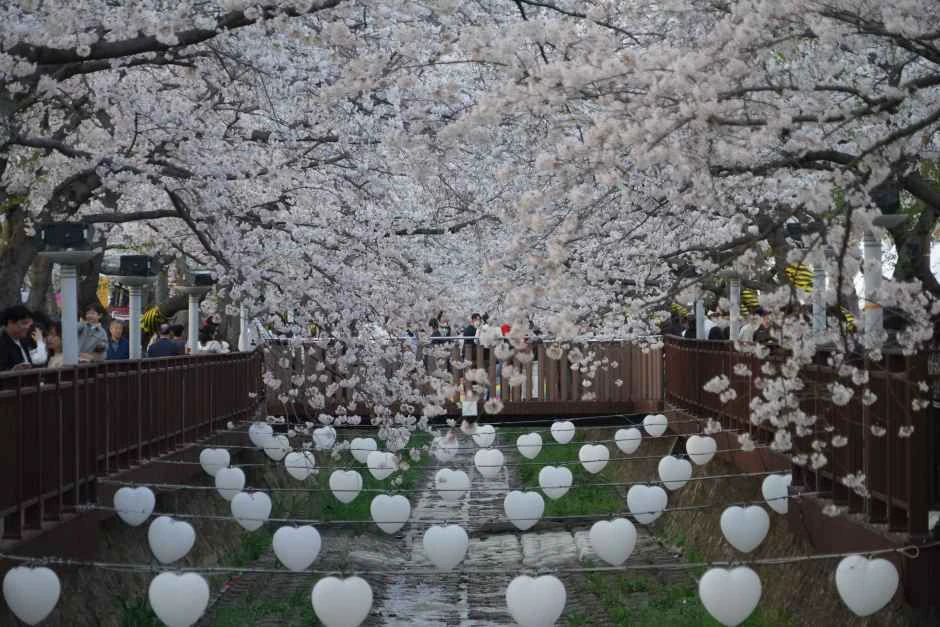
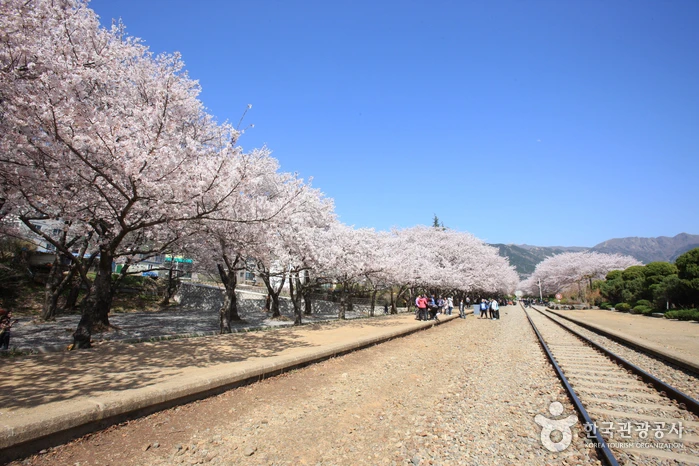
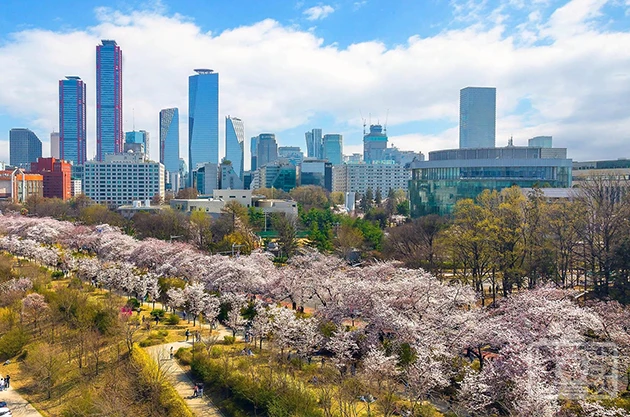
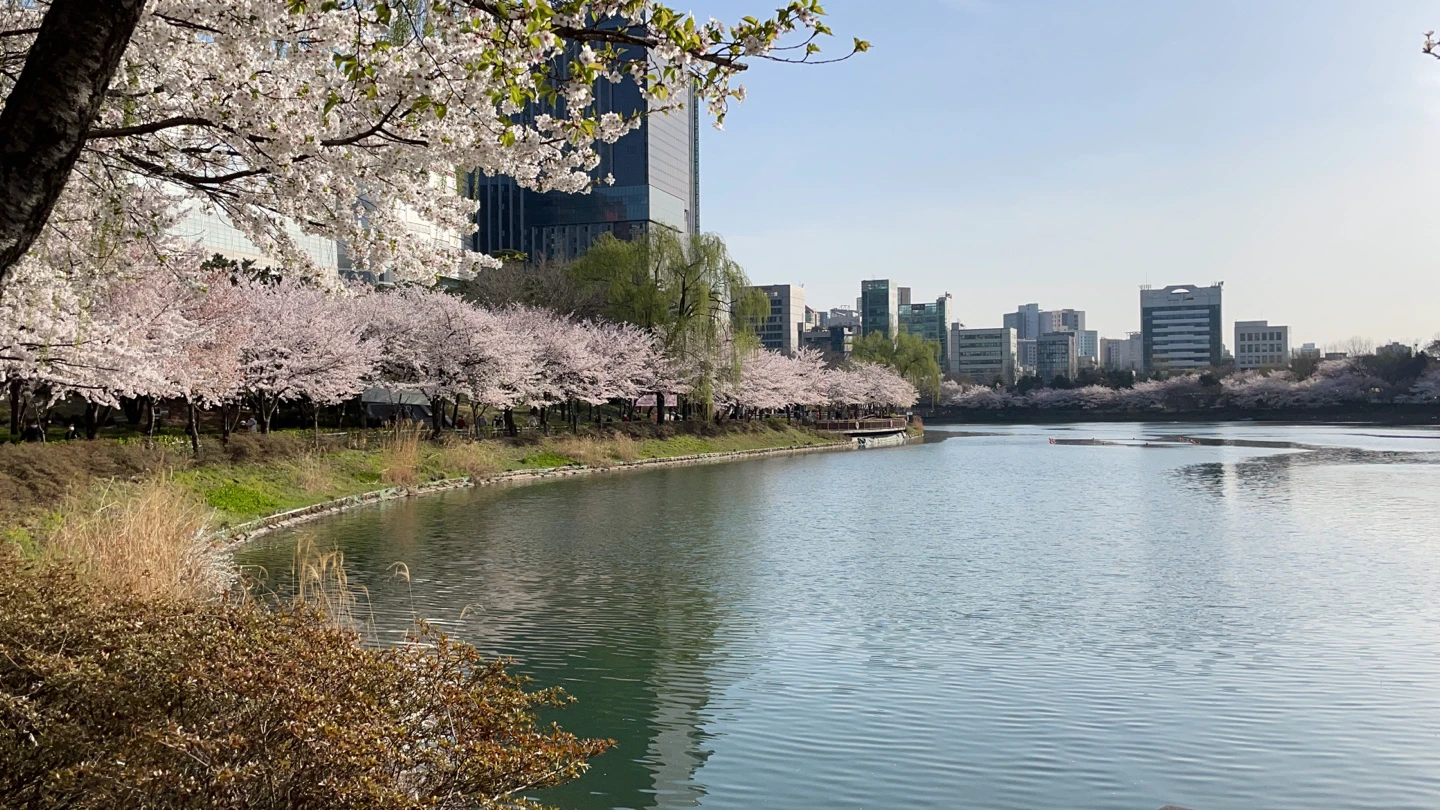
Jinhae therefore earns its travel time through concentration and identity. Blossoms connect multiple districts to a festival narrative, and the evening changes the scene. If that sounds like the reason for the trip, Seoul is not a substitute.
What Seoul gives you instead
Seoul does not offer Jinhae’s naval-city story, but it offers more ways to get a good blossom day without staking the itinerary on one long transfer. Yeouiseo-ro in Yeouido is a broad urban event corridor beside the National Assembly and Hangang parks. Seokchon Lake gives a continuous waterside walk with blossoms, towers, and dense Jamsil city scenery. Yangjaecheon, palace grounds, neighborhood parks, and other routes add alternatives.
That flexibility is measurable. Seoul’s official spring-flower road map lists 175 routes totaling 251 kilometers across the city. A visitor who misses one event window can still react to where trees are actually blooming and choose a route near the day’s other plans.
Yeouido is easy to combine with central or western Seoul and is served by multiple subway stations, but convenience does not mean quiet. Seoul’s official Hangang festival guide describes Yeouiseo-ro and Hangang Park as a major cherry-blossom destination and counts 1,886 cherry trees along the area. Expect crowd controls and walking diversions during the festival.
Seokchon Lake is similarly busy at peak bloom, yet it is simple to reach from Jamsil and easy to abandon or revisit if weather turns. The final Seoul civic notice for 2026 scheduled the Yeouido festival for April 3–7 and the Seokchon Lake festival for April 3–11. Earlier city materials had different dates, which is exactly why a future trip should follow the final local notice rather than a months-old roundup.
For a Seoul-only itinerary, this is the decisive advantage: a failed blossom plan costs a subway ride, not an intercity travel day.
The crowd trade-off is different, not absent
Both choices can be crowded. The difference is how easy it is to recover.
At Yeouido or Seokchon Lake, you can arrive early, leave when the path becomes uncomfortable, and switch to another neighborhood. In Jinhae, the two headline sites draw many visitors into a smaller city while road controls, tunnels, station connections, and temporary services carry festival traffic. The same 2026 Changwon transport plan added temporary routes and managed access to normally restricted military areas, a useful signal that transport pressure is part of the event rather than an occasional surprise.
Community reports reinforce that planning problem without providing a universal verdict. In a post-festival discussion on r/koreatravel, visitors agreed that the blossoms were beautiful but split over whether the crowd diminished the value. Another traveler planning with older parents worried less about the flowers than about weekend congestion, bus access, and fatigue. Those are personal reports, but the repeated questions are useful: mobility, patience, and last-mile transport should be part of the decision.
If you go to Jinhae, arrive early, keep luggage out of the day, and choose one or two priority areas rather than trying to cross the city repeatedly. An overnight lets you use evening lighting and an early morning without compressing both into the same arrival-and-departure window.
Bloom timing can erase the value of the detour
Festival dates and peak bloom are related, not identical. In 2026 the Korea Meteorological Administration recorded Seoul and Yeouido blooming on March 29, with Seoul six days earlier than in 2025 and ten days earlier than the long-term norm. The KMA season report is a reminder that a historical average is not a booking guarantee.
Do not book a nonrefundable Jinhae detour months ahead solely because a past festival occupied similar dates. Reserve the transport and room only when the trip works even if bloom is imperfect, or keep the booking flexible until the official bloom and event updates become useful.
Rain and wind matter too. A city-scale festival can remain lively after petals begin to fall, but the main visual reason for a long Seoul detour weakens quickly. Seoul’s many routes make it easier to follow the better-looking area on the day.
When Jinhae is worth it
Jinhae is worth the trip when at least two of these are true:
- You are already sleeping in Busan, Changwon, or nearby.
- Yeojwacheon and Gyeonghwa Station are specific photographic goals.
- You want the military band, Admiral Yi Sun-sin, or naval-base context, not only trees.
- You can stay after dark or sleep locally and start early.
- You have checked the live bloom and current transport notice.
- You can tolerate dense pedestrian traffic and flexible meal or bus timing.
It is usually not worth it when the plan is a tour-bus dash from Seoul, the traveler has limited mobility, the only free day is a peak weekend, or Jinhae would replace a major first-time Seoul day. In those cases, choose a Seoul route that fits the rest of the itinerary and judge it by the quality of the walk, not by whether it is Korea’s most famous blossom city.
Verdict
For a Seoul-only first trip, stay in Seoul. Yeouido, Seokchon Lake, and the city’s many secondary routes give you more control over weather, bloom, crowds, and the rest of the day.
For a spring trip already reaching the southeast—or for someone who wants the festival as an event—go to Jinhae and give it real time. Its value is not that every tree is prettier. It is that blossoms, an old rail corridor, a lit stream, and naval-city traditions combine into a place that feels organized around one short season.
Photo credits
- Featured Yeojwacheon night scene and daytime Yeojwacheon: Korea Tourism Organization, Jinhae Gunhangje Festival; used with written operator permission.
- Gyeonghwa Station Cherry Blossom Street: Korea Tourism Organization destination page; used with written operator permission.
- Yeouido Cherry Blossom Festival: Seoul Metropolitan Government; used with written operator permission.
- Seokchon Lake with cherry blossoms: Hyeonyoung Lee 21 via Wikimedia Commons, CC BY-SA 4.0.
Sources and image credits
- Changwon city plan for the 2026 festival — Checked for guide details or image attribution.
- Korea Tourism Organization’s official festival page — Checked for guide details or image attribution.
- official Yeojwacheon listing — Checked for guide details or image attribution.
- official destination page — Checked for guide details or image attribution.
- spring-flower road map — Checked for guide details or image attribution.
- official Hangang festival guide — Checked for guide details or image attribution.
- Yeouido festival for April 3–7 and the Seokchon Lake festival for April 3–11 — Checked for guide details or image attribution.
- post-festival discussion on r/koreatravel — Checked for guide details or image attribution.
- Hyeonyoung Lee 21 via Wikimedia Commons — Checked for guide details or image attribution.
- CC BY-SA 4.0 — Checked for guide details or image attribution.
Last updated


