
15 First-Trip Mistakes in Korea—and What to Do Instead
Most first-trip problems in Korea are small decisions that compound. Fix the wrong branch, overloaded days, missed cutoffs, heavy shopping, luggage handoffs and brittle transfers before they consume the trip.

Most first-trip mistakes in Korea are not dramatic emergencies. They are small decisions that consume the day in combination: saving the wrong branch, crossing Seoul twice, reaching a gate after last admission, buying heavy products too early, or treating an airport transfer like a short commute.
A large r/koreatravel discussion about Korea travel regrets repeatedly mentions overpacking, heavy luggage, underestimated walking and stairs, difficult summer weather, and too little time in each place. These are traveler-experience signals, not official statistics. Their useful lesson is to build an itinerary that can absorb ordinary friction.
Use the list as a final audit. Every mistake has one action to take before or during the trip.
1. Using one map for every task
A place appearing in a global search result does not guarantee equally useful walking routes, entrances or current branch information. VisitKorea's current Helpful Apps & Resources guide, updated in August 2026, describes Naver Map's route suggestions, travel-time estimates, business information, reviews and saved-place function when available.
Do instead: Install Naver Map before departure, choose the preferred language, and save the hotel plus the day's exact stops. Keep the familiar global map too. The mistake is making one app the only source.
2. Saving a famous name instead of the exact branch
Korea has repeated café names, department-store branches, similarly named venues and multiple bus terminals. An English label can lead to the correct brand in the wrong district—or the back of a complex whose entrance is on another road.
Do instead: Save the Korean name, street address and branch together. Compare the pin with the operator's current page and keep a screenshot of the entrance, floor or building when the handoff is complicated.
3. Testing navigation and translation only after getting lost
The street is the worst place to discover that an app needs a login, permission or data. Translation is also faster when camera, image and voice modes are already familiar.
Do instead: On Wi-Fi, open one saved route, translate one menu photo, and copy the accommodation address in Korean. Save essential addresses and bookings somewhere that still opens offline.


App artwork: Naver Map and Papago, published by Korea Tourism Organization. Set up the tools before day one, not on the pavement after the route fails.
4. Treating a route estimate as door-to-door time
A route estimate rarely includes every transfer cost: locating the correct station entrance, walking a long corridor, waiting for the next train, finding a lift, using a locker, or reaching the venue gate. A displayed 35 minutes can take a much larger block of the itinerary.
Do instead: Add practical transfer time to every cross-city move. For a timed reservation, work backward from check-in, then add walking inside the station or venue. Treat a route with several handoffs as harder than a single-seat ride even if the displayed minutes match.
5. Crossing the city for every individual highlight
Gyeongbokgung in the morning, lunch in Jamsil, shopping in Hongdae and sunset near Namsan may look possible when each pin is considered separately. The result is often a day spent entering stations.
Do instead: Group each day by area. Choose one anchor, add two nearby options and name one cut-first item. The official Seoul map and guidebook page can help show districts as clusters; the page was reachable through Seoul's official channel when rechecked August 12, 2026, although automated access was blocked by its web firewall.
6. Treating arrival day as a normal sightseeing day
The flight's arrival time is not the time you will reach the hotel. Immigration, baggage, airport navigation, transport and check-in sit between them, while fatigue makes every small problem harder.
Do instead: Give arrival day one easy neighborhood walk and one flexible meal. Decide the luggage handoff before sightseeing if the room is not ready. Do not place a prepaid performance, distant day trip or last-entry attraction immediately after landing.
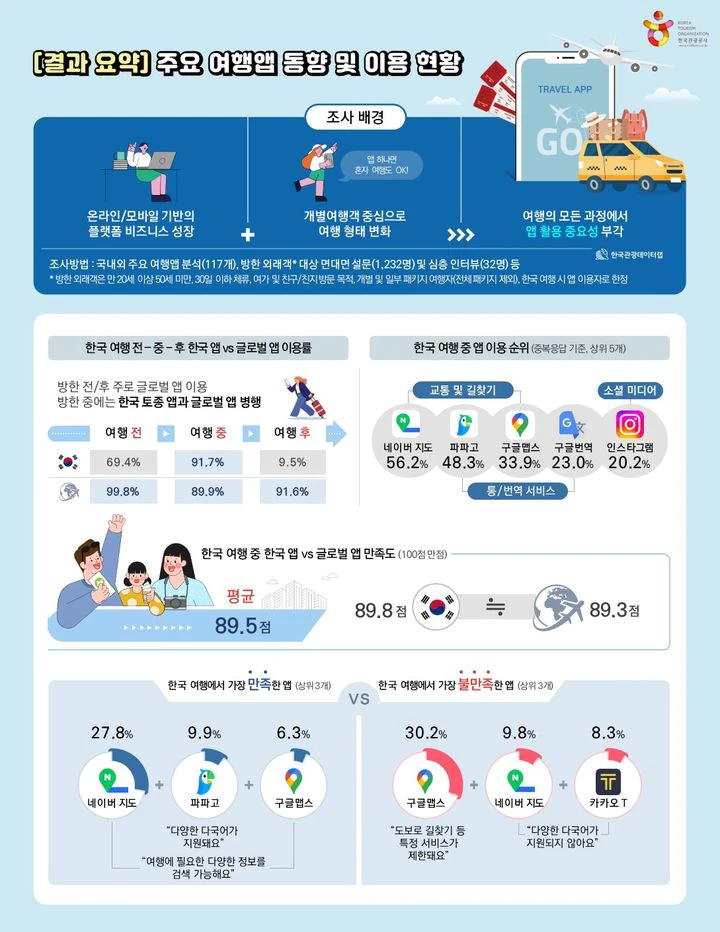
Graphic: Korea Tourism Organization, via Newsis / Naver News. This is a March 2024 survey snapshot showing that international visitors combined Korean and global apps at different trip stages; it is historical context, not a current product ranking.
7. Checking opening time but not closure, last admission or break
“Open today” does not mean admitting visitors when you arrive. Museums, palaces, markets and restaurants can have weekly closures, last-entry cutoffs, temporary maintenance or afternoon breaks. Search snippets and old posts can lag behind the operator.
Do instead: Check the official venue page while planning and again the evening before. Record closed day, last admission, break time and reservation requirement beside each anchor. Keep one nearby outdoor or walk-in alternative.
8. Building a day around three famous queues
A viral restaurant, limited pop-up and observation deck may each be worthwhile. Combining all three lets every delay threaten the next booking and turns meals into logistics.
Do instead: Choose one queue-dependent priority per half-day. Save two nearby restaurants that accept walk-ins. Set a line limit before arriving; if it is exceeded, use the backup without renegotiating the whole day on the sidewalk.
9. Buying heavy or duplicate products too early
One highly rated reply in the regret thread describes buying products available at home for only a small saving, then struggling with the luggage. Early purchases also travel through every hotel change.
Do instead: Photograph the product and price, check whether it is genuinely difficult or expensive to buy at home, and keep one shared shopping list. Buy bulky repeats near the end and reserve suitcase space before departure.
10. Packing for imagined emergencies rather than the itinerary
Extra shoes, full-size toiletries and just-in-case outfits multiply quickly. Korea's station corridors, stairs and transfers make bag weight affect the trip long before the flight home.
Do instead: Pack repeatable outfits around a realistic laundry point. Wear the bulkiest layer in transit. Bring footwear already tested for hours of walking; a new pair is not a backup plan.
11. Dragging luggage through a sightseeing day
A hotel change can consume half a day when checkout, transit, stairs and the next check-in happen with every bag in hand. Even a step-free route may require a long detour to the accessible exit.
Do instead: Decide before the trip between hotel storage, station lockers and a luggage-transfer service. Check size limits, hours and the provider's cutoff. Keep medication, identity documents, batteries and one essential layer with you.
12. Looking up the last ride only when dinner ends
Airport and intercity routes do not follow the assumptions of a central Seoul subway ride. A late arrival changes which option is practical, and the final connection can be earlier than expected. Incheon Airport maintains separate official pages for trains, buses and taxis, all rechecked August 12, 2026.
Do instead: Check the operator's current timetable and final usable departure before committing to a late event or tight hotel transfer. Save the last realistic option and know the price and pickup point of the fallback. Do not copy a timetable from an undated blog.
13. Chaining exact intercity connections with no recovery time
An airport train, intercity departure, hotel check-in and timed attraction can each be punctual on paper. Chaining them tightly makes the day brittle: one delayed bag or wrong exit invalidates the rest.
Do instead: Put the buffer before the expensive or capacity-limited segment. Know whether the ticket can change, which terminal is correct and what you will drop if the first leg runs late. Buffer is part of the itinerary, not wasted time.
14. Depending on one card, one battery and one data connection
A payment rejection, dead phone or failed data connection is manageable alone. It becomes serious when the same device holds the map, booking code, hotel address and only payment method.
Do instead: Carry a second payment method separately, some local cash and a charged power bank. Save tickets and addresses as screenshots. Share the hotel and next meeting point with a travel partner instead of keeping everything on one phone.
15. Refusing to remove anything
The last mistake is treating a dropped stop as failure. Weather, fatigue, an unplanned meal or a longer conversation can become the best part of the trip. Protecting the checklist at all costs often creates the regret it was meant to prevent.
Do instead: Label every day must, nice and cut first. If the group is tired or more than one hour behind, remove the cut-first item immediately. Do not borrow the time from sleep or the next morning.
The five-minute audit before bed
Confirm only five things:
- Is tomorrow's anchor open, and when is last admission?
- Are the saved pins the correct branches and entrances?
- What is the realistic travel time including station walking?
- Which item disappears first if the day slips?
- Are the phone, data, backup payment and offline hotel address ready?
That small audit prevents most ordinary first-trip failures without turning the holiday into project management. Preparation matters, but so does leaving enough space to notice where you actually are.
Sources and image credits
- r/koreatravel regrets discussion — traveler-experience signal only; not used as official evidence.
- VisitKorea Helpful Apps & Resources — current Naver Map and Papago functions and app artwork; page updated August 2026, rechecked August 12, 2026.
- Naver Map logo asset — Delivery Spot asset from the credited Korea Tourism Organization artwork.
- Papago logo asset — Delivery Spot asset from the credited Korea Tourism Organization artwork.
- VisitKorea app artwork source — Korea Tourism Organization source for both app-art images.
- Visit Seoul map and guidebook — official district map/guidebook channel; rechecked August 12, 2026, with automated access blocked by the site's firewall.
- KTO app-use infographic asset — Delivery Spot asset derived from the Newsis/KTO survey graphic.
- Newsis / Naver News survey article — March 2024 KTO survey snapshot; historical context only.
- Incheon Airport train guide — official airport rail information; rechecked August 12, 2026.
- Incheon Airport bus guide — official airport bus information; rechecked August 12, 2026.
- Incheon Airport taxi guide — official taxi and call-van information; rechecked August 12, 2026.
- Cover image asset — traveler with phone and suitcase beside transport icons; Delivery Spot original illustration.
Last updated


