
Is a Custom Suit or Shirt in Korea Worth It?
A custom suit or shirt in Korea can be worthwhile when you value fit, fabric, and the fitting process—and your itinerary leaves room for corrections. Confirm the construction method, fitting dates, fabric details, total price, and pickup buffer before paying a deposit.
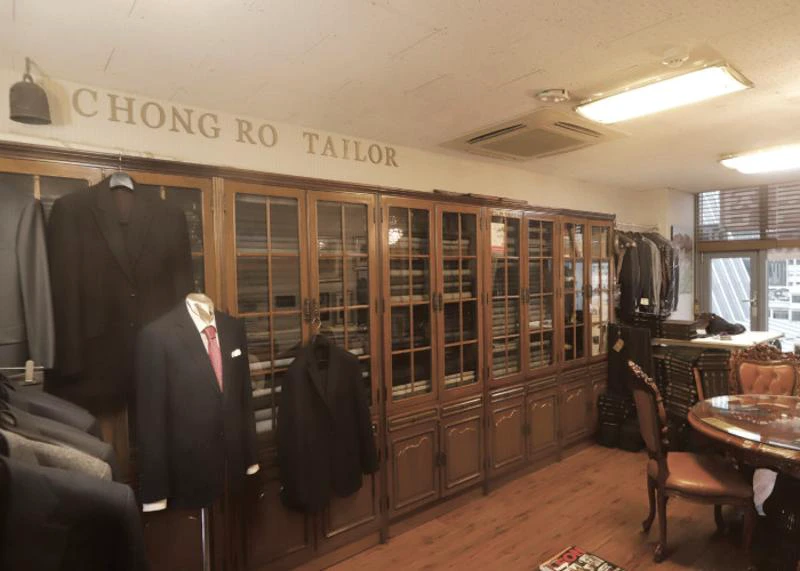
A custom suit or shirt in Korea can be worth it, but only when your trip has enough time for the actual fitting process. It is a poor bet if you expect a guaranteed bargain, want a finished suit in a few days, or cannot return for corrections. The safest decision is to judge the process, calendar, fabric, and aftercare rather than the word bespoke on a sign.
Seoul has a genuine tailoring tradition. The city’s official tourism guide profiles Chong Ro Tailor, a long-established shop surrounded by shelves of cloth, while the national tourism site lists contemporary custom-tailoring businesses such as Tailorable. That proves the craft is present; it does not mean every shop offers the same construction, schedule, or house style.
The short answer: who is it worth it for?
A Korean custom order makes the most sense if you want a garment for a repeatable purpose—work, weddings, formal events, or a reliable shirt pattern—and can explain how you want it to fit. It also suits travelers who enjoy choosing cloth and participating in fittings. The value is the chance to refine proportions and details with a tailor, not simply to buy a souvenir faster or cheaper than at home.
It is less likely to be worth it if you leave Seoul in under a week, dislike making fit decisions, or plan to accept international shipping without trying on the finished garment. If off-the-rack clothes already fit after minor alterations, compare that simpler option first. Our guide to Korean clothing sizes explains why the label alone is a weak predictor of fit.
For a first order on a short visit, one shirt or one pair of trousers is a lower-risk test than a full suit. You learn the shop’s communication and pattern without committing the entire budget at once.
Ask what “custom” actually means
Tailoring terms are not applied consistently from shop to shop. Before discussing lapels or buttons, ask the tailor to describe what will physically happen to your order. A useful working distinction is:
- Altered ready-to-wear: an existing finished garment is adjusted.
- Made-to-measure: an existing block is modified from measurements, often with a fitting garment or sample size.
- Bespoke: an individual pattern is made and the garment is normally checked in a temporary, basted state before completion.
The Savile Row Bespoke Association’s terminology describes a baste as a garment assembled loosely for an early fitting and distinguishes an individual bespoke pattern from made-to-measure. That is a useful process benchmark, not a promise that a Seoul shop follows British naming or timing. Ask concrete questions: Will you draft a personal pattern? Will I try a sample garment or my actual cloth? Is there a basted fitting? How many fitting opportunities are included? Who cuts and who makes the garment?
A shop offering a very fast “bespoke” suit may be offering a different construction path, fewer fittings, or work completed elsewhere. None of those automatically makes the garment bad. The problem is paying for one process while receiving another.
Put every fitting on the calendar before paying
Do not accept “about two weeks” as the whole plan. Ask the shop to write down calendar dates for the consultation, first fitting, any second fitting, planned final try-on, and collection. Then compare those dates with your departure—not just your hotel checkout. Include weekends, Korean public holidays, and any days when the cutter or fitter is unavailable.
One current Korean shirtmaker, Gentlist, quotes 7–15 business days for a remote sample-shirt process. One tailoring company, Beautiful People, advertises a two-week delivery. These are vendor-specific examples, not a Seoul-wide guarantee. A true multi-fitting bespoke process can take much longer: the Savile Row Bespoke Association describes three intermediate fittings and roughly three months as its own standard.
A real fitting can also create another fitting. In a Permanent Style account of a Korean Assisi bespoke fitting, the customer and tailor changed the shoulders, lapels, waist suppression, and back after seeing the garment on the body. The hoped-for single fitting was not enough. That is exactly why a tight flight deadline and good tailoring can conflict.
Leave at least one or two full business days after the planned final pickup for a correction. If the shop cannot place the final try-on before that buffer, treat shipping as a contingency rather than an equivalent substitute.
Choose fabric by specification, not by nationality
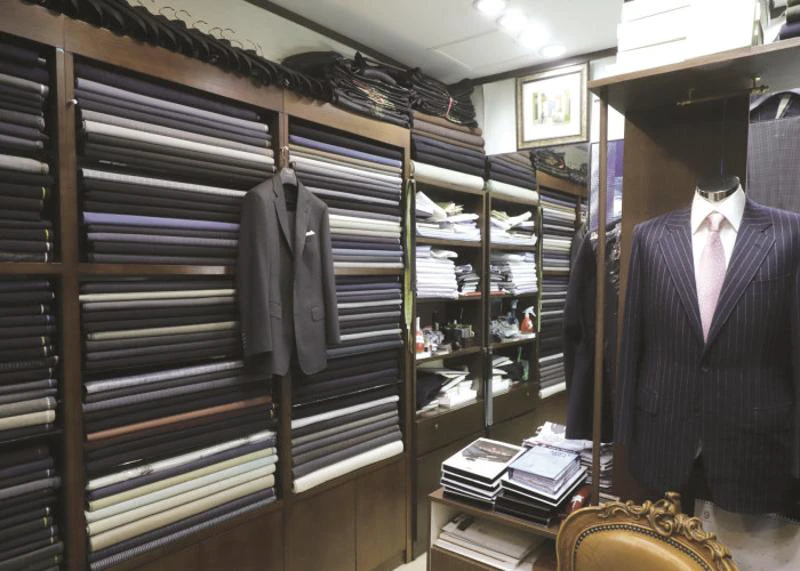
“English fabric,” “Italian fabric,” and a famous mill name do not tell you how a cloth will behave in your climate or suitcase. Ask to see the bunch label or selvage and record the exact mill, bunch, article code, composition, weight, weave, and intended season. Photograph those details next to your chosen swatch. Also ask whether the cloth is physically in stock and whether enough remains for a future repair.
Weight and weave matter. For example, Holland & Sherry describes one current summer suiting as a 220-gram Super 120s wool in a plain weave, while its high-twist travel collection emphasizes breathability and crease resistance at 260 grams. Those examples do not make either cloth right for you; they show why a complete specification is more useful than a country label.
For frequent travel, ask how quickly the cloth recovers from wrinkles. For hot, humid weather, discuss breathability and lining. For a daily work suit, durability may matter more than a very fine fiber number. Check the swatch in daylight if possible, because navy, charcoal, and surface texture can look different under warm shop lighting.
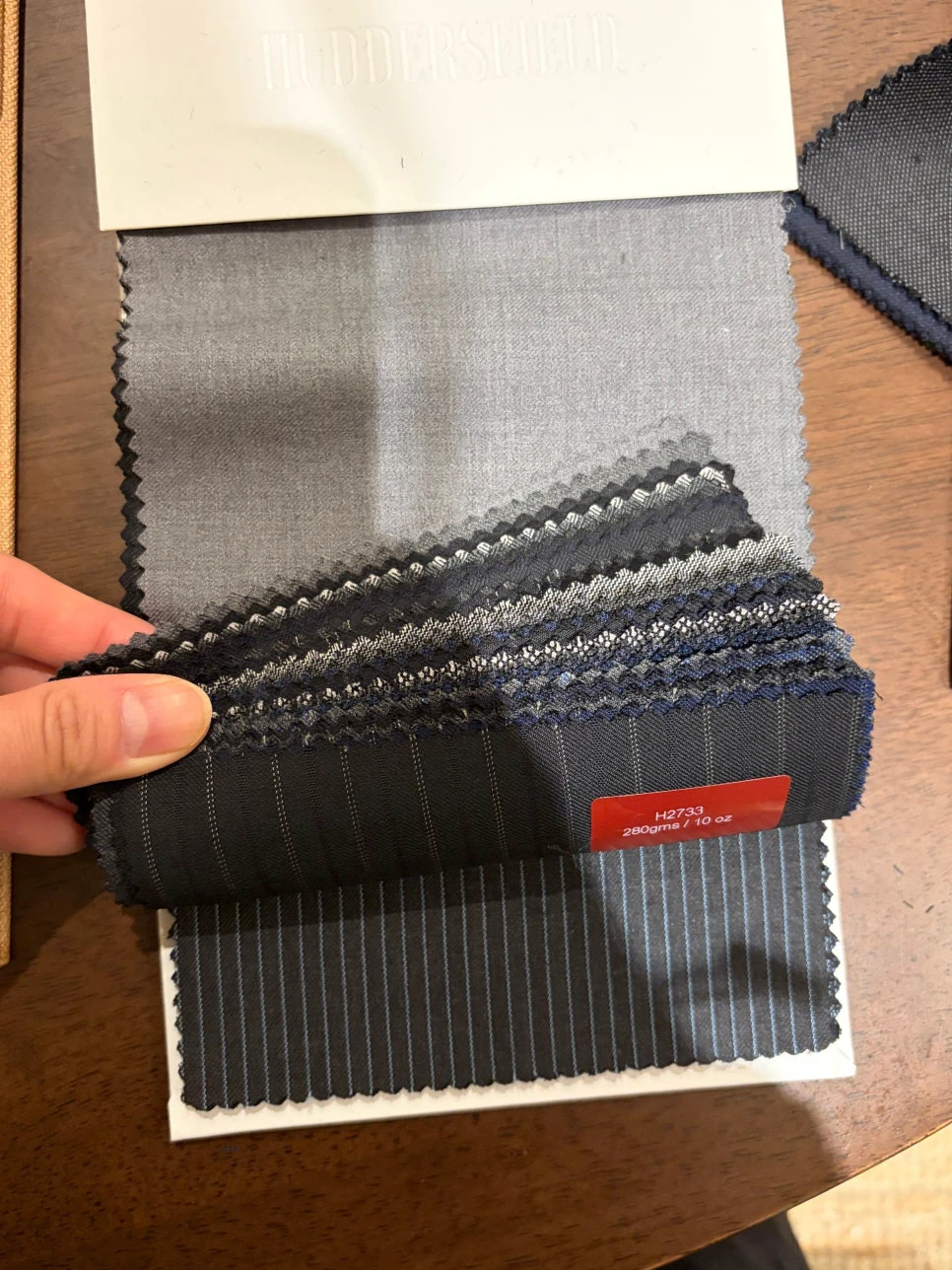
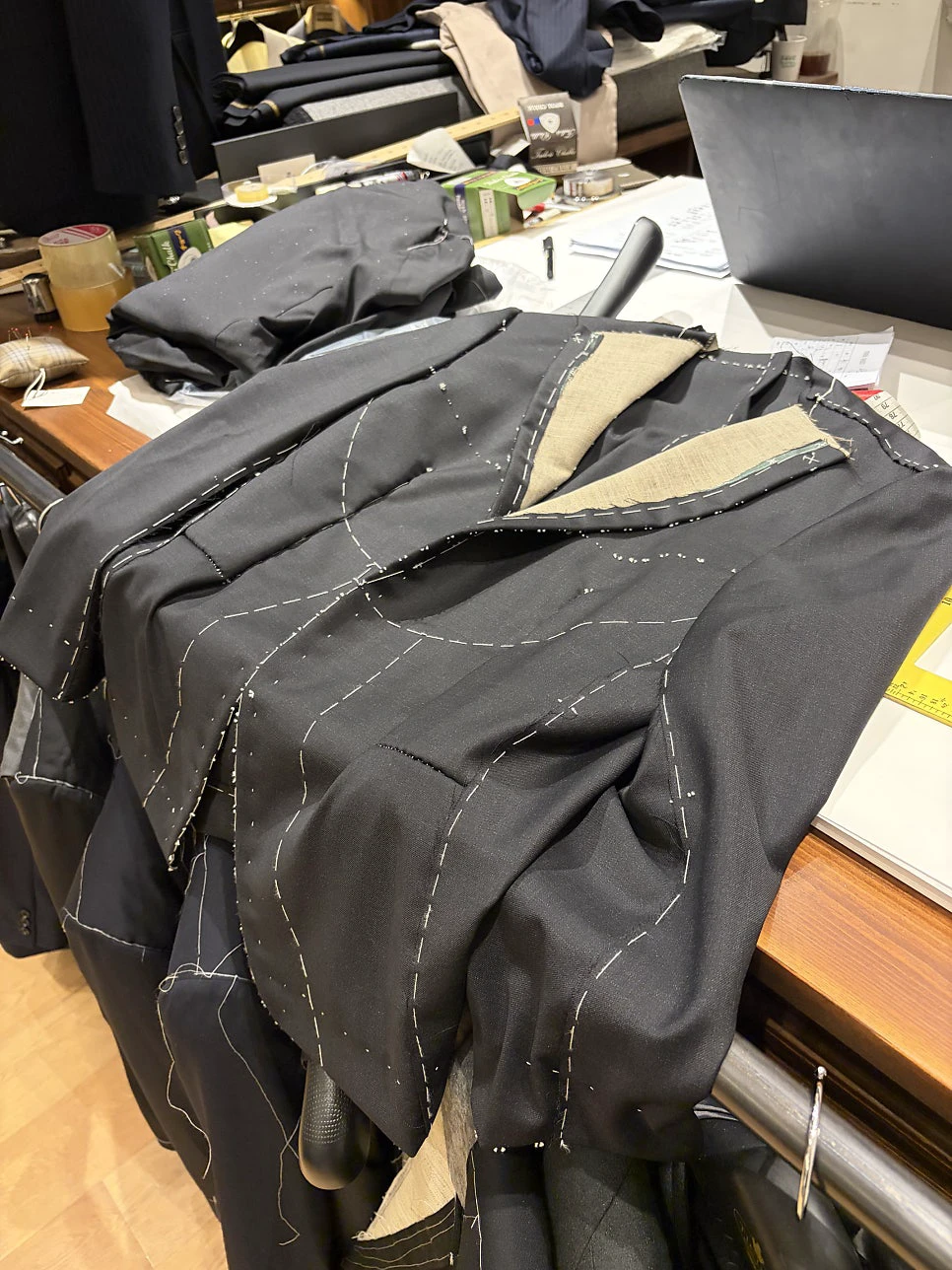
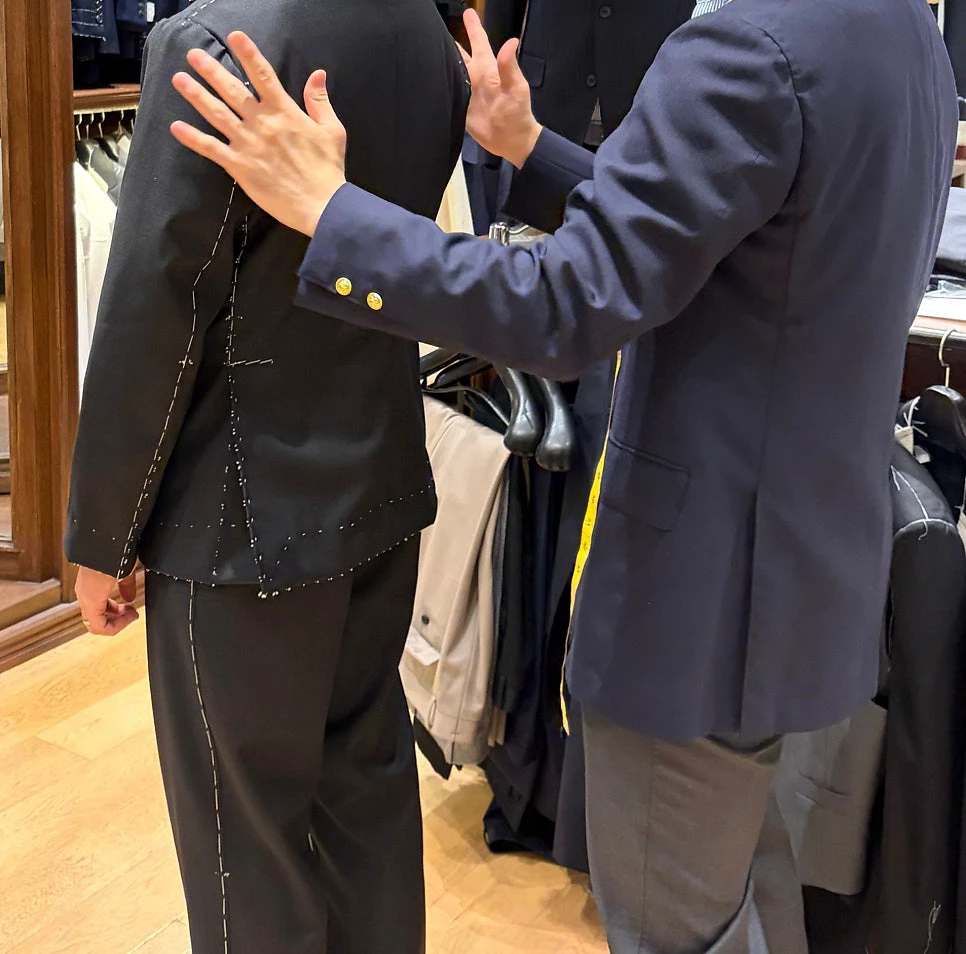
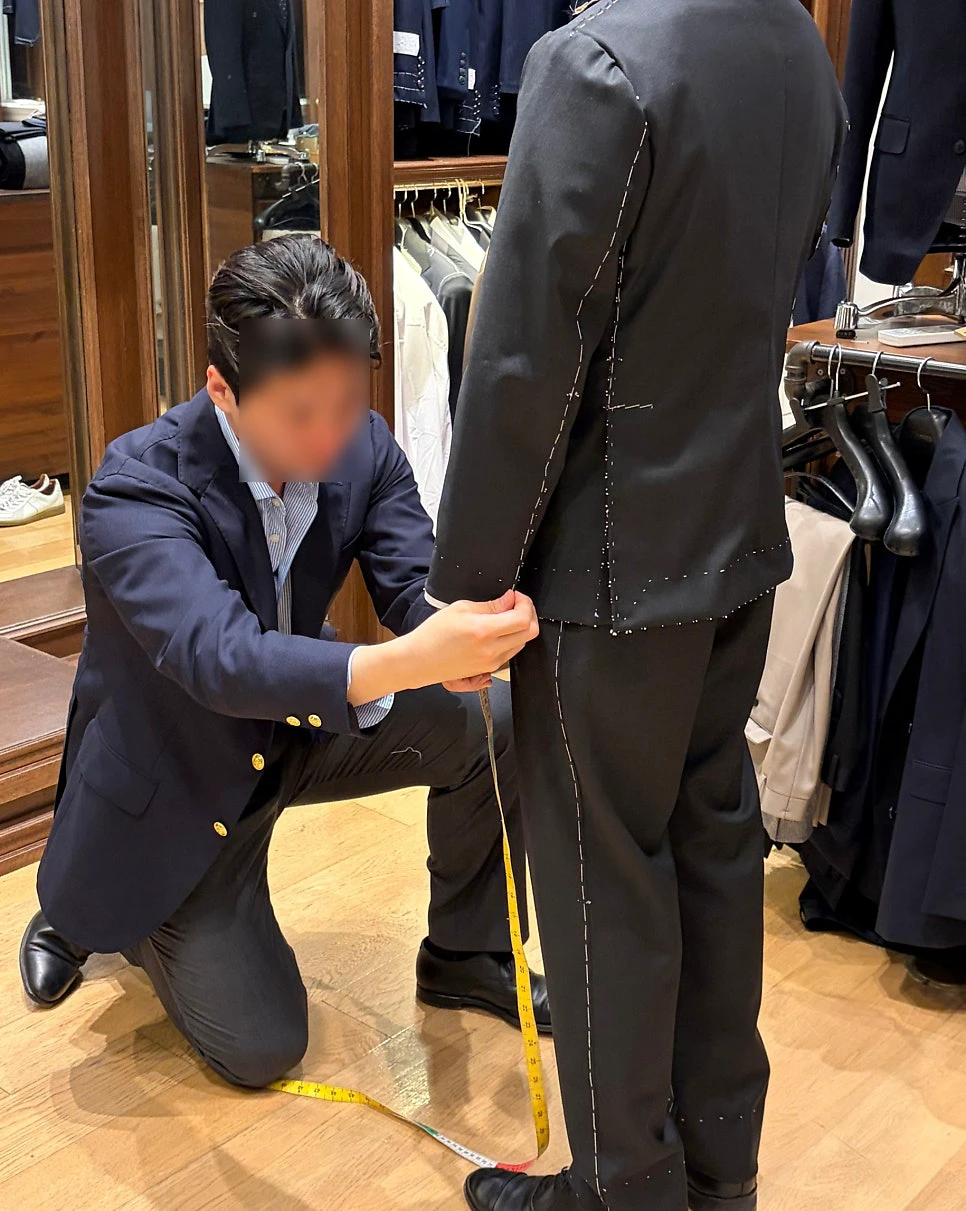
This four-stage example from a recent Seoul tailoring visit shows why the order is more than measurements: a labeled cloth choice becomes a loosely basted garment, then a fitting on the body, then detailed adjustment. A fast deadline has to leave room for each stage the shop says it will perform.
Make the fitting useful
Bring the shoes you will wear with the suit, your usual dress shirt or undershirt, and the belt or braces you plan to use. Empty unusually heavy pockets. If you have a jacket or shirt that fits well, bring it—or bring clear front, side, and back photos—and explain what you like about it. Reference photos are most useful when you name the feature: higher trouser rise, softer shoulder, more waist shape, a longer jacket, or more room through the upper back.
During the fitting, do not stand frozen in front of the mirror. Button the jacket, sit, walk, raise your arms, reach forward, and put your hands in the trouser pockets. Look for a clean collar without a large gap, balanced jacket fronts, sleeves that hang without strong twisting, and trousers that let you sit comfortably without pulling at the seat or rise. Check the rear view as carefully as the front.
Tell the fitter what feels wrong, not only what looks wrong. Tightness across the back, pressure at the neck, a waistband that moves when you sit, or an armhole that restricts reach are useful observations. A tailor may have a recognizable house style, but “Korean fit” is not a single shape and a fashionable slim silhouette should not override your comfort or intended use.
For a shirt, check the collar both open and buttoned, shoulder position, sleeve length, cuff width over your watch, torso ease, and whether the hem stays tucked when you reach. Ask whether shrinkage has been allowed for and how the shop wants the finished shirt washed.
Confirm the complete price
Ask for an itemized written quote before the deposit. It should identify the jacket, number of trousers, waistcoat or shirt, cloth, lining, buttons, construction level, fittings, and alterations. Confirm whether VAT is included, whether the purchase is eligible for a tourist tax refund, how much the deposit is, and what happens if you cancel or the garment cannot be completed before departure.
Also ask what costs extra: premium cloth, functional sleeve buttons, handwork, rush service, a second pair of trousers, delivery, international shipping, insurance, and customs charges at home. A low starting price is not comparable to a quote that already includes the cloth and options you selected. Keep the receipt and photograph the order sheet after checking that your name and contact details are correct.
Protect the final handoff before your flight
Never schedule collection on the way to the airport. Try on the finished garment with the same shoes, shirt, and waistband setup used at the fitting. Repeat the sitting, walking, and reaching checks. Inspect buttons, buttonholes, lining, seams, trouser hem, spare buttons, and whether requested details match the order. If something is wrong, agree on a correction date in writing before leaving.
Before collection, ask for:
- Your final garment measurements or order specifications
- The cloth mill, bunch, article code, composition, and weight
- Care and pressing instructions
- The shop’s policy for post-delivery alterations
- The method for a future reorder and whether the pattern will be kept
- A shipping quote with tracking, insurance, declared value, and expected customs handling if needed
International shipping can solve transport, but not an untested final fit. If you must leave before completion, ask who pays if a local tailor at home must correct the garment and whether the original shop needs photos or measurements before authorizing work. Get the answer in writing; do not assume reimbursement.
A practical decision rule
Book the full custom experience only when the shop can explain its construction clearly, reserve fitting dates that fit your itinerary, identify the exact cloth, itemize the final price, and complete a final try-on with a correction buffer before departure. If one of those conditions is missing, choose an altered ready-to-wear garment, start with a shirt, or wait for a trip with more time.
The right Korean tailor can make the process memorable and produce a garment shaped around you. The wrong schedule can turn the same order into an expensive package you first try on at home. Buy the process you can verify, not the deadline you hope will work.
Photo credits
- Tailor-shop interior and fabric shelves: Visit Seoul / Seoul Tourism Organization; used with written operator permission.
- Fabric-selection and fitting sequence: Pi9Ji Blog via Naver Blog; used with written operator permission.
Sources and image credits
- Chong Ro Tailor — Checked for guide details or image attribution.
- Tailorable — Checked for guide details or image attribution.
- Savile Row Bespoke Association’s terminology — Checked for guide details or image attribution.
- Gentlist — Checked for guide details or image attribution.
- Beautiful People — Checked for guide details or image attribution.
- Savile Row Bespoke Association — Checked for guide details or image attribution.
- Permanent Style account of a Korean Assisi bespoke fitting — Checked for guide details or image attribution.
- summer suiting — Checked for guide details or image attribution.
- high-twist travel collection — Checked for guide details or image attribution.
- Pi9Ji Blog — Checked for guide details or image attribution.
Last updated


